Onboarding in Foodservice: A 7-Day Plan
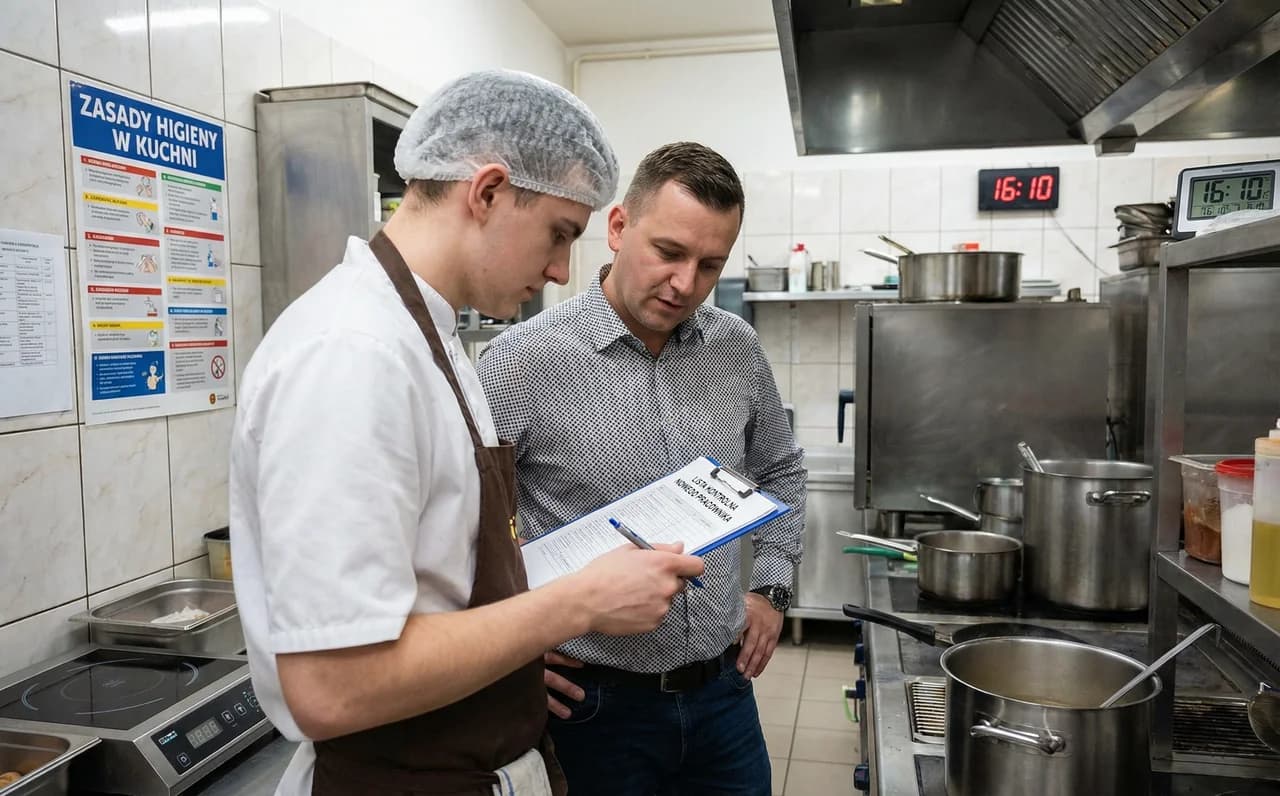
A week-by-week schedule for introducing new staff to hygiene procedures and HACCP. See what to cover on each of the first 7 days.
"Watch and do." And then: "Why is he doing it differently?" and "Who taught him that?" If you want HACCP/GHP/GMP to live in the kitchen, onboarding cannot be random. It must be short, repeatable, and measurable.
The goal of onboarding in one sentence
After one week, a new employee should:
- know the zones,
- understand the critical rules,
- be able to work during the rush without breaking standards,
- know where the logs are and how to use them.
This is not "nice to have." This is the minimum so you can sleep at night when the new person works a shift without you.
What NOT to do in onboarding
Before we cover the how, let's cover the how NOT. Because most places make exactly these mistakes:
- "Watch Mark and do what he does" - Mark has his own habits, half of which break the procedures. The new person learns mistakes, not standards. And then you ask: "who taught them that?"
- Thrown into the deep end on day one - the new person shows up at 10:00, lunch rush hits at 11:30, and they are on station. They don't know the zones, don't know where the logs are, don't know how to handle an allergen order. Result: stress, errors, potential hazard.
- One-time HACCP training - an hour-long talk "about hygiene" on day one, after which the new person signs a sheet saying "trained." By the next day they remember nothing. But you have the sheet in a binder. That is theater, not onboarding.
- No verification - the new person "manages somehow" for 2 weeks until one day the inspector asks them about meat storage temperatures and gets a shrug. That is the moment your system collapses.
Why verbal-only onboarding doesn't work
You tell the new hire: "You measure temperatures morning and evening, the logs are over there, we handle allergens like this." They nod. The next day they don't remember half of it, because:
- They were stressed on their first day - information goes in one ear and out the other.
- They had nothing to go back to - no written instruction, no cheat sheet, no checkbox.
- Verbal onboarding changes from person to person - Mark says "measure in the morning," Anna says "measure when you remember," Kasia says "honestly, nobody measures." The new person doesn't know who is right.
Onboarding must be in written form. Not a 50-page manual - a single A4 sheet with a checklist for each day is enough. The new person checks off, the buddy signs, the manager verifies. Simple and repeatable.
A 7-day plan that works in the real world
Day 1: Kitchen and critical rules
- Kitchen walkthrough - zones (raw/ready-to-eat, allergens, pass). Physical demonstration: "here is the raw zone, here is ready-to-eat, we don't mix here."
- Handwashing "after what" - not a general "wash hands often," but specific triggers: after the restroom, after contact with raw product, after touching your phone, after a smoke break, after changing zones.
- Where the logs are and who is responsible - physically walk to each log, read the micro-instruction, show a completed example.
- The "I don't know = I ask" rule - the new person must hear: "It's better to ask 10 times than to do it wrong once. Nobody will be upset about a question."
Day 2: Workstation + tools
- Workstation instruction - show the exact station where the new person will be working. What goes where, how it is labeled.
- Tools and their purpose - color-coded system for boards, knives, containers. Which board for raw, which for ready-to-eat, which for allergens.
- 15 minutes of practice + corrections - the new person performs a task under the buddy's supervision. The buddy corrects in real time, not after the fact.
- Storage rules at the workstation - what can sit on the counter, what must be in a covered container, what goes back to the fridge.
Day 3: Allergens and the pass
- The allergen order workflow from A to Z - from the moment the server marks the order, through preparation with separate tools, to serving with a label.
- "We don't guess - we check" - the new person must understand that with allergens you NEVER say "I think there's no gluten." You check the label or ask the chef.
- Allergen labeling at the pass - how to distinguish a plate with a gluten-free order so the server knows which one it is.
Day 4: Cleaning and sanitizing in practice
- What, with what, when - a specific list: counters -> product X, sanitizing -> product Y, floors -> product Z. Not "clean the kitchen," but precise tasks.
- What "good" looks like at the end of the shift - physical demonstration of the standard: clean counters, empty sinks, labeled containers in the fridge, mopped floor, trash taken out.
- Sanitizer concentrations - the new person must know that "more is not better." Too much sanitizer is a chemical hazard. Too little has no effect.
- Cleaning log - show how to check off tasks on the cleaning checklist. Check off AFTER completing, not "in advance for the whole shift."
Day 5: Rush under control
- Fast but not chaotic - the new person observes the rush (lunch rush / dinner rush) and learns that pace does not lower standards. Fast yes, sloppy no.
- Cross-contact check at the pass - during the rush, mistakes happen easiest. The new person learns to check orders before serving: "is this plate definitely gluten-free?"
- Communication under stress - the new person must know that during the rush you speak loud and clear: "allergen coming!", "raw on the counter!" Silence during the rush = chaos.
Day 6: Independent shift + observation
- The new person works, someone watches - the buddy observes a full shift of the new employee. Does not help, does not prompt (unless there is a hazard). Observes.
- Note 3 corrections - not 15. The three most important things to improve. Discuss them at the end of the shift, brief and specific.
- Log check - did the new person fill in the logs independently, correctly, at the right moments.
Day 7: Practical test
- 5 questions - e.g.: "At what temperature do you store meat?", "What do you do when the fridge reads 8 degrees C?", "How do you handle a gluten-free order?", "Where is the temperature log?", "What do you do after contact with raw meat?"
- 3 practical tasks - e.g.: "Measure the fridge temperature and enter it in the log," "Set up your workstation according to the instruction," "Show me how you transition from raw to ready-to-eat."
- If they don't pass - go back to the gaps. It is not a "punishment." It is feedback: "you still need more practice here."
What if the employee doesn't pass the test after Day 7?
It is not the end of the world. It is feedback. Here is the procedure:
- Identify the gaps - what exactly went wrong? Temperatures? Zones? Allergens? Logs? Not "generally poor" - be specific.
- Add 2-3 extra days - repeat the elements that didn't work. The buddy accompanies them again for those specific tasks.
- Re-test - only on the areas with gaps, not the whole thing again.
- Document the decision - if after 10 days there is still no progress, it is time for a serious conversation. Not because the employee is "bad" - maybe they are not right for this position, maybe they need a different role, maybe the language barrier is too big.
The key: the decision must be made BEFORE allowing independent work. Not "let's give them another month, maybe they'll learn." A month without standards is a month of risk.
Documenting onboarding - a card for the inspector
The inspector may ask: "How do you train new employees?" If you say "verbally, as we go" - that is weak. If you show an onboarding card - that is strong.
The onboarding card is a simple A4 sheet with:
- Employee name, start date
- Checkboxes for each day (Day 1-7) with topics
- Buddy and manager signature for each day
- Day 7 test result (pass/fail + notes)
- Date of clearance for independent work
This card takes one minute to fill in per day, and during an inspection it is proof that you have a system, not just wishful thinking.
Onboarding foreign-language employees
More and more people from Ukraine, Nepal, India, and the Philippines work in Polish food service. The language barrier is not an excuse - it is a challenge that can be solved:
- Workstation instructions in PL/EN - even if the worker doesn't speak English, pictograms + simple English phrases help. "Wash hands" with a picture - universal.
- Pictograms at key points - a handwashing image by the sink, a thermometer image by the fridge, a "STOP" image at the allergen zone. Images work without translation.
- A buddy who speaks the new person's language - if you have a Ukrainian worker and hire another Ukrainian, the natural buddy is that first person. First days in their native language, then transition to Polish.
- Short Polish phrases to learn from Day 1 - "Raw!", "Ready!", "Allergen!", "Washing hands," "Temperature?" - 10 words that must be understood from the very first day.
- Show, don't tell - in the onboarding of a foreign-language worker, 80% is demonstration. Talk less, show more. The new person repeats the action, you correct with a gesture and a short word.
The most common onboarding pitfall
"Everyone knows what's going on." They don't. Knowledge in food service is hidden and informal. Everyone "knows," but everyone does it differently. And inspectors like to ask people, not binders. The inspector does not ask the manager - they ask the shift cook. And if the cook doesn't know where the temperature log is, your entire documentation is worth the paper it's printed on.
Mini-test: does your onboarding work? YES/NO
- Do you have a written 7-day plan for new employees?
- Does the new employee have an assigned buddy?
- Is there a practical test after one week (not just a "trained" signature)?
- Do you have an onboarding card with signatures?
- Are instructions available in a language the foreign-language worker understands?
- Does the new person know what to do when the fridge temperature is too high - without asking the manager?
If you answered "NO" 3 or more times - your onboarding is wishful thinking, not a system.
Where GastroReady comes in
At GastroReady, onboarding is not an "idea." It is a ready-made process: a 7-day checklist, PL/EN workstation instructions with pictograms, an onboarding card for the inspector, implementation materials, and the logic for "what if they don't pass the test." A system that can be maintained with a turnover of 3 people per quarter - because that is what real food service looks like.
Frequently Asked Questions
How long should onboarding a new food service employee take?
Effective onboarding takes 7 days. The first two days cover critical rules and kitchen orientation, the following days are hands-on work at the station under a buddy's supervision, and day seven is a practical test. After a week, a new hire should know the zones, understand hygiene rules, and be able to work independently without breaking standards.
Does the health inspector check how we train new employees?
Yes. An inspector can ask any employee on shift about meat storage temperature, handwashing procedure, or handling an allergen order. An onboarding card with checkboxes for each day, the buddy's signatures, and the test result is concrete proof that you have an actual training system, not a one-time chat.
What if a new employee doesn't pass the test after 7 days?
Identify the specific gaps (temperatures, zones, allergens, records), add 2-3 days to work on those areas with continued buddy support, and retest on the areas that were weak. If there's still no progress after 10 days, you need to make a decision BEFORE letting them work unsupervised.
How do you onboard an employee who doesn't speak Polish?
Three things matter most: workstation instructions with pictograms (images work without translation), a buddy who speaks the new employee's language if possible, and teaching 10 basic Polish phrases from day one, e.g. "raw," "ready," "allergen," "washing my hands." Onboarding a non-Polish-speaking employee is 80% demonstration, not talking.
Need complete HACCP documentation?
"Watch and do" is not onboarding. GastroReady includes a ready 7-day onboarding process: checklist, workstation instructions with pictograms, and training records that hold up even with high staff turnover. From 299 PLN, with PL/EN instructions so every new hire learns the same standard regardless of language.