Food Production Process in HACCP
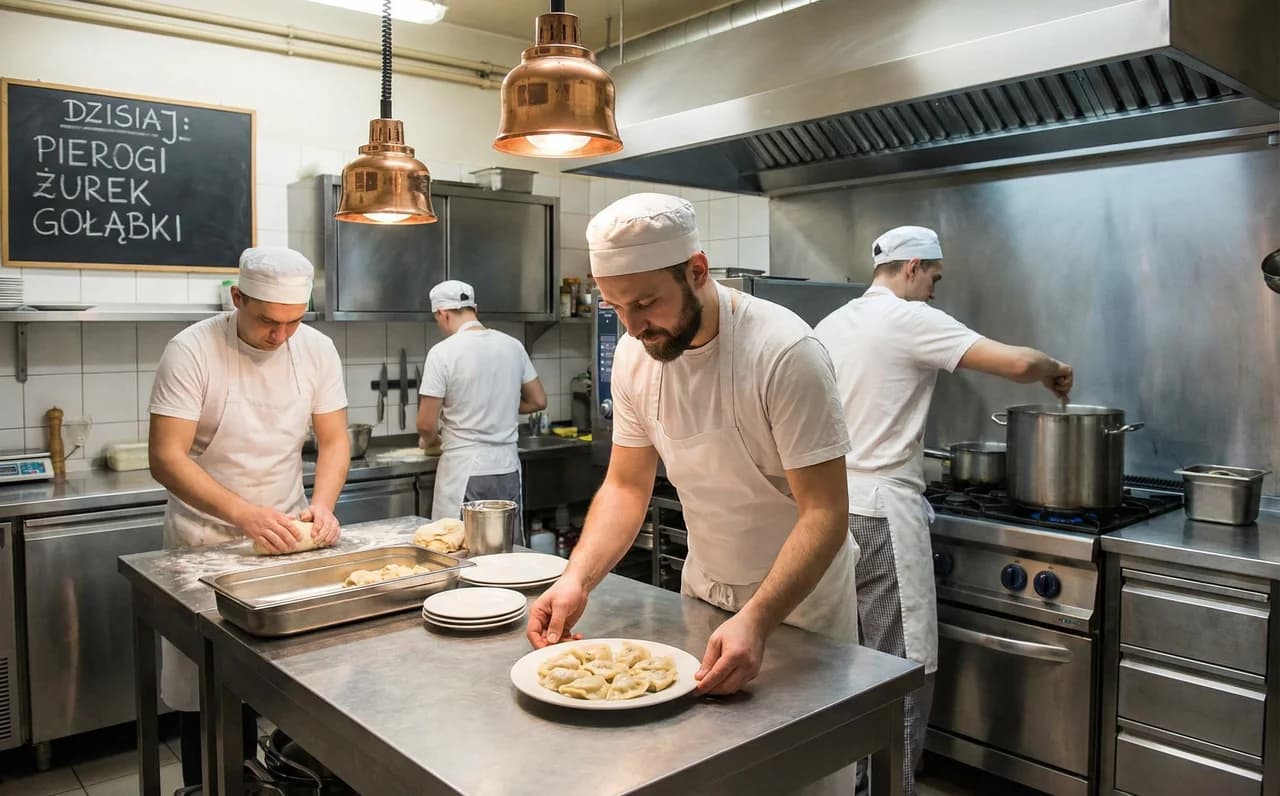
A process description template and best practices: from raw material to serving the dish. See how to write it clearly and realistically.
The inspector does not need poetry. They need to understand that:
- you know what you are doing,
- you know where the risks are,
- you have control and evidence that the system works.
The most common mistake: a process described like a textbook ("prepare the dish according to culinary standards"). The second most common mistake: a process copied from the internet that does not match your kitchen.
Why do you even need a process description?
Because without a process, you cannot properly create:
- a hazard analysis,
- CCPs,
- records,
- allergen and packaging rules.
The process is the backbone of HACCP. If the process description is generic or inaccurate, the rest of the system is built on sand. The inspector starts with the process because it is the map of your kitchen - and based on that map, they check whether the rest of the documentation makes sense.
10 rules for a good process description
- Write in steps, not paragraphs
Each step is one action.
- Use action verbs
"Receive," "check," "store," "wash," "cut," "cook," "cool," "package," "label," "serve."
- Add "where" and "with what"
A step without a location and tool is too vague.
- Mark the "raw vs ready-to-eat" separation
This is one of the most common consistency checkpoints.
- Flag the points where allergens enter
You do not need an essay - you need to show that you know where the risk is.
- Include packaging and dispatch (if you do delivery)
Because that is part of the process, not an afterthought.
- Do not pretend everything is perfect
The description should reflect the reality of a shift and peak hours.
- Assign responsibility
At the role level: shift cook, service station worker, manager.
- Leave room for monitoring and response
The process must connect to records. Otherwise it is just a description.
- Make sure the team understands the description
With a multilingual team, this is critical. If people do not understand the process, the process does not exist.
Mini-example 1: chicken + rice + sauce (delivery)
Bad description:
"Prepare the meal and package it."
Description that makes sense:
- Receiving raw materials - basic inspection and storage in the designated zone.
- Preparation - processing in the raw zone, separate tools.
- Thermal processing - according to the establishment's set standard.
- Assembly - time rules and tool hygiene.
- Packaging - clean zone, minimizing cross-contact, order verification.
- Labeling - consistent with the menu and procedure (including allergens).
- Dispatch - rules for delays and package completeness.
Mini-example 2: salad bar / takeaway salads
A salad bar has different specifics - you mostly work with raw products, you have many ingredients, and the customer often builds their own dish. The process description must reflect this.
Bad description:
"Prepare a salad from selected ingredients."
Description that makes sense:
- Receiving raw materials - freshness and temperature check, cold storage.
- Washing and sanitizing vegetables/fruit - in the designated zone, separated from ready-to-eat products.
- Cutting and preparing ingredients - clean tools, separate cutting boards (meat, vegetables, fruit), labeled containers.
- Display - maintaining temperature below 4 degrees Celsius, replacing containers at set intervals, protection from contamination.
- Order assembly - hand hygiene/gloves, separate utensils for each container, accounting for allergens during assembly.
- Packaging - clean containers, allergen labeling, packaging date.
- Dispatch - waiting time rules, priority for orders with allergen declarations.
Notice: a salad bar has different risks than a kitchen with thermal processing. The key issues are washing raw produce, cross-contact between ingredients, and display temperature. The process description must show this.
Flow diagram: a visual representation of the process
Not every inspector wants to read a list of steps. Many will appreciate a simple flow diagram. You do not need professional software - an A4 sheet with rectangles and arrows is enough. Key principles:
- Each rectangle is one process step - receiving, storage, preparation, processing, packaging, dispatch.
- Arrows show the direction of flow - from raw material to finished dish.
- Mark the critical points - where you designate CCPs, flag them on the diagram (e.g., with a star or color).
- Mark allergen entry points - at which steps do allergens appear?
- Show the raw/ready-to-eat separation - if you have a raw zone and a clean zone, it must be visible on the diagram.
A flow diagram is not a legal requirement, but it is a powerful communication tool. The inspector sees it and immediately understands your process. A new employee looks at the wall and knows how the workflow goes.
How the process description connects to CCPs and records
The process description does not live in a vacuum. It is the foundation on which you build the rest of the HACCP system:
- CCPs come from the process description - you designate critical control points where the process reveals the highest risk. Without an accurate description, you do not know where those points are.
- CCPs generate records - every critical control point requires monitoring and documentation. Temperature logs, goods receiving logs - all of this flows from the process.
- Inconsistency = a problem during inspection - if the process says "thermal processing," the CCP says "temperature control above 75 degrees Celsius," and the log is empty - the inspector sees three documents that do not align.
That is why the process description must be truthful. Because the entire rest of the system is built on it. An error in the foundation = errors throughout the structure.
When and how to review the process description
The process description is not a document you write once and forget. Review it:
- When the menu changes - a new dish may require a new step (e.g., you add sushi but had not previously worked with raw fish).
- When equipment changes - a new oven, new cold room, new worktop - these change the flow in the kitchen.
- When suppliers change - a different supplier may mean different product forms (frozen vs fresh), and that changes the process.
- After an incident - food poisoning, complaint, temperature deviation - review the process and check whether it needs correction.
- Once a quarter as routine - even if nothing has changed, it is worth reviewing with the team: "Is this still how we do things?"
What the inspector asks about the process
Inspectors have their favorite questions. Here are the most common ones - and you must have answers ready:
- "Please show me the path of a product from receiving to dispatch."
- "Where do you separate raw from ready-to-eat?"
- "What do you do when the cooking temperature is too low?"
- "Who is responsible for checking goods on receiving?"
- "What does your delivery order packaging look like? Who checks accuracy?"
If your process description is good, the answers to these questions flow naturally from the document. If it is vague - you have to improvise, and improvising during an inspection is a risk.
Process description for catering and delivery
If you run a catering or delivery operation, your process description must include additional steps that you do not have with dine-in service:
- Order assembly - how do you gather dishes into one package? Who verifies that the package is complete and correct?
- Packaging and labeling - what containers, how are they secured, what information is on the packaging (allergens, date, order number)?
- Waiting time before pickup - what do you do when the courier is late? How long can a package wait? Where does it wait (temperature)?
- Transport - if you have your own transport: how do you maintain temperature? If you use external couriers: what are your handover rules?
These steps are part of the production process and must be described. "Food leaves the kitchen" is not the end of the process for delivery - the end is when the customer receives the order.
Most common pitfalls in process descriptions
- Missing packaging and dispatch for delivery (as if the food teleported to the customer)
- No raw/ready-to-eat separation in the steps
- No indication of where allergens enter
- Process does not match the kitchen layout and equipment
- Description is so generic it cannot be linked to any record
These are the things that create a "paper shield."
Where GastroReady comes in
When you want a process description that is:
- consistent with your documents,
- consistent with your records,
- understandable for the team (including PL/EN),
- and genuinely helpful during an inspection,
...you need not just knowledge, but tools and structure: tailored templates, instructions, and an implementation system. GastroReady gives you ready-made process description templates for different types of establishments - from a simple kitchen to delivery and catering. You customize them to fit your operation, and the structure ensures nothing gets missed.
Frequently Asked Questions
How detailed should a food production process description be in HACCP?
The description should include concrete steps with operational verbs, the location where each step happens, and the tools used. It doesn't need to be long, but it needs to be true - it should describe what actually happens in your kitchen. Generic phrases like "prepare according to standard practice" won't pass an inspection.
Does every dish need its own separate process description?
No. It's enough to describe the typical processes for groups of dishes, e.g. dishes with heat treatment, salads made from raw ingredients, cold desserts. What matters is that every type of process has its own description, not that every single dish gets one.
What if my process description doesn't match what the kitchen actually does?
Update the description, not the kitchen. HACCP documentation is meant to reflect reality. If the kitchen works differently from what the paperwork says, an inspector will treat that as a non-conformity - regardless of which version is "better."
Does the health inspector compare the process description with what they see in the kitchen?
Yes, that's one of the basic inspection methods. The inspector reads the process description, then checks whether the kitchen operates in line with it. Gaps between documentation and practice are the most common cause of non-conformities.
Need complete HACCP documentation?
GastroReady gives you ready-made production process description templates for different types of establishments - from a simple kitchen to delivery and catering - with a structure that makes sure no step or hazard gets missed. You fill in your own dishes instead of copying a textbook description that doesn't match your kitchen. From 299 PLN, with PL/EN instructions.