Kitchen Zones and Cross-Contamination
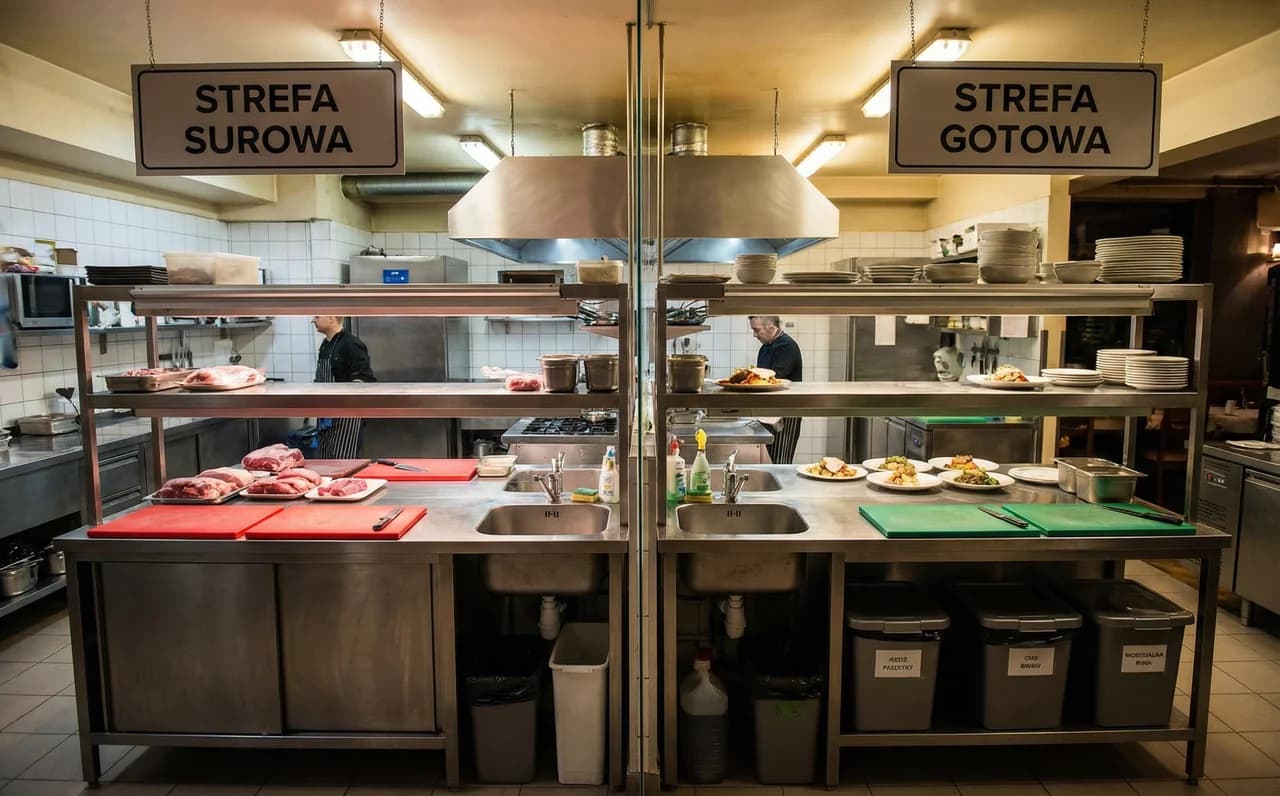
Dividing the kitchen into clean and dirty zones, plus rules for staff and product movement. Learn how to limit cross-contamination by design.
Cross-contamination rarely comes from "lack of knowledge." It comes from the fact that the kitchen is set up for speed, not for control. The good news: you don't need a big kitchen to have good zones. You need good logic.
4 zones worth distinguishing even in a small kitchen
- Raw
Meat, eggs, unwashed vegetables, unpacking. This is the "dirty" zone - risk enters from outside here. Everything here is treated as potentially contaminated. Raw chicken on the same counter as a salad? That is exactly the situation that puts people in the hospital.
- Ready-to-eat
Everything after thermal processing that should not go back to the "dirty" side. Cooked meat, sauces, plated dishes. This zone must be physically or logically separated from raw. "Logically" means: different work sequence, different tools, different containers.
- Allergens / special orders
It doesn't have to be a separate room. Sometimes a separate workflow is enough: sequence of actions + tools + the pass. But that workflow must exist and must be known by everyone on the shift. A "gluten-free" order prepared on the counter after pizza is not allergen management - it is Russian roulette.
- The pass / packing
This is where mistakes happen most often, because this is where the rush hits and the pace picks up. People under stress grab whatever is closest, mix up orders, place ready dishes next to raw sushi ingredients. The pass needs its own rules more than any other zone.
Sample zone layout for a 20 sqm kitchen
A small kitchen is not an excuse. Here is how it looks in practice in 20 square meters:
- Left wall (by the entrance): receiving and unpacking zone. This is where you unpack, leave boxes (and take them out immediately). Here you have the vegetable wash sink and the raw cutting board.
- Center: thermal processing zone - stove, oven, fryer. This is where raw turns into ready-to-eat. Workflow direction: from left (raw) to center (processing) to right (ready).
- Right wall: ready-to-eat zone and the pass. This is where you portion, garnish, and pack. No raw products enter here. No dirty tools sit here.
- Fridge: shelves from top to bottom: ready-to-eat on top, raw on the bottom. Never the other way around. Raw chicken above a salad is the classic mistake an inspector will catch in 10 seconds.
The key rule: one-way flow. Product enters from the left, passes through processing, exits from the right as a finished dish. It never goes back. Like a production line - straight and one-directional.
The color-coding system - simple and effective
Color-coded labels are the cheapest way to eliminate mistakes. The most widely used industry scheme uses 6 colors:
- RED = raw meat. Red boards, red containers, red gloves. When someone sees red - they know it is a risk zone.
- YELLOW = raw poultry (or, in some systems: cooked meat). This is the most common variant that depends on the scheme you adopt - which is exactly why it must be spelled out clearly in your documentation and used consistently in one version.
- BLUE = raw fish and seafood. Separate board, separate container. Fish have specific bacterial flora - mixing with meat is asking for trouble.
- GREEN = vegetables and fruit. Green boards for cutting salads and peeling vegetables. Green = the plant-produce zone.
- WHITE = bakery, dairy and ready-to-eat products. White boards and containers for what no longer goes back to the "dirty" side - finished dishes, cold cuts, cheeses.
- PURPLE = allergens. Purple tools for preparing gluten-free, dairy-free orders, etc. The purple color signals: "be extra careful here."
You don't need to buy a professional set for a lot of money. Colored electrical tape on knife handles and board edges costs very little and does exactly the same job. What matters most is not which exact color you pick, but consistency - the system must be coherent, described in your GHP, and known by everyone on the shift. If in your venue yellow means cooked meat rather than poultry, that is fine, as long as the choice is documented and everyone applies it the same way.
What the inspector checks in the first 2 minutes
The inspector walks into the kitchen and within 120 seconds knows whether you have a system or chaos. Here is what they look at:
- Counters: whether raw and ready-to-eat are sitting on the same surface. If so - first note in the report.
- Fridge: they open the door and look at shelf order. Raw chicken above dessert? Already writing it down.
- Cutting boards: one board for everything = red flag. The inspector looks for differentiation - by color, labels, anything.
- Cloths: one cloth "for everything" lying on the counter is a classic. The inspector spots it instantly.
- Staff movement: whether someone just went from raw chicken to cutting salad without washing hands and changing tools.
Those first 2 minutes set the tone for the entire inspection. If the inspector sees order - the rest of the inspection is calmer. If they see chaos - they start digging deeper.
3 real cross-contamination scenarios
Scenario 1: Salad with salmonella
A cook cuts raw chicken on a red board. Then sets the board aside but does not wipe the counter. A moment later someone else places salad ingredients on the same counter. Salmonella from the raw chicken gets on the tomatoes. A customer eats the salad - 12 hours later they are in the hospital. Cost to the restaurant: closure, fines from the health authority, reputation destroyed.
Scenario 2: Allergic reaction at the pass
A "no nuts" order prepared correctly in the kitchen. But at the pass it sits next to a nut sauce. A server grabs both plates at once - sauce drips over. The customer with an allergy ends up in the emergency room. The venue has a legal problem because "the procedure was on paper" but the pass had no separation logic.
Scenario 3: Defrosting salmon in the ready-to-eat zone
A cook takes frozen salmon and places it to defrost on the counter in the ready-to-eat zone - "because there was space." Juices from the defrosting fish drip onto the counter where dessert will be portioned an hour later. Nobody wipes the counter in between. Result: food poisoning for three customers, health authority inspection the next day.
Staff movement rules between zones
Zones are not just places - they are rules for moving between them. Here is the minimum:
- Handwashing at every transition - from raw to ready-to-eat: wash your hands. Always. No exceptions. Even if "just for a second."
- Change tools - don't carry a knife from the red board to the green board. Put it down, pick up a new one. It takes 5 seconds and eliminates the most common source of contamination.
- Change gloves - gloves are not "universal protection." Gloves after contact with raw meat are JUST AS dirty as bare hands. Changing zones = changing gloves.
- Apron and clothing - if you work in the raw zone and your apron is stained, you don't walk into the ready-to-eat zone wearing it. In a small kitchen, an extra apron on a hook is enough.
- One-direction rule - if possible, organize work so staff moves in one direction: from dirty to clean. Not back and forth.
Cleaning between zone transitions
This is the element most venues skip. Between working in the raw zone and the ready-to-eat zone, "a quick wipe" is not enough:
- Counter: wash, sanitize, wipe with a clean cloth. Not the same one that's been sitting by the sink since morning.
- Tools: dirty ones go to the wash area, clean ones come from the drying rack. Not "rinsed under the tap."
- Containers: raw products in containers with lids. Ready-to-eat products - separate containers, separate shelf.
If you have one dishwasher and one wash station - set the order: first wash tools from ready-to-eat (cleaner), then from raw (dirtier). Never the other way around.
It's not about the square meters - it's about the flow
Bad zones are usually:
- the same counter for raw and ready-to-eat,
- the same cloth "for everything,"
- no sequence rules,
- chaos at the pass.
Good zones are:
- a clear work sequence (from dirty to clean),
- visible "what goes where" (colors, labels, fixed spots),
- visible signage (even a laminated A4 sheet saying "RAW ZONE" on the wall),
- one person responsible for maintaining the standard on the shift - and with the authority to say "stop."
Mini-test: do your zones work? YES/NO
- Do raw and ready-to-eat have separate tools or a separate work sequence?
- Does the pass have its own rules and cleanliness standards?
- During the rush, does everyone know where to put things?
- Do allergens have a separate workflow, not "shared chaos"?
- Do you have a color-coding system (boards, containers, gloves)?
- Does staff wash hands at EVERY transition between zones?
- Is the counter sanitized between raw and ready-to-eat work?
- In the fridge, is ready-to-eat ALWAYS above raw?
If this is falling apart, documentation will never protect you, because the kitchen speaks a different language than your procedures.
Where GastroReady comes in
GastroReady brings rules from the PDF into the kitchen: practical zoning with color-coded signage, staff movement instructions, cleaning logs between zones, and procedures for the pass. Everything designed to work in 20 sqm just as well as in 80 sqm. A standard visible on the wall, not hidden in a binder.
Frequently Asked Questions
How do you set up zones in a small kitchen where space is tight?
In a small kitchen, you define zones logically, not physically. The key is the direction of work - from raw to ready, never the other way round. A consistent order of operations, separate color-coded boards, and a rule that raw products never sit next to finished ones are enough.
What is cross-contamination and how does it happen?
Cross-contamination is the transfer of bacteria from one product to another, most often from raw to ready-to-eat. It happens through shared boards, knives, hands, cloths, or a lack of separation in the fridge. It's one of the most common causes of foodborne illness in food service.
What cutting board colors are used in food service?
The most common scheme is: red for raw meat, yellow for raw poultry (or, depending on the system, cooked meat), blue for raw fish and seafood, green for vegetables and fruit, white for bread, dairy, and ready-to-eat products, and purple for allergens and special orders. Regulations don't mandate specific colors - what matters most is consistency: the system you adopt must be documented in your GHP and understood the same way by the whole team.
Does a sanitary inspector check how a kitchen is zoned?
Yes, it's one of the first things an inspector looks at. They check the fridge layout (ready-to-eat stored above raw), the condition of the boards, tool separation, and the direction of workflow. No visible zoning is a signal that the whole kitchen may have a cross-contamination problem.
Need complete HACCP documentation?
GastroReady offers ready-made HACCP, GMP, and GHP templates for every type of food business. From 299 PLN, with PL/EN instructions.