Free HACCP Templates: 6 Red Flags to Spot
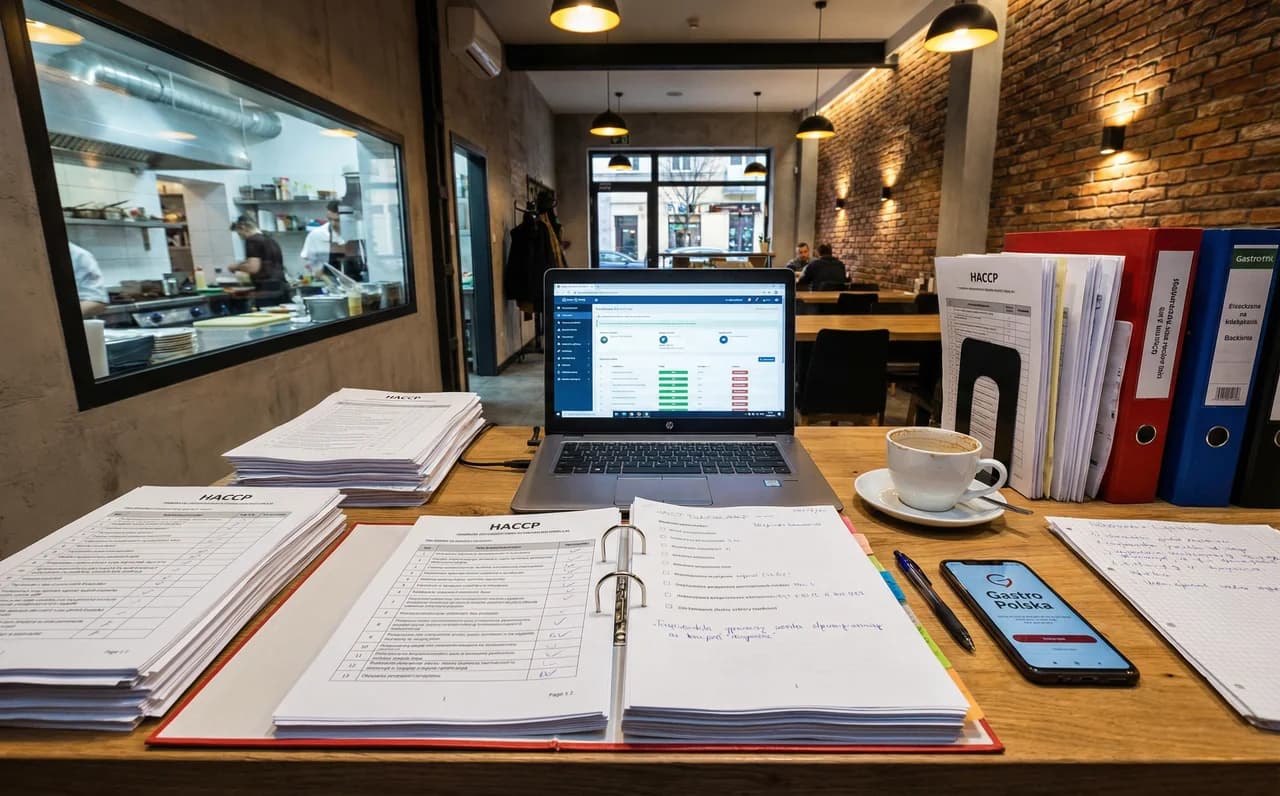
A free HACCP template often costs the most. See 6 red flags in online templates and do a quick test to check if your documents actually protect you.
A free HACCP template sounds like a saving. In practice, it can be like a "cheap umbrella in a storm" - looks fine until it starts raining. And the "rain" in foodservice has a name: inspection. At GastroReady we say it directly: the apparent saving from free templates is often a trap that ends with a fine. Why? Because the inspector does not evaluate whether you have a PDF. They evaluate whether your kitchen = your documents. Below are 6 red flags. This is not a guide on "how to DIY your HACCP" - it is a radar to show you whether you are heading straight for trouble.
Why inspectors recognize templates instantly
An inspector who does 200 inspections a year has seen hundreds of HACCP documents. And they know one thing: free templates from the internet all sound the same. The same wording, the same tables, the same "procedures." When the inspector reads your document and recalls seeing exactly the same text in a completely different restaurant yesterday - you have a problem.
The most common giveaways:
- Identical wording - "Staff are required to maintain personal hygiene" appears word for word in a hundred restaurants. The inspector sees this.
- Generic process descriptions - the document describes "thermal processing of meat" while you only make salads and sandwiches.
- No specific product or equipment names - the document says "cold room" but you have an under-counter fridge. The document says "receiving area" but you take deliveries at the kitchen door.
- Records that nobody maintains - because there are too many of them or they do not match your daily operations.
6 red flags in free HACCP templates
- Menu and processes do not match reality
Your documentation includes meat processing, but you only sell ready-made semi-finished products. Or the opposite: you make sauces from scratch, but the documents pretend you only "reheat." This is the simplest inconsistency to catch.
- No meaningful records or evidence of action
Templates love nice descriptions but hate daily reality. And an inspection asks: "OK, but where is the record that this works?" This is why complete records and procedures are key at GastroReady - not just descriptions.
- Zero "what do we do when things go wrong"
In free HACCP documents, everything is perfect. In a real kitchen: refrigerator breakdown, late delivery, allergen mix-up. If the document has no logic for "deviation - response - record," it is decoration.
- "Procedures" are as generic as a horoscope
"Maintain cleanliness," "disinfect regularly," "uphold hygiene" - sounds beautiful, but nobody knows:
- with what product,
- how often,
- who does it,
- where to check it off.
- No common language across the team
Foodservice is international. If your team includes PL/EN speakers and the paperwork is only in Polish, then the procedures exist only "on paper." At GastroReady, "care" means PL/EN instructions among other things, so everyone knows what to do.
- The template does not give you a shield - it gives you stress
The worst effect of free HACCP is psychological: you think "the topic is handled," and then an inspection shows you have nothing solid. This is exactly why we deliver a Real Shield, not Paper Armor.
Real-life scenario: how a free template failed
Imagine a small lunch bar in the city center. The owner downloaded free HACCP from the internet, printed it, and put it in a binder. For six months nobody opened it. Then the inspection came.
The inspector opened the documentation and started comparing it with the kitchen. The result:
- The documentation described a "receiving area with a loading dock" - the bar had a back door.
- There was a "fish processing procedure" - the bar never served fish.
- Temperature records had been empty since the day they were printed.
- The allergen list did not match the current menu (because the menu had changed but the list had not).
The result? A non-conformity report, post-inspection recommendations with a 30-day deadline, stress, and the need to quickly rebuild the documentation from scratch. The cost of the "free" template turned out to be far higher than professional documentation would have been from the start.
What good HACCP documentation looks like - key characteristics
Good HACCP documentation stands out through several characteristics that an inspector notices immediately:
- It is personalized - it contains the name of the establishment, address, description of specific equipment, specific menu items.
- Processes match reality - if you make pizza, the process description is about pizza, not "general thermal processing."
- Records are maintained - not empty, not backfilled in one handwriting. Real entries, real dates.
- Corrective actions are included - the document states what you do when temperature exceeds limits, when a delivery is late, when an employee is sick.
- The team knows it - asking a cook "what do you do when the fridge breaks down?" should produce an answer consistent with the documents.
- It is up to date - the last update date is not from two years ago.
Comparison: free template vs professional documentation
To give you the full picture, here is a point-by-point comparison:
- Fit to premises: Template - zero (one size fits all). Professional - full (your menu, your equipment, your layout).
- Records: Template - generic or missing. Professional - ready for daily use, tailored to your process.
- Corrective actions: Template - usually absent. Professional - specific scenarios and responses.
- Allergens: Template - generic list or none. Professional - matrix for your menu.
- Updates: Template - you have to know what to change yourself. Professional - update instructions built into the system.
- Support: Template - zero, you are on your own. Professional - implementation instructions, pre-inspection checklist.
- Apparent cost: Template - 0 PLN. Professional - from 299 PLN.
- Real cost: Template - hours of customization + risk of fines + stress. Professional - implementation time and peace of mind before inspections.
Hidden costs of free templates
"Free" is an illusion. Here is what a free template actually costs:
- Time to customize - 20-40 hours if you know what you are doing. If you do not (and most owners are not HACCP specialists) - significantly more. And you still have no certainty that it is correct.
- Risk of fines - on-the-spot fines up to 500 PLN, but for more serious non-conformities, administrative penalties can be many times higher. Plus the stress and time needed for post-inspection corrections.
- False sense of security - you think you "have HACCP," but in reality you have a PDF that does not protect you from anything. This is the most expensive trap because you only discover it during an inspection.
- No updates - the menu changes, suppliers change, but the template stays the same. Every change without a document update is growing risk.
5-minute test: is your template a ticking bomb?
Answer YES/NO:
- Do your documents match your menu (ingredients, dishes, allergens)?
- Do they match your kitchen layout and equipment?
- Do you have records that can realistically be maintained during a shift?
- Is there a description of "what we do when things go wrong" + a place to record it?
- Can a new employee (or a non-Polish speaker) understand the procedures without your explanation?
If you answered "NO" 2-3 times - the free template is not a saving. It is a risk.
How GastroReady personalizes documents
At GastroReady, you do not get "one PDF for everyone." The system is designed to fit your restaurant:
- Editable templates - you get the structure and content, but you customize it yourself: enter your menu, your equipment, your kitchen layout.
- Implementation instructions - we do not leave you wondering "what now?" Each document has clear instructions: what to fill in, how to adapt it, what to pay attention to.
- Records ready to use - you do not need to design forms. You get ready-made temperature logs, goods receiving logs, cleaning/disinfection logs - print and go.
- PL/EN versions - because people from all over the world work in Polish foodservice and everyone needs to understand the rules.
Where GastroReady comes in
If you simply want a documentation base to edit: there is the Fundament (Foundation) package (299 PLN - templates + instructions + records). If you want a real shield for inspections: the Tarcza (Shield) package (399 PLN) adds a "Pre-Inspection" checklist and additional support, among other things. This is exactly the GastroReady philosophy: we do not leave you with a PDF and questions - we give you a system designed to work in the kitchen, not just look good on screen.
Frequently Asked Questions
Is a free HACCP template from the internet legal?
The template itself isn't illegal, but the problem is that a generic document doesn't describe your establishment. An inspector expects documentation matched to your menu, equipment, and processes. A "copy-paste" template is a signal that the system is dead on paper.
How does an inspector tell that documentation came from a template?
Inspectors see hundreds of sets of documentation a year and recognize recurring phrasing. Typical red flags include: identical sentences across multiple establishments, process descriptions that don't match the reality of the kitchen, logs that don't fit the actual tasks performed, and equipment listed in the documents that isn't actually on site.
How much does professional HACCP documentation cost?
Prices range from a few hundred to several thousand PLN, depending on scope. What matters more than price is whether the documentation actually fits your establishment and whether you get tools to maintain it day to day, rather than just a one-off PDF file.
Can I write HACCP documentation myself?
In theory, yes - our guide on how to write HACCP step by step walks through the whole process - but it requires a solid grasp of the regulations, the principles of hazard analysis, and the ability to translate theory into your kitchen's practice. Most owners don't have the time or the expertise for that, which is why it's better to build on a proven system and adapt it to your establishment.
Need complete HACCP documentation?
Free templates look like a saving until the inspector recognizes the same generic text from another restaurant. GastroReady gives you HACCP, GMP, and GHP documentation you adapt to your own kitchen - with instructions, records, and a pre-inspection checklist instead of a dead PDF. From 299 PLN, with PL/EN instructions.