Soft-Serve Machine Cleaning and Disinfection
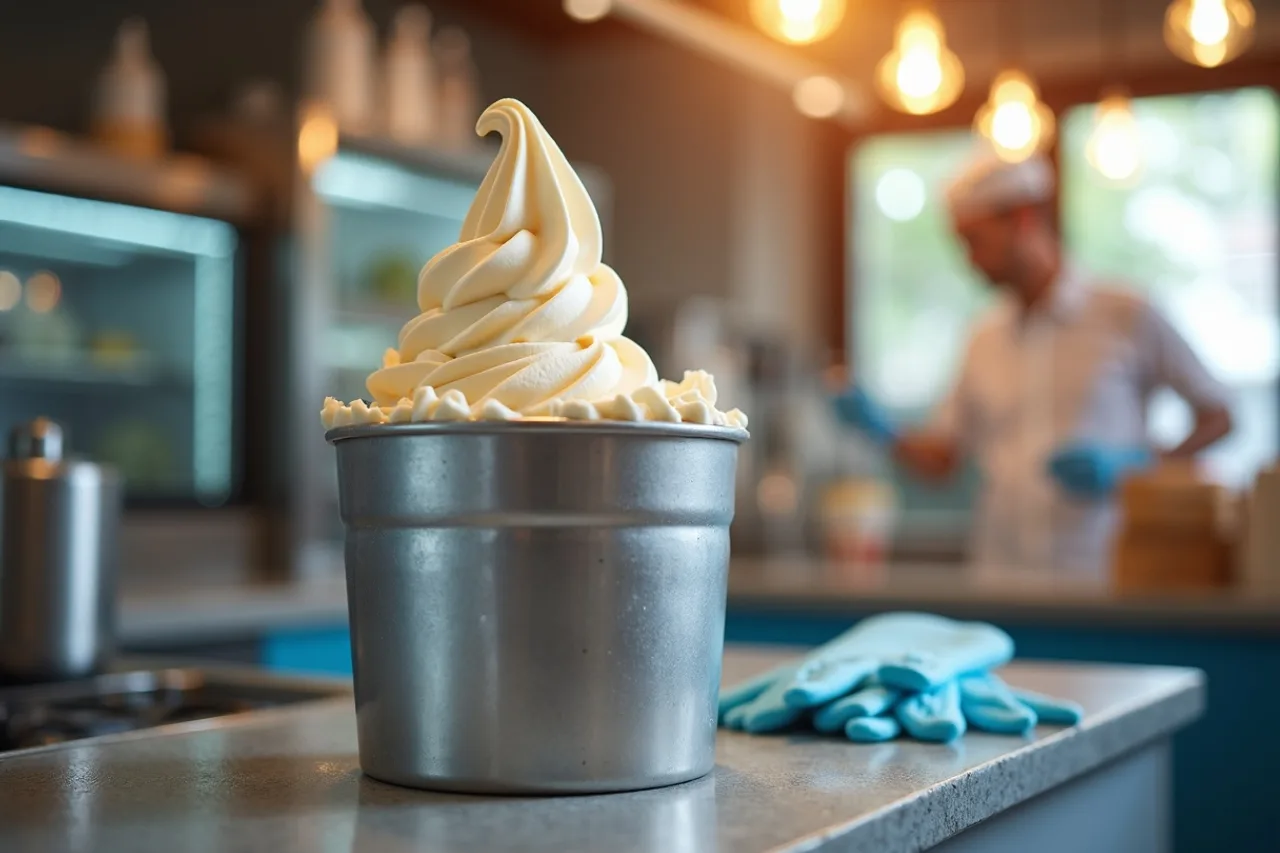
With soft-serve, the biggest hazard is the machine itself. See how to clean and disinfect it with disassembly, control the mix, and what to log.
Soft-Serve Ice Cream: Cleaning and Disinfecting the Machine That Sanepid Requires
With soft-serve ice cream the biggest hazard is not the mix - it is the machine itself. A soft-serve machine is a warm, moist interior full of milk residue: an ideal environment for bacteria if it is not cleaned and disinfected regularly and thoroughly. Sanepid knows this, and that is exactly where they look. This article shows how to set up cleaning and disinfection of a soft-serve machine so the machine is safe and you have it documented.
If you also make artisan ice cream, see HACCP for an ice cream shop - there pasteurisation is key. Here we focus on the machine.
The essentials
- The machine is the main risk point - milk residue inside is a feeding ground for bacteria.
- Cleaning and disinfection must be regular - per the manufacturer's manual and your procedure, with disassembly of parts that contact the product.
- The mix has a temperature too - in the machine's hopper the mix is chilled; its temperature and replacement schedule are another control point.
- The cleaning log is the proof at an inspection - without entries the procedure "exists only on paper".
Why the machine matters most
In a soft-serve machine the milk mix sits in a hopper and flows through channels, the cylinder and the nozzle. Residue stays everywhere, and the temperature in parts of the machine can be higher than in the hopper. That means without regular cleaning, bacteria have somewhere to multiply - and the customer gets them in the scoop. So cleaning and disinfecting the machine is not housekeeping, it is a food-safety element.
How to clean and disinfect the machine - the logic of the procedure
The exact schedule depends on the machine model and the manufacturer's manual, but the logic is always similar:
- Routine / daily cleaning. Removing residue, cleaning external parts and nozzles, rinsing per the manual.
- Cleaning with disassembly (periodic). Removing parts that contact the product (cylinder, seals, nozzle), washing, disinfecting, thorough rinsing and drying before reassembly.
- Disinfection. An agent approved for food contact, at the concentration and contact time on the product data sheet. After disinfection - rinse if the agent's instructions require it.
- Check. Verify that parts are clean and dry; record it in the log.
The general principle of "a procedure that actually works" (rather than a downloaded generic one) is laid out in cleaning and disinfection - a procedure that works.
The mix in the machine
The second front is the mix itself. In the machine's hopper the mix is chilled but not frozen - so temperature matters. Watch:
- the hopper cooling temperature - the mix must not drift into the danger zone,
- the mix replacement schedule - do not top up fresh into old indefinitely; set a rule for emptying and cleaning,
- storing the mix in the fridge before pouring it into the machine.
What to write in the records
- Machine cleaning and disinfection log - what, when, who; routine and periodic-with-disassembly separately.
- Mix / hopper temperature - a check that the mix is in a safe range.
- Mix replacement - when it was emptied and cleaned.
- Mix receipt - temperature and date on delivery.
The most common mistakes
- "Quick" cleaning without disassembly. The internal parts you do not remove collect the most residue.
- Topping up fresh mix into old. Old mix at the bottom of the hopper never leaves - a constant bacteria source.
- Wrong agent or wrong concentration. Disinfecting "by eye" instead of per the product data sheet does not work.
- No log. The machine may be cleaned daily, but without entries the inspector will not accept it. Ready-to-fill cleaning logs come with a ready-made HACCP documentation package.
- Ignoring the manufacturer's manual. Every model has its own requirements - your procedure must reflect them.
FAQ
How often should a soft-serve machine be cleaned?
Per the manufacturer's manual and your HACCP procedure. In practice you use routine (daily) cleaning plus periodic cleaning with disassembly of parts that contact the product. You write the frequency into the procedure and confirm it in the log.
Can I top up fresh mix into old?
Better not. Old mix lingering at the bottom of the hopper becomes a constant bacteria source. Set a rule for emptying and cleaning the hopper and replacing the mix, rather than topping up indefinitely.
What does Sanepid check on a soft-serve machine?
Above all the cleanliness of parts that contact the product, the cleaning and disinfection log, and the temperature of the mix. A machine with dried-on residue and an empty log is a typical non-compliance.
Ready-made procedures for a soft-serve machine
The hardest part is describing cleaning-with-disassembly and mix replacement so it matches your machine model and is realistically doable. The Fundament package from GastroReady gives you ready GHP procedures and records that you adapt to your machine - instead of inventing them from scratch.
Got a soft-serve machine and need procedures?
GastroReady offers ready-made GHP procedures and cleaning/disinfection logs with PL/EN instructions - adapt them to your machine in a few hours. From 299 PLN.