Cleaning and Disinfection: A Working Procedure
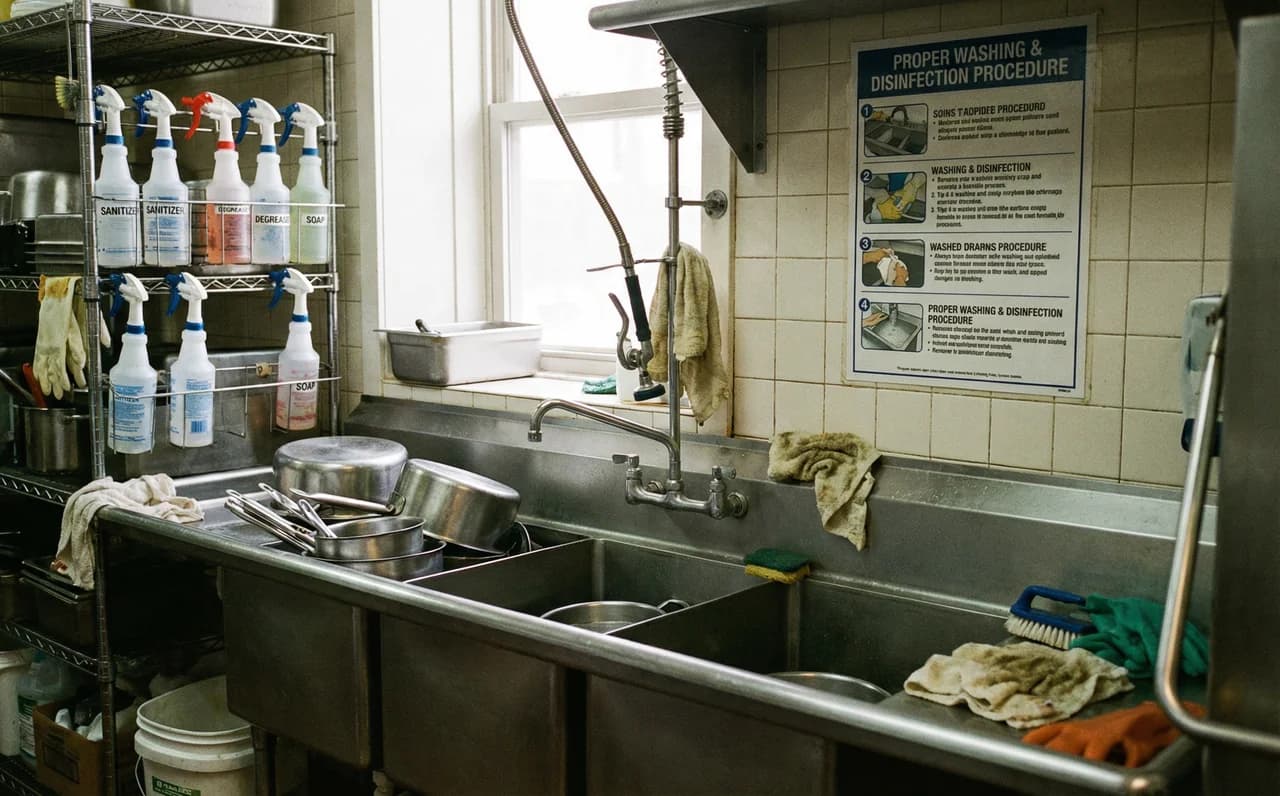
Simple rules for writing cleaning and disinfection procedures and schedules that are actually used. See what to include and what to cut.
The most common "paper sin" in food service: the procedure sounds like a slogan. "Maintain cleanliness." "Disinfect regularly." "Ensure hygiene." The inspector then asks one question: "How exactly?" And suddenly nobody knows: with what, when, who is responsible, and where is the proof. This post will show you the structure of a procedure, but it will not give you a ready-made schedule to copy (because it must fit your kitchen, equipment, and traffic - and that is exactly what the GastroReady system does).
Cleaning vs disinfection - in brief
- Cleaning removes dirt - food residue, grease, deposits. You do this with detergents and water.
- Disinfection reduces microorganisms on a clean surface. You do this with disinfectants, but only AFTER cleaning.
Disinfection without cleaning is "perfume on a dumpster." If the surface is dirty, the disinfectant will not reach the bacteria - it simply reacts with the dirt and loses effectiveness. This is why the inspector checks not only WHETHER you disinfect, but HOW you do it and in what order.
6 elements of a procedure that works in the real world
- What we clean
List of areas: countertops, cutting boards, knives, machines, fridges, handles, sinks, floors, service counter. Every item must be named specifically - not "work surfaces," because that can mean anything.
- What we clean with
Specific product / method. Not "chemicals." Product name, concentration, usage method. If you use product X for countertops and product Y for floors - that must be documented.
- When
"After use," "at the end of the shift," "every 4 hours," "after contact with raw meat" - depending on the process. The more specific, the fewer questions.
- Who
Role: service station worker / shift cook / kitchen assistant. Not "everyone" - because "everyone" means "nobody."
- How we verify
Minimum: visual inspection + touch + a simple rule of "we do not leave wet dirt behind." In larger establishments, there may be additional methods, but do not pretend to be a laboratory if you are not one.
- Where the record is
An execution log - short, manageable, always in the same place. If the log is in a drawer, buried under a pile of papers - it is not a log. It is fiction.
Disinfectant contact time - why this is the key
Many establishment owners do not realize that a disinfectant needs time to work. This is called "contact time" or "exposure time." You spray the counter and wipe it right away? You just wasted the product.
- Typical contact time is 1-5 minutes, but it depends on the manufacturer and product.
- The information is on the product label and in the Safety Data Sheet.
- If your team does not know this time - disinfection is just a gesture, not an action.
Practical tip: write the contact time directly into the procedure, next to each product. "Product X - apply, wait 3 minutes, wipe with a clean cloth." Then there is no guessing.
Chemical storage and Safety Data Sheets
The health inspector does not only ask "what do you clean with," but also "where do you store it" and "do you have Safety Data Sheets." This is not bureaucracy - it is your team's safety.
- Chemicals must be stored in a designated area, away from food.
- Every product must have a Safety Data Sheet (SDS) - you can get it from the manufacturer or distributor.
- The sheets must be accessible on-site - not on a computer in the office, not "somewhere in email."
- Products must not be poured into unlabeled bottles. If you have a spray bottle - it must have a label with the product name.
What the inspector will check: whether you have Safety Data Sheets, whether products are labeled, whether they are stored separately from food, whether the team knows what to do in case of contact with a chemical (rinse, contact a doctor).
Cleaning schedule: daily / weekly / monthly
A good schedule is not a long document. It is a simple table that tells the team "what to do today, what on Monday, what once a month."
Daily (every shift):
- Work countertops - cleaning + disinfection after every use with raw product
- Cutting boards and knives - cleaning after every use, disinfection at the end of the shift
- Kitchen floors - cleaning at the end of the shift
- Sinks - cleaning + disinfection at the end of the shift
- Door handles, fridge handles, oven handles - wipe with disinfectant
Weekly:
- Fridges - clean the interior, check dates, wipe shelves
- Ovens, microwaves - thorough cleaning
- GN containers - wash and disinfect the full set
- Walls near workstations - wipe down
Monthly:
- Exhaust hoods and filters - clean or replace
- Ice machine - clean and disinfect per manufacturer's instructions
- Freezers - defrost and clean
- Hard-to-reach areas - behind equipment, under shelves
The key: the schedule must be realistic. If you list 40 daily items and have 2 people on a shift - nobody will do it. Better 10 items completed than 40 ignored.
Equipment cleaning - specific machines
Every piece of equipment has its own rules. You cannot clean a meat slicer the same way you clean a fridge. Here are the most common pitfalls:
Meat slicer: Must be disassembled before cleaning. Cleaning an assembled slicer is fiction - dirt stays under the blade. The inspector knows this and will check. Remember protective gloves when disassembling.
Mixer / food processor: Remove all parts that come into contact with food. Bowl, whisk, hook - all separately. Wipe the base, do not submerge it.
Ice machine: This is the "silent killer" - ice looks clean, but the inside of the machine can harbor mold and biofilm. Clean at least once a month with a dedicated product. If you see pink or black buildup - you are already behind.
Deep fryer: Changing the oil is not cleaning. Deep fryers need to be regularly washed from the inside, removing residue from the bottom and walls. Oil masks dirt.
Verification methods - how to check if it is really clean
Looking alone is not enough - but you do not need to buy a laboratory either. Here is the range of methods:
- Visual inspection: The foundation. You look, touch, smell. This is sufficient for daily checks in a small establishment.
- ATP testing (luminometry): A surface swab + a device that measures the level of organic contamination. Result in 15 seconds. Costs about 3-5 PLN per test. Good for larger establishments or if you want to run an "audit" once a month.
- Microbiological swabs: You send a sample to a laboratory. This is an option for large operations, catering companies, hospitals. In small food service - you probably do not need it.
The rule: match the method to the scale. A small establishment with 3 people does not need ATP tests. A large catering operation producing 50 dishes daily - probably does.
What the inspector asks about cleaning - and what they look for
Health inspectors have their favorite questions. If you know them, you can prepare:
- "What products do you use for disinfection?" - you must know the name, not "the white one."
- "Where are the Safety Data Sheets?" - you must show them, not promise to email them later.
- "How often is the slicer / ice machine cleaned?" - you must have a schedule and a log.
- "Who is responsible for cleaning on this shift?" - there must be a specific person, not "everyone."
- "Can I see the log?" - the log must be current. If the last entry is from 2 weeks ago, you have a problem.
The inspector is not looking for perfection. They are looking for a system. They are looking for proof that you have a plan and you are executing it. No plan means an inspection report.
3 traps that destroy a procedure
- Schedule is too long - nobody does 40 items daily
- No accountability - "it wasn't me" is the default answer when nobody is assigned
- No room for exceptions - in practice, things always happen (dishwasher breaks down, product runs out, one person fewer)
Minimum routine "without heroics"
- Start of shift: quick review of cleanliness in key zones (2 minutes, not a full inspection)
- During the shift: clean after raw products / after allergens / after contamination - immediately, not "in a minute"
- End of shift: fixed set of tasks + check off in the log
This must be doable on a day when one person is missing. If the procedure requires full staffing to work - it is not a procedure. It is a wish.
Mini-test: is your cleaning a system? YES/NO:
- Does everyone know where the chemicals are and which product is for what?
- Is it clearly described what to do after raw meat and allergens?
- Can the schedule be completed in 10-15 minutes at the end of a shift?
- Is there a log that does not look like it was "filled in before the inspection"?
- Do you have Safety Data Sheets accessible on-site?
- Does the team know the disinfectant contact time?
- Do you have a weekly and monthly schedule, not just a daily one?
If this is falling apart, it is not that "people are bad." The procedure is poorly designed.
Where GastroReady comes in
At GastroReady, procedures are written to be doable and consistent with the records - not "pretty." You get schedules tailored to your scale, chemical storage instructions, log templates, and a disinfection procedure with specific contact times. And if you have a PL/EN team - the instructions must be understandable for everyone, otherwise cleaning will always be "catching up."
Frequently Asked Questions
Is disinfection required every day in a food service establishment?
Yes. Food-contact surfaces (countertops, cutting boards, knives) need disinfection after every use or whenever you switch product type. Floors and other surfaces are disinfected on a schedule, most often at the end of a shift or the working day.
What's the difference between cleaning and disinfection?
Cleaning removes dirt, grease, and food residue with detergent and water. Disinfection reduces microorganisms on an already-clean surface. The order matters - clean first, then disinfect. Disinfecting a dirty surface doesn't work.
What is contact time for a disinfectant, and why does it matter?
Contact time is how long the product needs to stay on the surface to effectively reduce bacteria. It's usually 1 to 5 minutes, depending on the manufacturer. Spraying and immediately wiping it off means the disinfection didn't actually happen.
How do I document cleaning and disinfection for an inspection?
Keep a log with the date, time, area, person responsible, and product used. The log should be short and kept in a fixed, accessible location. The inspector checks not just whether you clean, but whether you can prove it.
Need complete HACCP documentation?
"Maintain cleanliness" is a slogan, not a procedure. GastroReady gives you cleaning and disinfection procedures that answer the inspector's "how exactly?" - with what, when, who, and where the record is - plus schedules and log templates matched to your kitchen. From 299 PLN, with PL/EN instructions so the whole team cleans the same way.