Staff Hygiene in Foodservice: Non-Compliances
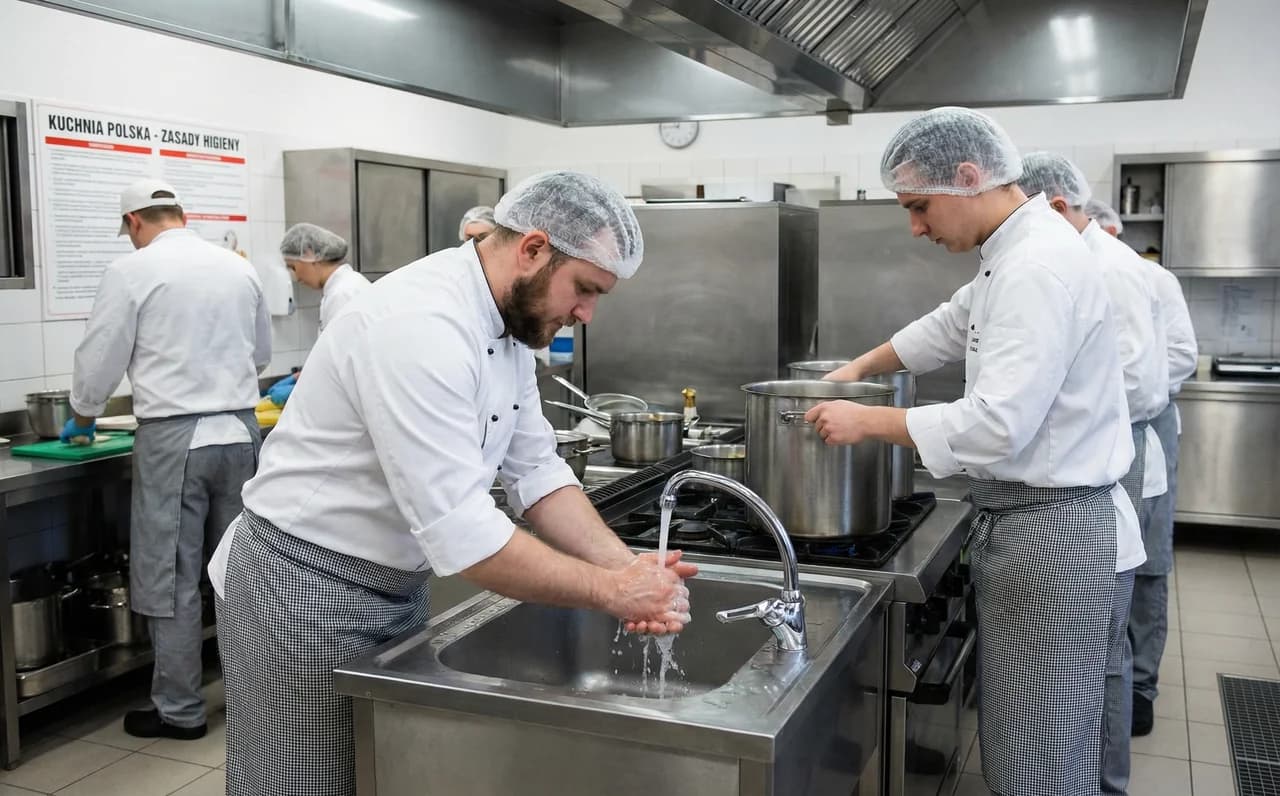
What inspectors look for in staff clothing, habits and training records. Learn how to minimize the risk of hygiene non-compliance in your team.
Paper accepts everything. People do not. That is why staff hygiene is where systems "crack" most often: turnover, rush, peak hours, fatigue. And an important note: this is not a text about "how to train people for 3 hours." This is about how to build a minimum set of rules that hold up in the real world. The full instructions and implementation in GastroReady exist so you do not have to invent this from scratch.
What the health inspector spots first
- dirty towels/cloths as a "multi-contamination tool"
- jewelry, watches, long nails
- work clothing "that has seen better days"
- a phone in the production area
- no rules for illness ("we'll manage somehow")
- inconsistent answers from the team ("I do it this way, my colleague does it differently")
The inspector does not need to read your procedures to see a problem. All they have to do is walk into the kitchen and see a cloth hanging on a door handle, a cook wearing a watch, and a dirty cap on the hook. These things speak louder than any binder full of documents.
10 staff hygiene rules that work because they are simple
- Work clothing is for work only
- Hair covered (cap/net - depending on the establishment)
- Short nails, no decorations
- No jewelry on hands
- Handwashing after specific events (not "often")
- Gloves do not replace handwashing
- Phone stays outside the production area
- Clear "stop" rules for cough/cold/diarrhea
- Wounds covered and reported
- One person per shift owns the standard (a role)
Illness and injury procedure: 3 steps you must have
Many establishment owners handle staff illness in "we'll figure it out" mode. The problem is that the inspector does not figure things out - they ask for a procedure. And if there is none, you have a non-compliance. The procedure should look like this:
Step 1: Reporting. The employee informs their supervisor about illness symptoms (diarrhea, vomiting, jaundice, fever, skin infections, infected wounds) BEFORE starting work. Not quietly, not "I'll push through." There must be a clear rule: you speak up before you enter the kitchen.
Step 2: Decision. The supervisor makes a decision: remove from food handling duties, reassign to another station (e.g., dishwashing, storage), or send home. This is not a question of "how do you feel" - it is a matter of food safety. Diarrhea or vomiting = zero contact with food. No discussion.
Step 3: Record. Every incident should be documented: date, person, symptoms, decision made, when they return to work. This record does not have to be complicated - a table in a notebook or a log is enough. But it must exist, because the inspector will ask.
Real scenario: a cook comes in with diarrhea. Says "I probably just ate something bad, I'll manage." You let them into the kitchen. Two hours later, a customer eats a salad this cook prepared. If something goes wrong - you are responsible, not the cook.
Sanitary-epidemiological health checks: who, when, where
Every person who has contact with food must hold a current medical certificate for sanitary-epidemiological purposes. This is not a "formality" - it is a legal requirement that the inspector asks about on practically every visit.
Who needs the checks? Everyone who has direct contact with food: cooks, kitchen assistants, waiters who serve food, people packing catering orders, people receiving deliveries. Also temporary workers and interns.
How often? Checks are done before starting work and then according to the doctor's recommendation (usually every 2-3 years, but the doctor may set a shorter interval). Important: if an employee has had an infectious disease - a new check is required before returning to work.
Where to store them? Medical certificates should be accessible at the establishment - physically or as copies. Best practice: a "Staff Health Checks" binder or a digital folder. The inspector will not call the doctor - they want to see the document on-site. Missing certificate = non-compliance. And a serious one.
Common mistake: You have 5 employees, but the certificates are "somewhere at home" or "we had them, but I don't know where." That is asking for a fine.
Work clothing: rules that actually work
Work clothing is not just a "white shirt." It is part of the hygiene system, and the inspector pays close attention to it. Here are rules that should be clear to the entire team:
Who launders the work clothing? Ideally, a laundry service or the establishment on-site. The employee washes their own at home? That is a risk - you do not control the wash temperature, you do not control whether work clothing is washed together with personal clothes. If there is no other option, set a minimum wash temperature (60 degrees Celsius) and instruct the team.
How often? A change of clothing after every shift - that is the standard. In practice, the minimum: clean clothing every day. If someone works a double shift and the clothing is dirty - a change during the day.
A spare set. There should be at least one spare set of work clothing at the establishment. Why? Because someone will show up without clean clothing, because someone will get dirty during work, because a new employee starts today and you have nothing for them. A spare set costs around 50 PLN. Not having a spare set costs a non-compliance.
Clothing storage. Work clothing and personal clothing cannot be in the same locker (or at least must be separated). The changing area should have a clear division: personal clothing on one side, work clothing on the other. No changing area? That is a problem that needs solving.
What happens when the inspector talks to your team
This is the moment many owners dread. And rightly so - because if the team does not know the rules, the inspector will catch it in 30 seconds. Here is what it looks like in practice:
The inspector approaches a cook and asks: "When do you wash your hands?" If the cook says "often" or "when they're dirty" - that is not an answer. A good answer: "When entering the kitchen, after using the toilet, after handling raw meat, after touching waste, after coughing, after switching tasks."
The inspector asks a waiter: "What do you do if a customer asks about allergens?" If the waiter says "I ask the cook" - that is acceptable, but only if that is what actually happens. If they say "I don't know" or "I don't think we have allergens on the menu" - you have a problem.
The inspector asks a kitchen assistant: "Where do you record temperatures?" If the answer is "I don't know" or "the boss does it" - the system is not working. Every person on shift should know where the logs are and what gets recorded in them.
Key point: the inspector is not looking for perfection. They are looking for consistency. If three employees say the same thing - you have a system. If each says something different - you have chaos. And no binder will fix that.
Documenting hygiene training
Training that is not documented does not exist. That is how the inspector sees it. You need:
- a training log: date, topic, who led it, who attended, signatures
- confirmation that a new employee completed hygiene onboarding before being allowed to handle food
- evidence of recurring training - at least once a year, and preferably more often
You do not need to organize multi-hour lectures. A 10-minute micro-training on Monday, recorded in the log, with one topic (e.g., "proper handwashing") - that is a system. The key is that the training topic should be specific, not "general hygiene." The inspector wants to see that you respond to problems: if you have dirty cutting boards, the training should be about cutting boards, not about "general hygiene."
How to train without it being theater
Instead of "once-a-year training":
- a 5-minute micro-briefing at the start of the week
- a 30-second check during peak hours ("hands, boards, cloths")
- new person test: 3 questions and show them where the logs are
This is a system in practice: not lecturing, but a system that guides people.
Mini-test: "does the team know the rules"
Ask randomly:
- "When do you wash your hands?" - they should name 3 situations
- "What do you do when you cut your finger?"
- "Where do you put your phone during work?"
- "What do you do if you have diarrhea before your shift?"
- "Where are your sanitary health certificates stored?"
- "How often do you change your work clothing?"
If the answers vary - you do not have a standard. You have habits. And habits will not pass an inspection.
Where GastroReady comes in
GastroReady gives you ready-made staff hygiene instructions, training logs, illness and injury procedures, a work clothing checklist, and onboarding materials for new employees - including a PL/EN version. Instead of inventing from scratch, you get a system the team understands and that can be maintained in a real kitchen. Because staff hygiene is not a topic for a lecture. It is a topic for a daily routine that works automatically.
Frequently Asked Questions
What are the most common staff hygiene mistakes inspectors catch?
Jewelry on hands, dirty or unchanged work clothing, no clear rules for handling illness, and phones in the production area. An inspector spots these within seconds of walking into the kitchen - before even looking at your paperwork.
Can an employee with a cold work in the kitchen?
It depends on your premises' procedure, but the general rule is simple: anyone showing symptoms of a gastrointestinal infection (diarrhea, vomiting) should not handle food. For a cold or cough, the manager decides based on internal rules and a risk assessment.
How often should foodservice staff be trained on hygiene?
At least once a year, plus whenever you hire a new employee and after any significant change to your procedures. Training doesn't need to run for hours - short, regular reminders work better than a one-off lecture.
Do disposable gloves replace handwashing?
No. Hands must be washed before putting gloves on and after taking them off. Gloves are an extra barrier, not a substitute for hand hygiene. Dirty hands inside gloves spread bacteria just as effectively as dirty hands without them.
Need complete HACCP documentation?
Staff hygiene is where systems crack first - turnover, rush, fatigue. GastroReady gives you ready staff hygiene instructions, training logs, illness and injury procedures, and a work clothing checklist that survive real kitchen conditions. From 299 PLN, with PL/EN instructions every employee can understand.