GHP and GMP in Your Restaurant: The Basics
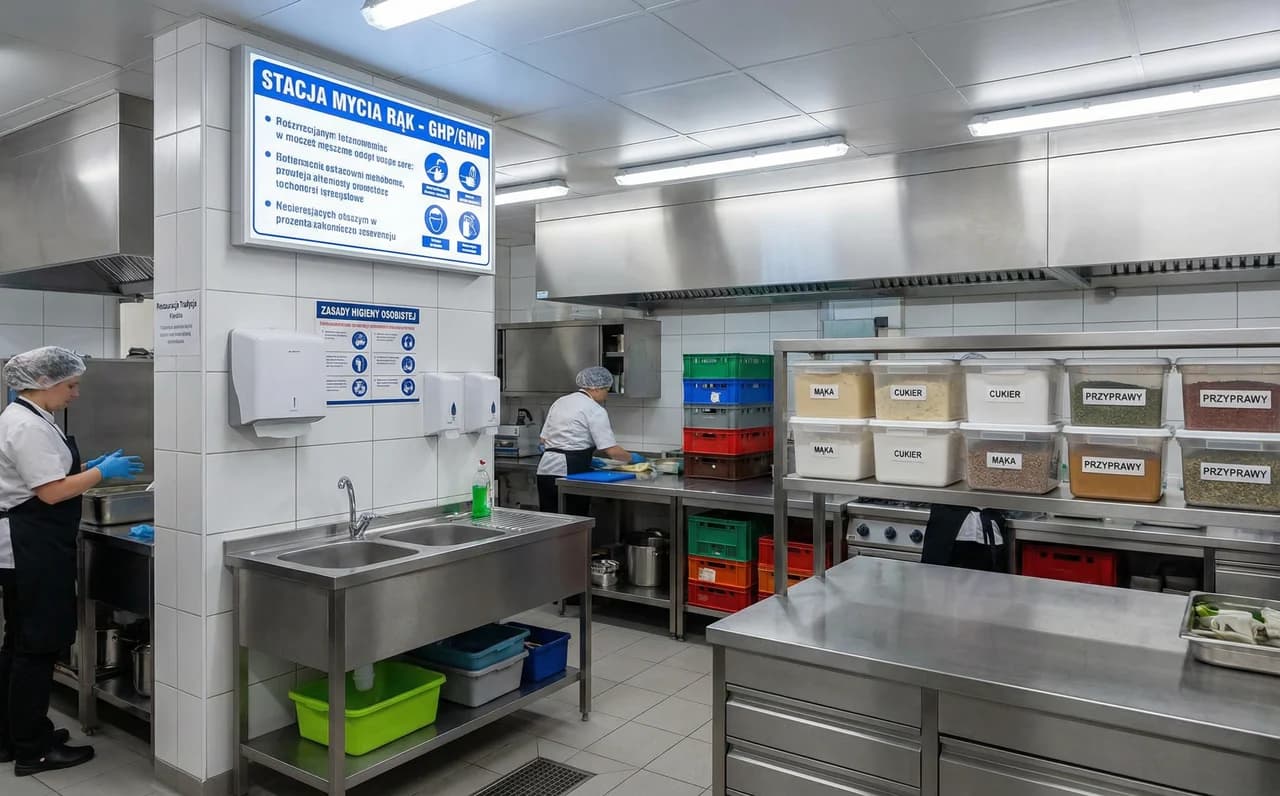
GHP and GMP explained in the foodservice context. Learn how to weave these requirements into everyday procedures your team will follow.
If HACCP is the "plan," then GHP and GMP are the floor you walk on every day. And here is the brutal truth: most problems during inspections do not come from "lack of HACCP" - they come from the fact that GHP/GMP exists on paper while the kitchen lives by its own rules. This post will help you recognize whether your GHP/GMP is a real system. You will not find ready-made procedures to copy here - because that is exactly the element that in GastroReady must be tailored to your establishment, menu, kitchen layout, and team.
What GHP and GMP actually mean in practice
- GHP (Good Hygiene Practice) - everything related to hygiene: people, hands, clothing, cleanliness, disinfection, waste, toilets, work order.
- GMP (Good Manufacturing Practice) - everything related to "how you make food": receiving goods, storage, sequence of operations, raw/ready-to-eat separation, tools, zones, allergens, packaging.
HACCP without GHP/GMP is like an alarm system in a house without doors. You can have the best hazard analysis system, but if people do not wash their hands after using the toilet and raw meat sits next to the salad - HACCP will accomplish nothing.
The difference between GHP/GMP and HACCP - a simple analogy
Imagine a house:
- GHP is cleaning, taking out the trash, mopping the floors, clean hands for everyone. This is what you do EVERY DAY to keep the house safe.
- GMP is how you cook: separate cutting boards, storing food in the fridge, the order in which you prepare dishes. These are your PRODUCTION HABITS.
- HACCP is the analysis: "what could go wrong and how do I prevent it?" This is the PLAN for dealing with risk.
GHP and GMP are the foundation. HACCP stands on that foundation. If the foundation is made of cardboard, the plan is meaningless.
Legal basis - what the law requires
GHP and GMP are not "good advice." They are a legal requirement. Here is what you need to know:
- The Act of 25 August 2006 on Food Safety and Nutrition (Journal of Laws 2006 No. 171, item 1225, as amended) - Article 59 requires the implementation of GHP, GMP, and the HACCP system.
- Regulation (EC) No 852/2004 of the European Parliament - sets out general hygiene requirements for all food business operators.
- The health authority (State Sanitary Inspection) checks compliance with these regulations. They have the right to inspect without prior notice.
In practice: you cannot run a food service establishment without implemented GHP/GMP. This is not an option "for the ambitious." It is a condition for operating legally.
7 GHP/GMP areas that the health inspector "reads" in 3 minutes
1. Zones and raw vs ready-to-eat separation
The inspector walks in and checks whether raw meat is sitting next to a ready-to-eat salad. They look at cutting boards - are they color-coded, or is there one for everything. They check the fridge - is raw on the bottom and ready-to-eat on top.
- Minimum: different boards (color-coded) and a clear rule: "raw does not touch ready-to-eat."
- Ideal: separate zones in the kitchen, but in a small establishment a consistent work sequence is enough.
- Example: "In the morning we prepare salads, then we handle raw products. Never the other way around without cleaning the workstation."
2. Cleaning and disinfection - a system, not a slogan
The inspector does not ask "do you clean." They ask "how, with what, when, who, and where is the record." If you do not have answers to these questions - you have a problem.
- Cleaning schedule: daily / weekly / monthly.
- Chemicals: name, concentration, contact time.
- Safety Data Sheets (SDS): available on-site.
- Log: simple, maintained continuously, not filled in "before the inspection."
3. Staff hygiene - habits + accountability
The inspector looks at hands, nails, clothing, hair covers. But they also ask:
- Is there a handwashing instruction posted by the sink?
- Does the team know when to wash hands (after using the toilet, after handling raw food, after allergens, after a break)?
- Is there clean work clothing and where is it stored?
- Example problem: a cook wears the same uniform to cook and goes outside for a cigarette. You just carried microorganisms outside and brought new ones in.
4. Goods receiving - controlling the risk at the door
If you do not check goods on arrival, you are welcoming risk into the kitchen with open arms.
- Minimum: temperature check of chilled products (thermometer!), checking expiration dates, condition of packaging.
- Rejection: damaged packaging, expired date, wrong temperature - do not accept.
- Receiving log: date, supplier, temperature, notes. A simple form.
5. Storage - order, labels, rotation
The inspector opens the fridge and sees a container with no date, no label. That is a note in the inspection report.
- FIFO rule: First In, First Out. Older products in front, newer in the back.
- Labels: date opened, use-by date after opening, product name.
- Temperature: fridge 0-4 degrees C, freezer below -18 degrees C. Measure and record - every day.
- Do not mix: chemicals separate from food. Raw on the bottom, ready-to-eat on top.
6. Allergens - consistency between menu and kitchen practice
The inspector will take the menu, point to a dish, and ask: "What allergens?" If the waiter says one thing and the cook says another - you have a problem.
- The allergen matrix must be up to date and accessible.
- Every menu change = allergen update.
- The team must know where to find the information (not in someone's head - in a document).
7. Waste and "dirty" areas
Trash bins are often a trigger for questions. The inspector checks:
- Are bins closable and opened with a foot/elbow (not by hand)?
- Is waste removed regularly (not "when it's full").
- Is there waste segregation (cooking oil, organic, mixed).
- Is the waste area separated from the food preparation area.
- Example: an open, full trash can next to a workstation. That is a photo in the inspection report.
Pest control - a GHP element that gets forgotten
Pests (mice, cockroaches, flies, ants) are not a "problem of old buildings." It can happen anywhere. And the inspector will ask about it.
- You must have a contract with a pest control company (DDD) OR conduct your own monitoring.
- Rodent traps: are they in place, where, when checked?
- Insects: screens on windows, insect lamps, closed doors.
- Documentation: reports from pest control visits, trap map, sighting log.
In practice: if you have never seen a pest - great. But you must prove you have a system to prevent them from appearing. "We've never had any" is not a system.
Waste management - a procedure that must exist
Waste in food service is not just "throw it in the bin." It is a system that must be documented:
- How often you empty kitchen bins (minimum: at the end of every shift, more often during peaks).
- Where you store waste before collection (a refrigerated waste area in large establishments, a closed outdoor container in small ones).
- Segregation: used cooking oil (separate container, dedicated collector), organic waste, packaging.
- Cleaning waste containers: regularly, because a dirty bin breeds bacteria and attracts pests.
Water quality - a topic that surprises people
If you use municipal water supply - you are generally safe. But the inspector may ask:
- Do you have a water test (mainly relevant for private sources - wells).
- Are filtration devices (if you use them) properly serviced.
- Is ice produced on-site made from potable water (sounds obvious, but an ice machine connected to the wrong source is a problem).
For most establishments: a water utility invoice is sufficient as proof of source. But if you have a well - you must have a current water test.
GHP/GMP documentation - what you must have
The inspector does not ask "do you have GHP/GMP." They say "show me." Here is the minimum documentation:
- GHP/GMP procedures - describing each of the 7 areas above.
- Workstation instructions - what each role does at their station (short, specific).
- Records: fridge temperatures, goods receiving, cleaning, training.
- Safety Data Sheets for chemicals.
- Pest control contract + visit reports.
- Allergen matrix.
- Staff training log.
This does not have to be a "200-page book." It can be a slim binder with specific documents. The key: it must be current, accessible, and actually used. A binder from 2019 that nobody opens is not documentation. It is a prop.
How to connect GHP/GMP with routine so it actually works
The most common mistake: procedures describe a perfect world.
A working system is bluntly simple:
- One rule = one behavior
Not "maintain hygiene." Instead: "wash hands after X" / "cutting boards by color" / "packaging stored here."
- Every shift has a "standard owner"
Not "someone." Instead: shift cook / service station worker. If nobody is responsible - nobody is responsible.
- Minimum records, but actually maintained
Records are meant to be proof of action, not punishment. If you have too many - you have none. Better 5 records maintained daily than 20 ignored.
- Procedures must be understandable for the team
If you have a multilingual team, instructions only in the local language are like a fire evacuation plan written in invisible ink. The team must understand what they are reading.
Mini-test: do you have GHP/GMP, or do you have a "binder"? Answer YES/NO:
- After 2 days, does a new person know where the zones are and what the rules are?
- Does your cleaning/disinfection have specifics: what product, when, who, where is the record?
- Do raw and ready-to-eat actually have separate tools or a defined work sequence?
- Does goods receiving have at least a minimum inspection standard?
- Are allergens consistent: menu -> kitchen -> service?
- Do you have a pest control contract and know when the last visit was?
- Is your documentation from this year, not from the previous one?
If you have 3x NO - the problem is not "lack of knowledge." The problem is lack of a system.
Where GastroReady comes in
GastroReady gives you implementation: procedures, instructions, records, and a way to transfer the rules to the kitchen. You get complete GHP/GMP documentation tailored to your establishment, with instructions in PL/EN, ready-made records, and training materials. This blog shows you what you need to have. The system makes sure you have it - and that the inspector sees a system, not a binder.
Frequently Asked Questions
What's the difference between GHP and GMP in foodservice?
GHP is about hygiene - clean hands, clean clothing, clean surfaces, waste management, and general order. GMP is about how you produce food - how you receive goods, how you store them, in what order you work, and how you separate raw from ready-to-eat. Both are legally required and complement each other.
Does a small foodservice business need GHP and GMP too?
Yes, without exception. The Food Safety and Nutrition Act and Regulation 852/2004 apply to every business operating in the food market. The size of the premises doesn't exempt you from the obligation - it only changes the scale of the documentation.
What does the health inspector check under GHP and GMP?
The inspector looks at the separation of raw from ready-to-eat food, the cleanliness of surfaces, the condition of work clothing, how food is stored, the availability of handwashing supplies, and whether actual practice matches the documentation. The inspection takes only a dozen or so minutes, but it covers all the key areas.
Are GHP and GMP enough instead of HACCP?
No. GHP and GMP are the foundation, while HACCP is the hazard analysis and control plan. The law requires all three elements to be implemented. In practice, though, well-functioning GHP and GMP resolve most problems, because they eliminate hazards before they turn into a critical situation.
Need complete HACCP documentation?
GHP/GMP that lives only on paper is exactly what inspections catch. GastroReady gives you complete GHP and GMP procedures, records, and training materials tailored to your premises, menu, and team - so the daily hygiene routine matches what the binder says. From 299 PLN, with PL/EN instructions.