Allergens in Catering: Kitchen to Delivery
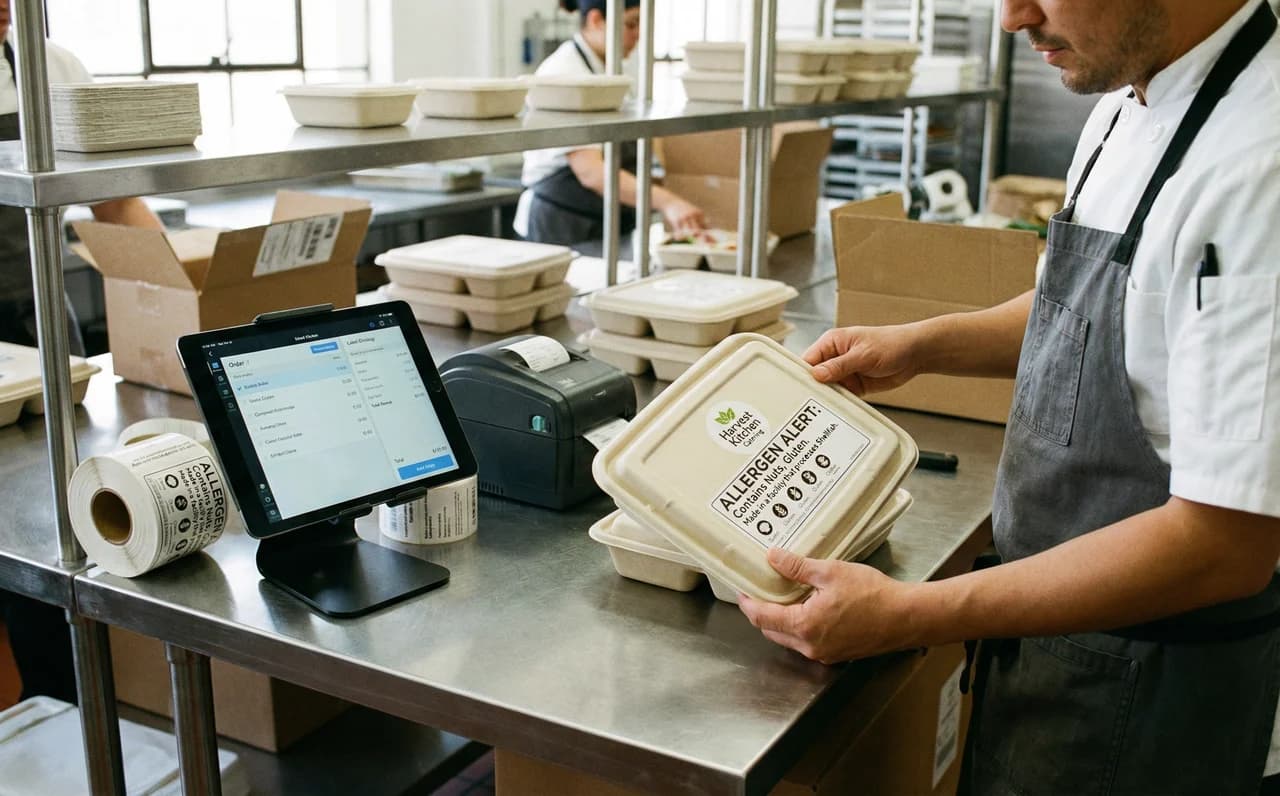
How to keep allergen information consistent from production through labeling to customer delivery. See where the chain usually breaks.
Catering and delivery have one problem: the customer doesn't see the kitchen. They see a box and trust that everything is true. Allergens in catering are not just about "what's in the dish". They're also about:
- the label,
- order assembly,
- mixed-up packages,
- cross-contact at the end of the process,
- logistics chaos.
And here's the important thing: in a restaurant, the customer can ask a server. In catering, the customer opens the box alone, at home or in the office. If the label is wrong or incomplete - there's nobody to correct the error. That's why the allergen system in catering must be airtight at every stage, from the kitchen to the delivery.
14 allergens you must know (EU Regulation 1169/2011)
The European Union requires labeling of 14 allergen groups. Not 5, not 8 - fourteen. Every catering employee should know them, and labels must include them:
- Cereals containing gluten (wheat, rye, barley, oats, spelt)
- Crustaceans and products thereof
- Eggs and products thereof
- Fish and products thereof
- Peanuts and products thereof
- Soybeans and products thereof
- Milk and products thereof (including lactose)
- Tree nuts (almonds, hazelnuts, walnuts, cashews, pecans, Brazil nuts, pistachios, macadamia)
- Celery and products thereof
- Mustard and products thereof
- Sesame seeds and products thereof
- Sulphur dioxide and sulphites (above 10 mg/kg or 10 mg/l)
- Lupin and products thereof
- Molluscs and products thereof
Most commonly overlooked in catering: celery (it's in spice blends!), mustard (it's in sauces!), sulphites (they're in wine, dried fruit, ready-made sauces). If your allergen matrix doesn't cover spices and sauces - it's incomplete.
Catering label requirements
The label on catering packaging is not a "nice touch". It's a legal requirement. Here's what must be on the label and what's optional:
Mandatory:
- dish name
- list of ingredients with highlighted allergens (bold, CAPITALS, or other emphasis)
- minimum durability date or use-by date
- storage conditions
- name and address of the producer (your business)
- net quantity
Recommended (not mandatory, but they protect you):
- nutritional information
- production batch number
- production date
- reheating instructions
- "may contain trace amounts of..." statement (if cross-contact risk exists)
A typical mistake: the label says "chicken salad", but doesn't list that the dressing contains mustard and eggs. Or: "pasta with vegetables", but the pasta is wheat-based - and nobody highlighted gluten. This is not a "minor detail". It's a potential death sentence for someone with allergies.
Minimum allergen process in catering
- Production follows the recipe, not the "today's variation"
If catering is to be safe, the recipe must be stable. Each recipe should have an assigned allergen matrix. Ingredient change = matrix update = label update. No exceptions.
- Batch labeling and separation
In catering, you produce in batches. You must be able to separate batches and avoid mixing. This means: separate containers, labels on lids, production sequence (allergen-free dishes first, then dishes with allergens).
- Packing as a separate stage with its own logic
Packing is the most common moment for cross-contact. It should have:
- a clean zone,
- a sequence of operations,
- tools and rules.
- Label consistent with the allergen matrix
The label cannot be "manually invented" during packing. It must come from a single source of truth - the allergen matrix, which is linked to the recipe.
- Order assembly and dispatch control
This is where package mix-ups happen. The minimum that works:
- labeled packages,
- a second check,
- the rule: "special orders don't go next to each other".
The allergen order path: from phone call to package
Imagine: a customer calls and says "I have a nut allergy". What should happen step by step?
1. Order intake. The allergy information must be recorded in the order system - not on a sticky note, not in the head of the person answering the phone. In the system, visible to the kitchen and packing team.
2. Kitchen. The cook sees the "NUT-FREE" label and checks the recipe. Does the standard dish contain nuts? Does the sauce have nuts? Is the oil nut-based? If so - they prepare a variant without, at a clean station.
3. Packing. The allergen order is packed separately, with a clear label on the packaging. Not at the same time as dishes with nuts. Not with the same tools.
4. Order assembly. The person assembling checks: is the package correctly labeled, does the label match the order, is the allergen order not placed next to a nut-containing order.
5. Delivery. The driver knows which order has an allergen restriction. Doesn't mix packages in the bag. Hands it to the customer with confirmation.
Sounds like a lot? That's 5 extra minutes per order. But those 5 minutes can save someone's life.
Batch production and allergen separation
In catering, you don't cook one dish at a time. You cook 50, 100, 200 portions. And that's exactly where the allergen system needs to be especially strong.
Production sequence matters. Always start with dishes without major allergens and finish with dishes containing allergens. Why? Because if you first make a nut dish, then a "nut-free" dish on the same surface - you have cross-contact.
Separate tools. In an ideal world: separate cutting boards, knives, bowls for allergen-sensitive dishes. In the real world: the minimum is thorough washing and sanitizing between batches. And a record that it was done.
Batch labeling. Every batch should have a number or label that links it to the recipe and the label. If a customer calls with a complaint "I had an allergic reaction" - you need to be able to say which batch their dish came from and exactly what was in it.
5 mistakes that happen most often in catering - and their consequences
- Label made "in a rush" and not matching the recipe
Consequence: a customer with an allergy eats something they shouldn't. Best case - a complaint. Worst case - anaphylactic reaction and criminal liability.
- Package mix-ups (often involving allergens)
Consequence: a customer gets someone else's dish. If they have an allergy and receive a dish with an allergen - it's a direct threat to life. Plus loss of the customer and a potential lawsuit.
- No separation of special orders
Consequence: cross-contact at the packing or transport stage. Even if the kitchen did everything right, the last step ruins all the work.
- Cross-contact at the pass/assembly
Consequence: the same gloves, the same spoon, the same surface - and the allergen transfers from one dish to another. Invisible, but real.
- Ingredient change without label update
Consequence: the kitchen changes sauce suppliers, the new sauce contains sesame, but the label still says "sesame-free". That's a ticking time bomb.
Mini-test: does your catering have allergen control?
YES/NO:
- Does the label come from a single source of truth (allergen matrix)?
- Do special orders have a separate path from kitchen to delivery?
- Is packing a "clean stage", not the tail end of chaos?
- Do you have a way to prevent package mix-ups?
- Can you name all 14 allergens from the EU regulation?
- Does a change in ingredients automatically trigger a label update?
If things are falling short - the problem isn't a lack of willingness. The problem is a lack of system that connects the kitchen with the label and the label with the delivery.
Where GastroReady comes in
In GastroReady, catering has its own logic: a 14-allergen matrix linked to recipes, packing procedures with an assembly checklist, label templates compliant with EU Regulation 1169/2011, an allergen order path from intake to delivery, and team instructions in PL/EN. You get a system that protects your customers and your business - without being a "full-time supervisor".
Frequently Asked Questions
What has to be on a catering dish label?
At minimum: the dish name, a list of ingredients with allergens clearly highlighted, a use-by date, storage conditions, the producer's name and address, and the net quantity. Allergens must stand out visually - in bold, capital letters, or another clear marker.
How do you avoid package mix-ups in diet catering?
The minimum that actually works: a clear label on every package, a second check during order assembly, and a rule that special (allergen-free) orders are never packed next to dishes containing that allergen. Allergy information needs to be visible in the order system at every stage, from the kitchen to delivery.
How many allergens need to be labeled on catering packaging?
EU Regulation 1169/2011 requires labeling for 14 allergen groups. The ones most often missed in catering are celery (hidden in seasonings and stock cubes), mustard (in sauces and dressings), and sulphites (in wine, dried fruit, and ready-made sauces).
Does switching suppliers mean you have to update catering labels?
Yes, without exception. A new supplier can use a different formulation for the same semi-finished product, which changes the dish's allergen profile. Every ingredient change should automatically trigger an update to the allergen matrix and the label. Skipping this after a supplier switch is one of the most common - and most dangerous - mistakes in catering.
Running a catering business? You need HACCP with delivery in mind
GastroReady HACCP documentation covers catering specifics: transport, cold chain, delivery critical points.