Allergen Cross-Contact: Where Kitchens Fail
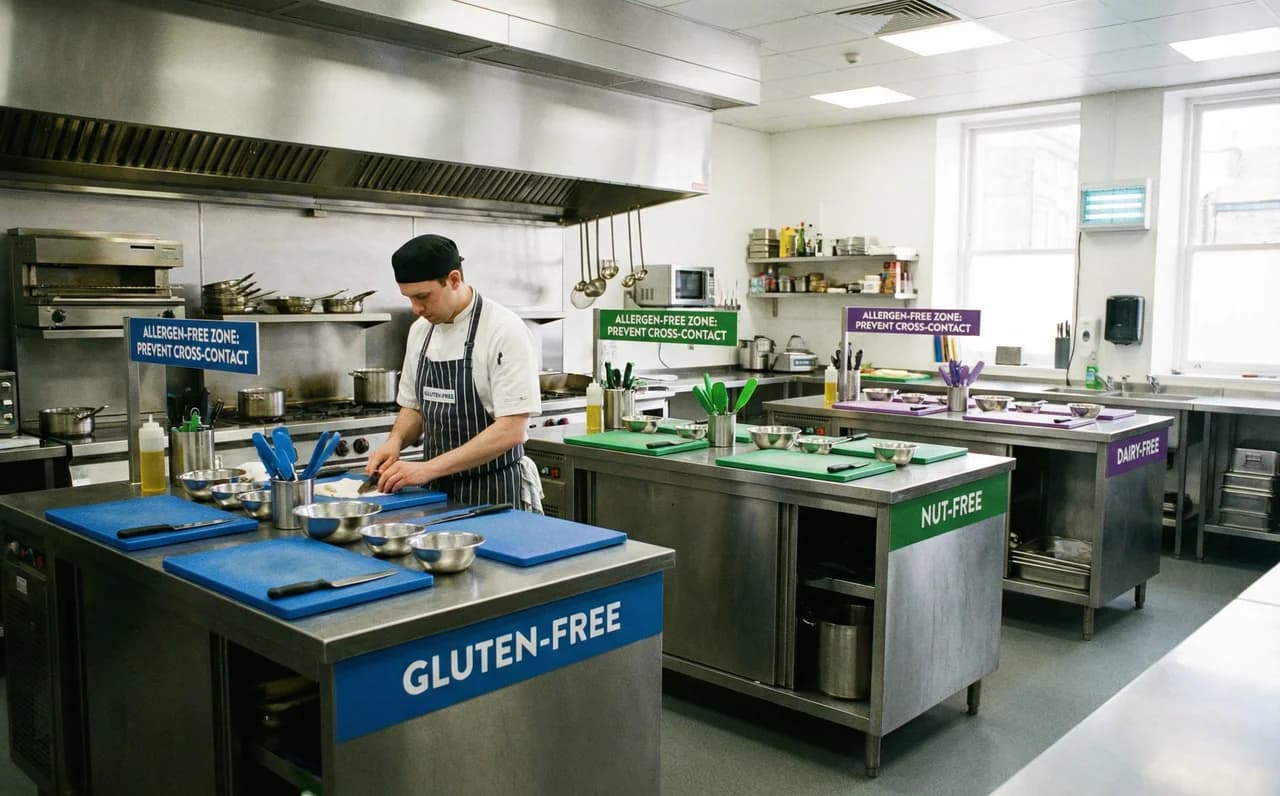
Typical cross-contamination spots in the kitchen and the procedures and habits that reduce them. Find out where your setup is most at risk.
In foodservice, most allergen problems don't come from "missing a list" but from the fact that allergens travel. And they do it very effectively: on hands, on cloths, in oil, at the pass, in containers used "just for a moment". This post will show you the risk areas and the logic of control, but it won't give you a complete step-by-step procedure for your kitchen. With GastroReady you get a ready-made implementation system.
What cross-contact actually looks like in practice
It's a situation where an allergen ends up in a dish:
- even though it wasn't part of the recipe,
- because it "touched" utensils, surfaces, oil, or hands.
The customer feels the effect. The inspector sees a missing system.
Cross-contact vs cross-contamination - not the same thing
Many people use these terms interchangeably, but in the context of food safety they are two different things:
- Cross-contamination - refers to the transfer of bacteria, viruses, or chemical substances. E.g. raw meat touches a ready-to-eat salad. This is about microbiology.
- Cross-contact (allergen cross-contact) - refers to the transfer of allergenic protein from one product to another. E.g. a spoon from a nut sauce goes into a container of tomato sauce. This is about allergens.
Why does this matter? Because cross-contact is not destroyed by cooking. You can boil, fry, bake - the allergenic protein is still active. Bacteria can be killed by heat. An allergen cannot.
For your team: if someone says "it was cooked, so it's safe" - that's wrong. Allergens don't work like bacteria.
10 places where allergens "leak" most often
- One cutting board / one knife for everything "because it's faster"
- A spoon used in multiple sauce containers
- Cloths and sponges used for multiple tasks
- Gloves treated as magical protection (they're just dirty hands in latex)
- Flour in the air (gluten loves to fly around and settle)
- Deep fryer / oil used for different items (the allergen stays in the oil)
- GN containers and "top-ups" (mixing batches)
- The pass and order assembly (rush = chaos)
- Spices and toppings (shared containers, shared spoons)
- Storage (opened products without labels, decanting)
The deep fryer and oil - a silent allergen carrier
This is one of the most underestimated problems. Frying oil is an excellent allergen carrier. If you fry battered calamari (gluten) and then fry "gluten-free" fries in the same oil - those fries are not gluten-free.
- Milk, egg, wheat, and crustacean proteins transfer through oil.
- Changing the oil doesn't eliminate the risk if the fryer isn't cleaned inside.
- The only solution if you claim "free from": a dedicated fryer OR a statement that the dish may contain traces.
In practice: label your fryers. If you have two - one for battered items, one for plain. If you have one - don't claim "gluten-free" on fries. That's honesty, not weakness.
Flour and airborne gluten - the problem you can't see
Gluten is unique among allergens because flour travels through the air. If your kitchen has a station where breading, dough-making, or flour-dusting happens - gluten particles are airborne and settle on everything within several meters.
- Dishes, surfaces, ready meals within range - all of these can have gluten traces.
- Ventilation doesn't fully solve the problem - it spreads particles further.
- The only solution: time separation (do breading BEFORE preparing gluten-free dishes) or space separation (different station, ideally on the other side of the kitchen).
If your kitchen is small and breading is an essential part of the menu - let's be honest: you probably can't guarantee "gluten-free". And that's fine. It's better to communicate "gluten-free in ingredients, but we work with flour" than to pretend you have a sterile zone.
Dedicated allergen prep zone - when is it needed
Not every establishment needs a dedicated zone. But there are situations where it's necessary:
- You serve a large number of customers with allergies (e.g. a "free-from" restaurant or one near a hospital/clinic).
- Your menu has many items labeled as "free from" (gluten, lactose, nuts).
- You have the kitchen space to allow it.
What it looks like in practice:
- A designated section of the counter - marked with a color or a sign.
- A separate set of tools (cutting board, knife, spoon, bowl).
- Rule: the zone is cleaned BEFORE each use, not just at end of day.
- Tools don't go back into the general pool - they stay in the zone.
For most small establishments, a simplified version is enough: a separate cutting board + clean tools + handwashing before preparing a "free from" dish. It doesn't cost much, but it provides real protection.
Handwashing between tasks - a protocol, not a suggestion
Handwashing is the most effective and cheapest method of cross-contact control. The problem: people think they wash their hands "often enough". Almost never true.
- Before preparing a dish for someone with allergies - handwashing is MANDATORY, not optional.
- Simply changing gloves is not enough. If you touched nuts with bare hands, put on gloves, and then sliced a salad - the nuts are on the salad.
- Handwashing means: water + soap + minimum 20 seconds + drying. Not: rinsing under water for 3 seconds.
Tip: hang handwashing instructions by the sink with clear steps. Not because people don't know how to wash their hands, but because a reminder in their line of sight changes the habit.
Verifying cleanliness after working with allergens
After preparing a dish with a strong allergen (nuts, gluten, milk), you need to be sure the station is clean before you start something else.
- Minimum: wipe the counter with warm water and detergent + a clean cloth (not the one you just used to wipe up nut sauce).
- Tools: washed separately or replaced.
- Visual check: are there any residues on the counter, cutting board, or knife?
- In larger operations: ATP tests can confirm that cleaning was effective.
Key principle: cleaning after allergens is not "normal cleaning". It's a safety procedure. Your team needs to know that the standards here are higher than for routine washing.
5 rules that work in practice
- Sequence of tasks
First the "free from" items, then the items "with" the allergen. It's simple and very effective. If you're making a gluten-free salad, make it BEFORE you start the breading.
- Dedicated tools or a dedicated cleaning routine
You don't need 30 sets of tools. You need a clear rule for when and how to clean. Use color coding: green = "free from" dishes, red = everything else.
- One zone for packing and the pass
In delivery, cross-contact happens most often at the end of the process, not the beginning. The pass is the last point of control - and the most common point of failure.
- Instructions "on the wall", not in a binder
If a rule only exists in a document, it doesn't exist. Hang short instructions where the team works.
- Verification on allergen-sensitive dishes
Two checks (e.g. the cook + the person at the pass) are often cheaper than one mistake. Double-checking "free from" dishes is a standard, not overkill.
Mini-test: do you have cross-contact under control? YES/NO:
- Can you identify the "critical allergens" in your kitchen (top 3)?
- Do you have a rule for the deep fryer and oil?
- Does the pass have its own clear workflow?
- Does the team know what to do with a "free from" order (and do it the same way every time)?
- Do you know the difference between cross-contact and cross-contamination?
- Do you have a handwashing procedure between tasks involving different allergens?
- After working with a strong allergen, is the station cleaned according to a separate procedure?
If the answers vary - you don't have a standard.
Where GastroReady comes in
In GastroReady, cross-contact is not a "nice paragraph". It's a set of specific rules tailored to your kitchen, with instructions (also PL/EN), logs, and implementation components. You get a procedure for cleaning between tasks, oil management rules, an allergen zone protocol, and instructions for the pass. This post is here to show you where the risks are. The system is there to make sure you avoid them.
Frequently Asked Questions
What's the difference between cross-contact and cross-contamination?
Cross-contamination is about transferring bacteria or viruses, for example from raw meat onto a salad. Cross-contact is about transferring an allergenic protein from one product to another, for example with a spoon that goes from a peanut sauce into a tomato sauce. The key difference: bacteria can be killed with heat, but an allergen is not destroyed by cooking.
Does cooking eliminate allergens from food?
No. Unlike bacteria, allergenic proteins are resistant to high temperatures. You can boil, fry, or bake, and the allergen will still be active. That's why controlling cross-contact requires physical separation, clean equipment, and the right order of preparing dishes.
How do I avoid allergen cross-contact in a fryer?
If you fry breaded products (containing gluten) and want to offer gluten-free fries, you need a dedicated fryer. Allergens carried in the oil don't disappear just because you change the oil, if the fryer itself isn't thoroughly cleaned inside. If you only have one fryer, be upfront that the fries may contain traces of gluten.
Do gloves protect against allergen cross-contact?
Gloves alone aren't enough. If you touch nuts with bare hands and then put on gloves, the allergens travel with you. What matters is washing your hands with soap and water for at least 20 seconds BEFORE putting on gloves and before preparing a dish for someone with an allergy.
Need complete HACCP documentation?
Allergens travel on hands, cloths, oil, and the pass - and a list alone won't stop them. GastroReady gives you concrete cross-contact rules: cleaning between tasks, oil management, allergen zones, and pass protocols, plus logs to prove they are followed. From 299 PLN, with PL/EN instructions for your whole team.