Allergen Training for Foodservice: 45 Min
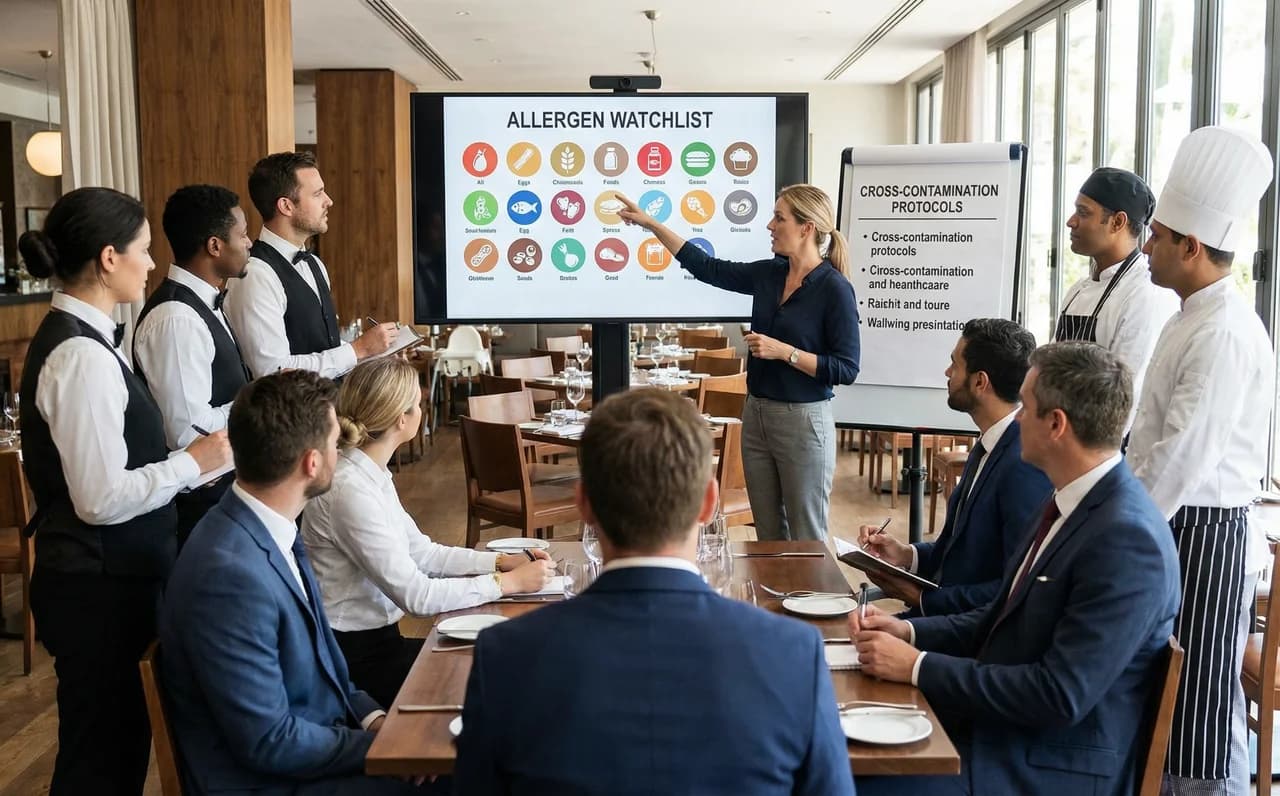
A ready-made 45-minute allergen training for your team: full plan, a 12-question test and a printable certificate that meets the documentation requirement.
Allergen training fails not because people are lazy. It fails because it is:
- too long,
- too infrequent,
- too theoretical,
- disconnected from the pass and the rush.
An effective training system is not "one training session once a year." It is micro-habits.
Rule number 1: train for risk, not for definitions
Your team does not need to recite the allergen list. Your team needs to be able to:
- find the information,
- give a consistent answer,
- prepare a special order without cross-contact,
- stop the process if they do not know.
That last one is the hardest. During the rush, with a full dining room, saying "I don't know, let me check" takes courage. Your role as a manager: make that answer OK, not a reason for criticism.
The 5-10 minutes per week system
- Micro-training at the start of the week (5 minutes)
One thing. One example. One rule. No lectures - a conversation over coffee at the start of the shift.
Example topics:
- what we do for a "gluten-free" order,
- what we do for a "dairy-free" order,
- where allergens most commonly "leak" through,
- what the special order workflow looks like.
- 3-question test (60 seconds)
Randomly, during the shift:
- "Where do you check the allergens for this dish?"
- "What do you do if a guest says: I have a severe allergy?"
- "How do you protect a dish from cross-contact at the pass?"
If the answers vary - keep training, because there is no standard yet.
- Customer conversation scenarios (2 minutes)
Your team needs a ready, safe response. The logic:
- we do not guess,
- we check the source,
- if we do not know - we say so directly and offer an alternative.
- Practical check during the rush (30 seconds)
"Hands, tools, the pass." This is where mistakes happen.
Step-by-step scenarios - what your team does
Theory is nice. But your team needs ready-made scenarios. Here are the two most common ones:
Scenario 1: A guest says "I have a nut allergy"
- Server: "Thank you for letting me know. I will check which dishes are safe for you. Please give me a moment."
- Check: allergen cards or allergen matrix - not memory, not "I think so."
- If the dish is safe ingredient-wise but cross-contact is possible: "This dish does not contain nuts in its ingredients, but we prepare it in a kitchen where nuts are used. I cannot guarantee the absence of cross-contact. Would you like to choose a different dish?"
- If the dish is safe: "This dish does not contain nuts. I will notify the kitchen about your allergy so they take extra precautions."
- Mark the order - physically, on a ticket or in the system, not "verbally through the window."
Scenario 2: A guest says "I have celiac disease - I cannot eat gluten"
- Server: "I understand. We have dishes marked as gluten-free by ingredients. However, I should let you know that we work with flour in our kitchen and cannot guarantee the absence of trace contact. Is that acceptable for you?"
- If the guest accepts: pass to the kitchen with the label "ALLERGY - GLUTEN," clean tools, separate preparation area.
- If the guest does not accept: "I understand. Unfortunately, we cannot guarantee full separation. You might prefer a restaurant that specializes in gluten-free cuisine."
This is not "scaring the customer away." This is honesty that protects both the guest and your business.
Training front of house vs kitchen - different needs
Front of house and kitchen teams need different knowledge. Treating them the same is a mistake.
Front of house team (servers, baristas, service staff):
- How to respond to guest questions about allergens
- Where to quickly check dish ingredients (allergen matrix, dish card)
- How to mark special orders in the system or on a ticket
- When to escalate to the manager or chef
- What to say and what NEVER to say ("it definitely doesn't have any" - that is a ticking time bomb)
Kitchen team (chefs, kitchen assistants):
- How to prepare a dish "without" an allergen - clean tools, work sequence
- Where hidden allergens lurk in semi-finished products (sauces, marinades, stocks)
- How to separate allergen dish preparation from the rest
- Handwashing and tool-cleaning procedure between tasks involving different allergens
- How to respond to the "ALLERGY" label on an order - what it changes in their workflow
Documenting training - what the inspector wants to see
The inspector does not want to see "a nice certificate on the wall." They want to see proof that training happens regularly and that your team actually took something away from it.
- Training log: date, topic, who attended, signature. It can be a simple spreadsheet or a paper list.
- Training scope: not "allergen training," but "we covered the procedure for a gluten-free order + practiced the scenario."
- Frequency: minimum once a year for formal training. But weekly micro-trainings - that is what actually works. You can log both types in the records.
- New employees: must have initial training BEFORE they start working with food. Not "during the first week." On the first day.
In practice: keep a simple notebook "Training - Allergens." Date, topic, who attended, signature. It takes 2 minutes and saves you during an inspection.
Annual training - how to organize it
Once a year you need to do a bigger training. It does not have to be a 3-hour lecture. It can look like this:
- 30 minutes of theory: refresher on the 14 allergens, menu changes, new procedures.
- 15 minutes of practice: customer conversation scenarios (role-playing).
- 15 minutes of testing: 10 YES/NO or multiple-choice questions. Not to "fail" anyone, but to see where the gaps are.
- Signatures and documentation.
Total: 1 hour. You can do it before opening on a Monday. Cost: zero. Value: priceless when the inspector asks "when was the last training?"
The "I don't know" situation - how to handle it
The hardest situation: a guest asks about allergens and the server is not sure. What then?
- NEVER say "I think it doesn't have any" or "probably yes." That is the most dangerous answer.
- Correct response: "I am not 100% sure. Let me check with the kitchen and I will be right back."
- If the kitchen does not know either: "Unfortunately, I cannot confirm that this dish is safe for someone with an allergy to [X]. May I suggest a dish that we are certain about?"
Your role: create a culture where "I don't know, let me check" is professionalism, not embarrassment. If a server is afraid to say "I don't know" because they will get scolded - they will guess. And guessing with allergens can end up in the hospital.
Legal consequences of an allergen incident
This is not fear-mongering. These are facts:
- A customer's anaphylactic reaction = ambulance call + potential criminal proceedings.
- If an inspection reveals a lack of training, no procedures, no documentation - liability falls on the owner.
- An administrative fine from the health authority is one thing. A civil lawsuit from the customer is another. Reputational damage is a third.
- Poland has already had several high-profile cases related to allergens in food service. Courts look at whether the establishment had a system and whether it was actually followed.
Simple weekly training + documentation = your insurance policy. Without it, you are on thin ice.
5 most common team mistakes (and how to catch them)
- Answering with confidence without checking - fix with scenarios and a "let me verify" culture
- No distinction between ingredients vs cross-contact - train with examples, not definitions
- Gloves as an excuse - gloves are not a shield if you touched nuts and then bread
- Shared tools at the pass - solution: dedicated tools OR washing between uses
- No workflow for special orders - you need a procedure, not "we'll figure it out"
Mini-test: is your training real? YES/NO:
- After 2 days, does a new team member know where to check allergens?
- Does your team have one consistent answer for a guest with an allergy?
- Is there a "special order" procedure at the pass?
- Do you run micro-trainings regularly?
- Do you have a training log with dates, topics, and signatures?
- Do the front of house and kitchen teams have separate instructions?
- Does your team know that "I don't know" is a better answer than "I think it doesn't have any"?
If the answer is "NO" - it is not a people problem. It is an implementation process problem.
Where GastroReady comes in
GastroReady gives you training as part of the system: instructions, rules, team materials, and ready-made scenarios that can also be implemented in PL/EN. You get training logs, test templates, allergen cards, and a special order procedure. This blog shows you what your team needs to know. The system makes sure they know it - and that you have proof.
Frequently Asked Questions
How often does a food service team need allergen training?
A formal training session with documentation (date, topic, attendees, signatures) should happen at least once a year. That said, short weekly micro-trainings of 5-10 minutes - for example at the start of a shift - are the most effective approach. New employees need to go through initial training on their very first day.
What should allergen training cover for waitstaff?
Waitstaff need practical knowledge: how to respond to guest questions, where to quickly check a dish's ingredients (the allergen matrix, the menu card), how to flag special orders, and when to escalate to a manager or the kitchen. The key lesson is that "I don't know, let me check" is always a better answer than guessing.
How do you document allergen training for a sanitary inspection?
Keep a simple training log with the date, topic, list of attendees, and signatures. The topic should be specific, e.g. "handling a gluten-free order," rather than a generic "allergen training." An inspector wants to see proof of regularity and real content, not a certificate on the wall.
What should a server do when they don't know the answer to a guest's allergen question?
The right answer is: "I'm not 100% sure. Let me check with the kitchen and I'll be right back." If the kitchen doesn't know either, tell the guest honestly and suggest a dish the team is certain about. Never guess - with allergens, a mistake can send someone to the hospital.
Need complete HACCP documentation?
GastroReady offers ready-made HACCP, GMP, and GHP templates for every type of food business. From 299 PLN, with PL/EN instructions.