Allergens in the Menu 2026: How to Label Them
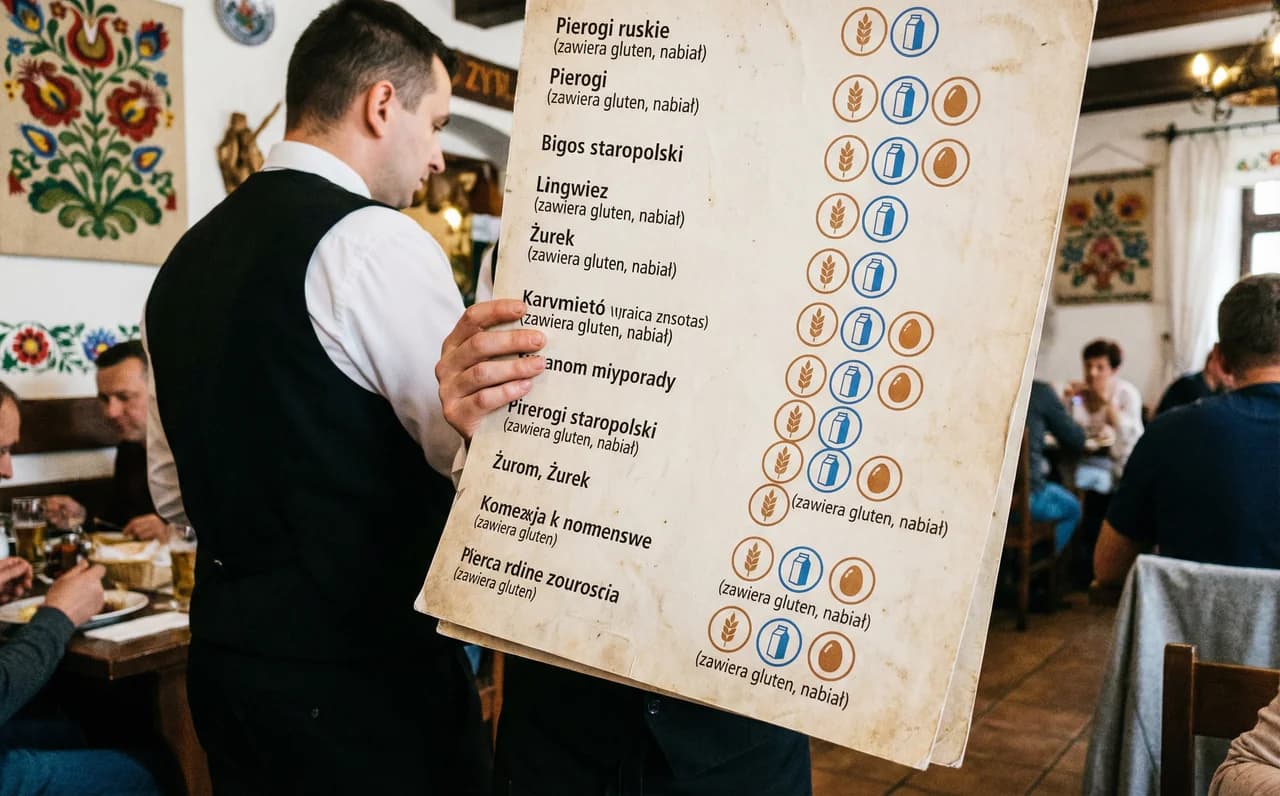
Step by step: label all 14 allergens in your restaurant menu. Grab a free template, proven phrasing, and avoid 6 mistakes that lead to complaints.
An allergen list is not an "add-on to the menu". It's a promise that the kitchen knows what it's doing - and that a customer with an allergy isn't a guinea pig. The most common mistake? The list is made "by eye", and then the supplier changes, the recipe changes, or the cook changes... and everything stops being true. This post will show you how to approach the topic, but it won't give you a complete allergen matrix or a ready-made list for your menu. With GastroReady you get a system: consistent documents + instructions + tools that hold up through menu changes and staff rotation.
What the law says: Regulation 1169/2011 in brief
EU Regulation No 1169/2011 on food information to consumers is clear: every food business serving food must inform customers about allergens. This applies to restaurants, bars, cafes, food trucks, catering, and delivery. No exceptions.
Key principles:
- Allergen information must be available before the purchase - not after.
- It must be easily accessible - on the menu, on a board, in written form on request. "Ask our staff" is acceptable, but only as support, not as the only form.
- Allergens must be highlighted in the ingredient list (bold, italics, different color).
- Responsibility lies with the food business operator, not the customer. If a customer asks and your employee gives incorrect information - the responsibility is yours.
14 mandatory allergens: the full list with hidden pitfalls
The European Union requires information about 14 allergens. Here they are - with the places where they most commonly "hide" in the kitchen:
- Gluten (wheat, rye, barley, oats) - breadcrumbs, flour-thickened sauces, beer in marinades, soy sauce
- Crustaceans (shrimp, crab, lobster) - shrimp paste, fish soups, seafood in salads
- Eggs - mayonnaise, cakes, batter, egg pasta, ice cream, some sauces
- Fish - Worcestershire sauce, anchovy paste, fish creams, stock
- Peanuts - Asian sauces, desserts, peanut oil, satay
- Soy - soy sauce, tofu, soy lecithin (in chocolate, bread), soybean oil
- Milk (lactose, casein) - butter, cream, cheese, chocolate, stock, mashed potatoes
- Tree nuts (hazelnut, walnut, cashew, pecan, Brazil, pistachio, macadamia) - pesto, desserts, granola, marinades, nut-crusted coatings
- Celery - in stocks, salads, soups, bouillon cubes, spice blends
- Mustard - mustard, marinades, dressings, sauces, mustard-spice blends
- Sesame - rolls, hummus, tahini, Asian salads, coatings
- Sulphur dioxide and sulphites (above 10 mg/kg) - wine, dried fruit, wine vinegar, processed meat
- Lupin - lupin flour (in gluten-free bread, pasta), protein preparations
- Molluscs (mussels, octopus, squid, snails) - frutti di mare, fish soups, seafood
Note: The biggest risk isn't in main dishes - it's in sauces, sides, spices, and semi-finished products. That's where allergens "hide" and where mistakes happen most often.
Rule number 1: the allergen list must match the recipe, not the "assumption"
If in the kitchen things "sometimes" go like this:
- butter instead of oil,
- cream instead of milk,
- a ready-made sauce instead of your own,
...then the allergen list must reflect this. Otherwise you have a piece of paper, not food safety.
How to create an allergen list in 4 steps
- List all menu items and break them down into ingredients
Not into "dishes", but into actual ingredients (sauces, marinades, bases, batters are also "dishes" - break these down to ingredient level too).
- Establish the "source of truth" for each item
The source of truth is not the cook's memory. The source is:
- the recipe,
- the product data sheet from the supplier,
- the semi-finished product specification.
If you don't have a source of truth - don't declare with certainty.
- Build a simple matrix: item - allergens
You don't need an encyclopedia. You need:
- consistency,
- up-to-date information,
- versioning (so it's clear what is "current").
- Choose a presentation format in the menu that your team can maintain
What works most often:
- allergen icons next to the dish,
- allergen list next to each item,
- "ask our staff" only as support, not as an excuse.
Allergen matrix: what it should look like
An allergen matrix is a simple table where rows represent menu items and columns represent the 14 allergens. At the intersection, you mark whether a given allergen is present in the dish. A good matrix should:
- Cover all items - main dishes, appetizers, desserts, drinks, sauces, and sides.
- Distinguish "contains" from "may contain" - "contains" means certainty (the ingredient is in the recipe). "May contain" means cross-contact risk (e.g. prepared on the same work surface).
- Have an update date - so it's clear whether the matrix is current.
- Be accessible in the kitchen - not in a desk drawer. On the wall in the kitchen or at the pass.
Printed vs digital allergen list
More and more establishments are switching to digital menus with QR codes. How does this affect allergens?
- Printed list: Advantages - always available, no technology required, the inspector sees it immediately. Disadvantages - needs reprinting with every menu change, easy to forget to update.
- Digital list (QR, tablet, website): Advantages - easy to update, single point of editing, convenient for the customer. Disadvantages - requires internet/device, older customers may struggle, the inspector may want a paper version.
Best practice: have both. Digital as your primary version (easy to update), printed as backup and for inspections. And remember: regardless of the format, the content must be identical and up to date.
How to handle seasonal menu changes
A seasonal menu is a challenge for allergen lists. Every new item potentially means new allergens. How to manage this without stress:
- With every menu change - update the allergen matrix BEFORE the new dish appears on the menu. Not after a week, not "when there's time". Before the first service.
- Establish a procedure - who is responsible for updating allergens when the menu changes? The head chef? The owner? If nobody specific - nobody will do it.
- Check new suppliers - a new seasonal dish may require a new product from a new supplier. Check the specification before declaring allergens.
- Archive previous versions - if the inspector comes and asks about a dish you've already removed from the menu, it's good to have the history.
Team training: how to talk to guests about allergens
Documents are half the battle. The other half is people. Your server needs to know:
- How to respond to "does this dish contain nuts?" - the answer cannot be "I don't think so" or "I'll check with the chef" (unless they actually do check). The answer must be confident and consistent with the matrix.
- Where to find the information - is the matrix on the wall in the kitchen? In an app? In a binder? The team must know where to look.
- When to say "I'm not sure" - it's better to say "let me check and I'll be right back with an answer" than to guess from memory. Especially with new dishes or supplier changes.
- What to do in an emergency - if a customer reports an allergic reaction, the team must know what to do (call emergency services, don't downplay it).
With a multilingual team (PL/EN), training must be in both languages. You can't assume that a non-native-speaking cook will "somehow understand" the allergen matrix in a language they don't fully read.
7 typical allergen list mistakes
- Missing allergens in sauces and sides (these most often "hide" milk, gluten, celery, mustard)
- Changing suppliers and getting a different semi-finished product composition
- No distinction between "in the ingredients" and "possible cross-contact"
- Lack of consistency: the menu says one thing, the staff says another, the kitchen does a third
- Seasonal dishes without updating the list
- Mistakes with "fit/vegan" dishes (e.g. cheese, butter, stock)
- A list made once and then forgotten
Mini-test: is your allergen list credible?
YES/NO:
- Can you identify the source of truth for 5 random menu items?
- Are sauces and sides covered the same way as main dishes?
- Do you know what happens when you change suppliers?
- Can the team answer allergen questions consistently?
- Does the matrix have a last-updated date?
- Does a new employee know where to find allergen information?
If you answered "NO" 2-3 times - you need a system, not another spreadsheet.
Where GastroReady comes in
GastroReady provides a ready-made, maintainable structure: an allergen matrix, update rules, team instructions (including PL/EN), and implementation components that don't fall apart after the first menu change. The Fundament package (299 PLN) includes an editable base - you enter your dishes and allergens into a ready-made structure. The Tarcza package (399 PLN) adds extra tools and a pre-inspection checklist so you don't discover gaps on the day the inspector visits.
Frequently Asked Questions
Does a restaurant have to list allergens in the menu?
Yes. EU Regulation 1169/2011 requires every food business to inform customers about the 14 allergens before they order. That information can appear in the menu, on a board, or as a written note available on request. "Ask a staff member" is only acceptable as a backup, not as the sole way of providing the information.
How many allergens have to be marked in a restaurant menu?
You're required to mark all 14 allergen groups defined by the EU: gluten, crustaceans, eggs, fish, peanuts, soy, milk, nuts, celery, mustard, sesame, sulphites, lupin, and molluscs. They need to stand out in the ingredient list - bold text or a different color both work.
How often should the allergen matrix be updated?
Update it every time the menu changes, you switch suppliers, or a recipe changes. A new dish should have its matrix filled in BEFORE it goes on the menu. It's good practice to version the matrix and stamp it with the date of the last update.
Does the allergen list have to be printed, or can it be digital?
Both formats are acceptable. The best approach is to combine them: a digital version (QR code, website) as the primary source, since it's easy to keep updated, plus a printed version as a backup and for inspections. Whichever format you use, the content has to be identical and current.
Need complete HACCP documentation?
GastroReady packages include a ready-made allergen matrix and menu labelling rules that stay accurate through supplier swaps, recipe tweaks, and staff rotation. Instead of building an allergen list "by eye", you get a structure that keeps the 14 EU allergens under control. From 299 PLN, with PL/EN instructions your whole team can follow.