HACCP Documentation
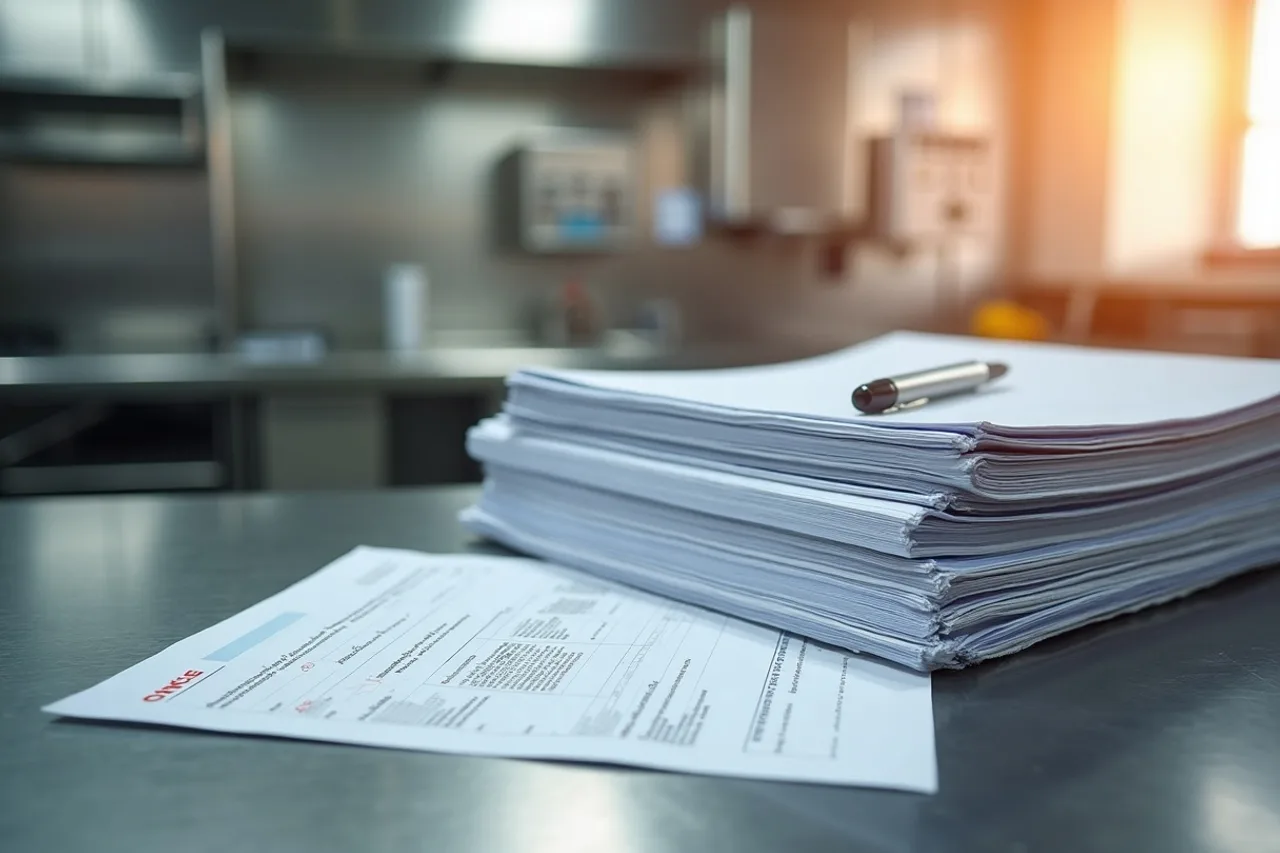
The three layers of HACCP documentation: GHP, GMP and the hazard analysis core, plus the records you fill in daily and what templates cover.
HACCP documentation is not a single document but a whole set of procedures, instructions and records that describe how your venue keeps food safe. If you are wondering what HACCP documentation must contain, this article breaks it down into its parts - the GHP layer, the GMP layer and the HACCP core itself. We show the full list of what needs to be included for a small food service business in 2026, so you can make an informed decision: build it yourself from scratch, or reach for ready-made PDF templates and HACCP documentation for food service tailored to your venue.
In brief
- Full HACCP documentation has three layers: GHP (hygiene), GMP (production) and the HACCP core itself (hazard analysis and critical control points).
- It is not a binder to put on a shelf, but a living system with records you must keep up to date.
- Free PDF templates from the internet are usually fragments you still have to adapt to your own venue, processes and menu.
- Ready-made HACCP documentation saves dozens of hours of work and the risk that something is missing during an inspection.
What HACCP documentation is - a binder or a living system
Many owners think of HACCP documentation as a binder you buy once, put on a shelf and show to the inspector. That is a misconception. The documentation has two layers. The first is the descriptive layer - procedures and instructions you can genuinely prepare once and update only when the venue changes significantly. The second is the records layer - tables you fill in daily or weekly: fridge temperatures, deliveries received, cleaning and disinfection. It is that second layer that makes HACCP a living system rather than dead paperwork.
A sanitary inspector looks at both. They check whether you have written procedures, but above all whether the records are being completed. An empty binder with beautiful instructions but not a single temperature entry signals that the system exists only on paper. That is why complete HACCP documentation must contain both the descriptive part and ready-to-fill records.
The GHP part - Good Hygiene Practice
GHP is the foundation everything else rests on. It is a set of instructions covering hygiene in the venue. Without this layer HACCP has nothing to stand on. In your HACCP documentation the GHP part should contain:
- Handwashing instruction - when, with what and how long staff wash their hands, usually also posted at the sink.
- Cleaning and disinfection instructions for surfaces, equipment and dishes - which agents, at what concentration, how often.
- Pest control procedure - deratisation, disinsection and disinfection, including the placement of traps.
- Waste management - how you separate, store and how often you remove kitchen waste.
- Staff hygiene and health - protective clothing, no jewellery, sanitary and epidemiological certificates.
- Training record - proof that every employee was trained in hygiene and food safety rules.
- Water supply instruction and handwashing procedures in production zones.
Keep in mind that GHP and HACCP are not the same thing, even though they are often confused. If you want to understand where one ends and the other begins, we explain it in detail in our article on the difference between GHP and HACCP.
The GMP part - Good Manufacturing Practice
GMP is the second layer, describing how you work with food from the moment of delivery to serving a dish. If GHP is about cleanliness, GMP is about the process. Complete HACCP documentation in the GMP part contains:
- Goods receipt instruction - what you check on delivery, which temperatures you accept, when you reject a batch.
- Storage and FIFO rotation rules - splitting dry, chilled and frozen products and applying first in, first out.
- Thermal processing instruction - minimum temperatures and times for boiling, frying and baking across product groups.
- Raw and ready-to-eat separation - how you prevent cross-contamination between raw products and ready-to-eat food.
- Labelling and dating - marking products after opening, use-by dates, describing containers.
- Allergen management - how you identify and communicate the 14 allergens in your menu, more in our article on the list of 14 allergens with dish examples.
This part matters especially in venues that cook on site and serve hot dishes. This is where most real hazards arise, hazards that are later analysed in the HACCP core part.
The HACCP part - hazard analysis and critical control points
This is the heart of the whole system and the hardest part to prepare on your own. The HACCP core cannot be copied from the internet, because it must reflect your specific venue, your processes and your menu. This part of the HACCP documentation contains:
- Description of the establishment and processes - a profile of the venue, a product list, flow diagrams of each process.
- Hazard analysis - identifying biological, chemical and physical hazards at every stage of production.
- Setting CCPs - critical control points with limits, for example thermal processing temperature or cooling temperature.
- CCP monitoring - who checks each critical point, when and how, and where the results are recorded.
- Corrective actions - what you do when a limit is exceeded, for example when a fridge shows too high a temperature.
- System verification - periodic checks that the whole system works, plus documentation reviews.
- HACCP records - documenting monitoring, deviations and corrective actions.
If you want to see how this part is built step by step, we describe the whole process in our guide on how to write a HACCP plan step by step. It shows the real effort behind the seemingly simple word documentation.
HACCP records - the layer you fill in every day
Records are the element most often forgotten by venues that build documentation themselves. Instructions can be written once, but records accompany you every working day. A complete set should include at least: a temperature record for refrigeration equipment, a goods receipt record, a cleaning and disinfection record, a training record and a corrective actions record. These usually decide the outcome of an inspection, because they prove the system is genuinely alive.
Keeping records takes routine and discipline, but it does not have to be complicated. We share practical tips and examples in a separate article on how to keep HACCP records, so that filling them in takes minutes rather than hours.
PDF templates - ready-made versus do-it-yourself
Many free HACCP documentation templates in PDF circulate online. Honestly: they have some value as a reference point, but they rarely suffice. They are usually single fragments, disconnected from one another, often prepared for a different type of business - a shop, a bakery or a large plant. Free PDF templates will not account for your menu, your processes or your CCPs, and those are exactly the elements an inspector checks most closely.
Building it from scratch means dozens of hours of reading regulations, assembling procedures and verifying that nothing is missing. Ready-made documentation is a set tailored to food service, with instructions, procedures and records in one place, ready to be completed with your venue's data. You will find a full, honest comparison of both routes, including cost and time, in our article on preparing HACCP documentation.
Where GastroReady fits in
Instead of assembling documentation from scattered PDF templates, with GastroReady you get a complete set: the GHP part, the GMP part and the HACCP core together with ready-made records. The Fundament package (299 PLN) covers the full documentation a small venue needs, and the Tarcza package (399 PLN) extends it with additional procedures and support. Everything tailored to food service and current requirements, ready to complete with your venue's data in a few hours rather than a few weeks.
Frequently asked questions
What must HACCP documentation contain?
Full HACCP documentation contains three layers: the GHP part (hygiene instructions, handwashing, pest control, waste management, training record), the GMP part (goods receipt, storage and FIFO, thermal processing, raw and ready-to-eat separation, allergens) and the HACCP core part (description of the establishment, hazard analysis, CCPs with limits, monitoring, corrective actions, verification and records).
Are free PDF templates from the internet enough?
Rarely. Free PDF templates are usually disconnected fragments prepared for a different type of business. They do not account for your menu, processes or critical control points, and those are exactly the elements an inspector checks most closely. You can use them as a reference point, but you still have to adapt them and add the missing parts.
Who can prepare HACCP documentation?
The documentation can be prepared by the venue owner, a consulting firm, or you can use a ready-made set tailored to food service. The law does not require a certified auditor to create it - what matters is that the documentation reflects the real processes in the venue and is kept up to date.
How much does ready-made HACCP documentation cost?
Prices depend on scope. Individual preparation by a consulting firm usually costs from several hundred to several thousand zloty. A ready-made set tailored to a small food service venue starts at GastroReady from 299 PLN for the Fundament package, which includes a complete GHP, GMP, HACCP and records bundle.
Ready-made HACCP documentation for your venue
Instead of assembling everything from free PDF templates, you get a complete GHP, GMP and HACCP set with ready-made records, tailored to food service. Packages „from 299 PLN", with filling-in instructions in PL and EN versions, ready to use in a few hours.