Cleaning and Sanitizing Register: Template
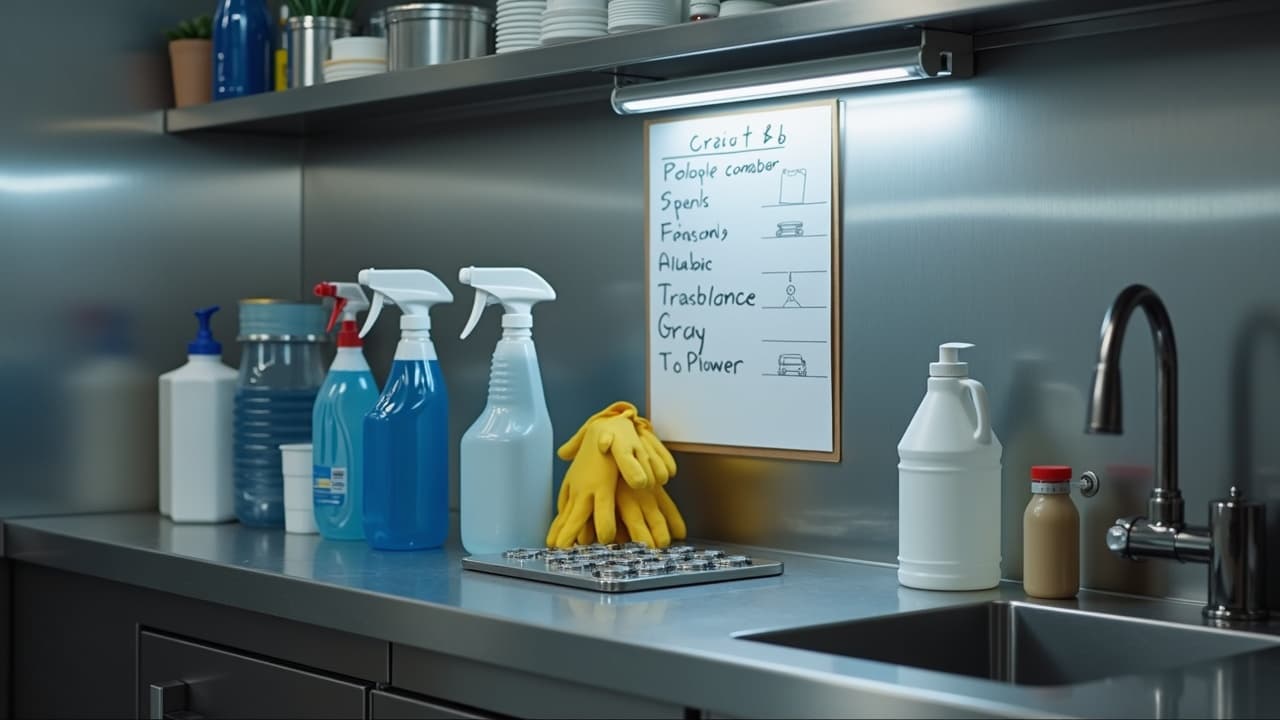
The cleaning and sanitizing register is one of the most frequently checked documents during a Sanepid inspection.
The cleaning and sanitizing register is one of the most frequently checked documents during a Sanepid inspection. It demonstrates that your kitchen is cleaned on a systematic schedule, not reactively when something looks dirty. A clean-looking kitchen is not enough: you need to prove, with dated and signed records, that specific surfaces and equipment were cleaned and sanitized at the correct frequency, using the correct products, at the correct concentration. This article covers what the register must contain, how the procedure works, and how often each part of your kitchen needs to be addressed.
Why Cleaning and Sanitizing Are Two Separate Steps
This distinction is fundamental to food safety and frequently misunderstood in practice. Cleaning removes visible dirt, grease, food debris, and organic matter from a surface. Sanitizing kills pathogens on contact surfaces. You must do both, in that order, and they are not interchangeable.
Applying a sanitizing product to a greasy or visibly soiled surface does not sanitize it effectively. Organic matter neutralises the active ingredient in most disinfectants and sanitizers, dramatically reducing their efficacy. A surface that has been sprayed with a disinfectant but not cleaned first may look treated but remain microbiologically unsafe. The correct sequence is always: clean first, then sanitize.
Your register must reflect both steps. A record that shows only "cleaned" without a sanitizing product entry is an incomplete record.
Mandatory Fields in the Register
Every entry in your cleaning and sanitizing register must include the following:
- Date: the date on which the cleaning was carried out.
- Surface or equipment: be specific. "Work surface zone A", "blue chopping board set", "refrigerator shelves unit 2", "floor preparation area". Vague entries like "kitchen" tell the inspector nothing and cannot be verified.
- Cleaning product used: the product name (brand and product line), the concentration used (e.g. 2% dilution), and the contact time applied. This allows the inspector to verify that the product is appropriate for the surface and is being used according to the manufacturer's instructions.
- Sanitizing product used: the same detail as for the cleaning product: name, concentration, and contact time. If you use a combined cleaner-sanitizer, note it as such and confirm it is approved for food contact surfaces.
- Who performed the cleaning: the name or initials of the food handler who carried out the task. Accountability is essential.
- Signature: the food handler's signature confirming the task was completed as recorded.
- Notes: any issues encountered: a product that ran out mid-shift, equipment that needed extra attention due to a spillage, a surface that was found in an unusually dirty condition. Notes demonstrate that your system responds to real conditions, not just a theoretical schedule.
The 6-Step Cleaning Procedure
Follow these steps for every surface or piece of equipment in your kitchen. The sequence is not negotiable: skipping steps undermines the effectiveness of the entire process.
- Remove all food and equipment from the surface. You cannot clean around objects. Clear the surface completely before starting.
- Pre-rinse with water to remove loose debris. This reduces the organic load before the cleaning agent is applied, making the cleaning step more effective and extending the working life of your cleaning solution.
- Apply cleaning agent at the correct concentration. Use a degreaser or detergent appropriate for the surface. Leave it for the contact time specified by the manufacturer: most degreasers require 30 seconds to several minutes of contact to break down grease effectively. Do not wipe it off immediately.
- Scrub with a clean cloth or brush. Use colour-coded cloths and brushes to prevent cross-contamination between areas: a standard colour-coding system uses red for raw meat areas, blue for general surfaces, green for salad and vegetable prep, and yellow for cooked food areas. Do not use the same cloth across different zones.
- Rinse thoroughly with clean water. Remove all cleaning agent residue. Residual detergent on food contact surfaces is a contamination risk and can interfere with the subsequent sanitizing step.
- Apply sanitizer at the correct concentration and leave for the correct contact time. Do not rinse off a no-rinse sanitizer approved for food contact surfaces: rinsing removes the active agent. If your sanitizer requires rinsing, follow the manufacturer's instructions precisely. Record the product, concentration, and contact time in the register.
Cleaning Frequency Table for Key Kitchen Elements
Use this table - or a ready-made cleaning register template with a pre-filled frequency schedule - as the basis for your kitchen cleaning schedule. Your specific layout and menu may require additional frequency for high-use items.
- Work surfaces: after each use during service and at the end of every shift. High-contact surfaces in busy kitchens may need sanitizing between tasks.
- Cutting boards: after each task change (switching from raw meat to vegetables, for example) and a full deep clean at the end of each day. Replace boards that are heavily scored, as deep cuts harbour bacteria that cannot be removed by surface cleaning.
- Refrigerators: internal surfaces weekly as a minimum, with a full deep clean including shelves, door seals, and drainage channels monthly. Spillages must be cleaned immediately.
- Floors: daily at minimum, more frequently during service if there are spills. A wet floor is both a hygiene risk and a slip hazard.
- Walls and splashbacks: weekly, more often in high-splatter areas such as the grill station or fryer area.
- Extractor hoods: the external surface and grease filters weekly; a full deep clean of the hood and ductwork monthly. Grease accumulation in extraction systems is a fire risk as well as a hygiene issue.
- Dishwasher interior: daily cleaning of filters, spray arms, and interior surfaces. A machine that cleans dishes cannot clean itself: manual daily cleaning is required.
- Bins: bin liners changed daily (more often if the bin is full); the bin itself sanitized weekly. Bins are a high-contamination point and a common source of pest attraction.
Common Mistakes Found During Inspections
- Using cleaning products at the wrong concentration: too diluted means ineffective cleaning and sanitizing; too concentrated means residue risk on food contact surfaces and potential harm to staff. Always follow the manufacturer's dilution instructions and use a measuring dispenser rather than estimating.
- Using the same cloth across different areas: a cloth used on the raw meat preparation surface must not be used on the salad preparation surface. Colour-coding eliminates this risk when followed consistently.
- Not recording the product name: an inspector cannot verify that your sanitizing product is appropriate for food contact surfaces if the register only says "disinfectant". Product names allow the inspector to cross-reference the product with the approved list and verify that you are using it correctly.
- Completing the register at the end of the shift for the whole day: records completed retrospectively are not reliable. Staff sign off on tasks they may not remember accurately, and the inspection is aware of this practice. Complete the register entry immediately after each task is finished.
- No sanitizing step recorded: a register that shows cleaning products but no sanitizing products suggests that the two-step process is not being followed. This is a significant gap that inspectors note directly.
ATP Testing as Verification
ATP (adenosine triphosphate) testing is an optional but strongly recommended verification method. An ATP swab test detects biological residue on a surface after cleaning and sanitizing, giving you a quantitative result in seconds.
- A result below 10 RLU (relative light units) indicates a clean surface.
- A result between 10 and 100 RLU suggests borderline cleanliness: investigate the cleaning procedure.
- A result above 100 RLU means the cleaning process has failed: repeat the full 6-step procedure and retest.
ATP testing does not replace the register, but it provides objective evidence that your cleaning procedure is working. Some Sanepid inspectors view ATP testing records favourably as evidence of a proactive food safety culture. It is also useful for training purposes: showing a new food handler the ATP result from a surface they just cleaned is more instructive than any verbal explanation.
For the broader context of how cleaning and sanitizing records fit into your overall HACCP documentation - available ready to print as part of a complete HACCP documentation pack - see our guide at The 7 Principles of HACCP with a Catering Example.
Frequently Asked Questions
Must the cleaning products be on the URPL (Polish drug and chemical register) list?
Biocidal products used for sanitizing food contact surfaces in Poland must be registered or authorised under relevant EU biocides legislation (Regulation 528/2012), and products sold in Poland are subject to URPL oversight. When a Sanepid inspector asks for the product name, they are checking that the product is legally placed on the market and appropriate for its stated use. Always purchase cleaning and sanitizing products from professional catering suppliers and retain the product data sheets, which confirm the product's authorisation and correct use instructions.
Can I use the same sanitizing product for all surfaces?
Not necessarily. Different surfaces have different requirements: a sanitizer approved for food contact surfaces may not be appropriate for floor cleaning, and a product used on stainless steel may damage rubber seals or plastic components. Check the product data sheet for each product and confirm its approved applications. For food contact surfaces, use only products explicitly approved for that use and follow the no-rinse or rinse instruction for each product.
What if a staff member forgets to sign the register?
A missing signature is a gap in your record and may be questioned during inspection. If you discover a missed signature promptly, the responsible person should sign and date the entry with a note explaining the delay. Do not have someone else sign on their behalf. More importantly, treat repeated unsigned entries as a training issue: your team must understand that an unsigned record is an incomplete record and that accountability is the point of the signature requirement.
How long must I keep the cleaning register?
As with other HACCP records, cleaning registers should be retained for a minimum of two years. Keep completed registers in a file accessible to inspectors during a visit. Do not discard records that cover a period in which a food safety complaint or incident was recorded: retain those indefinitely until the matter is fully resolved.
Can I automate the register with an app?
Yes. Digital cleaning registers are acceptable provided they capture all required fields, are completed at the time of the task, include user authentication (so the "signature" can be attributed to a specific person), and can produce a printed or screen-displayed record for inspection. Several food safety management apps are designed specifically for this purpose. If you use a digital system, ensure you have tested how to present the records during an inspection before the inspector arrives.
GastroReady Cleaning and Sanitizing Register
GastroReady cleaning register template includes a frequency table, product fields, and a URPL-ready product slot. Approved format for Sanepid inspection. The template covers all mandatory fields, includes a pre-filled frequency schedule for the most common kitchen surfaces and equipment, and provides a product data slot where you enter your specific products once and reference them across entries. Available in PL/EN as part of the GastroReady HACCP documentation pack.
See GastroReady Documentation