Diet Box Catering in Poland
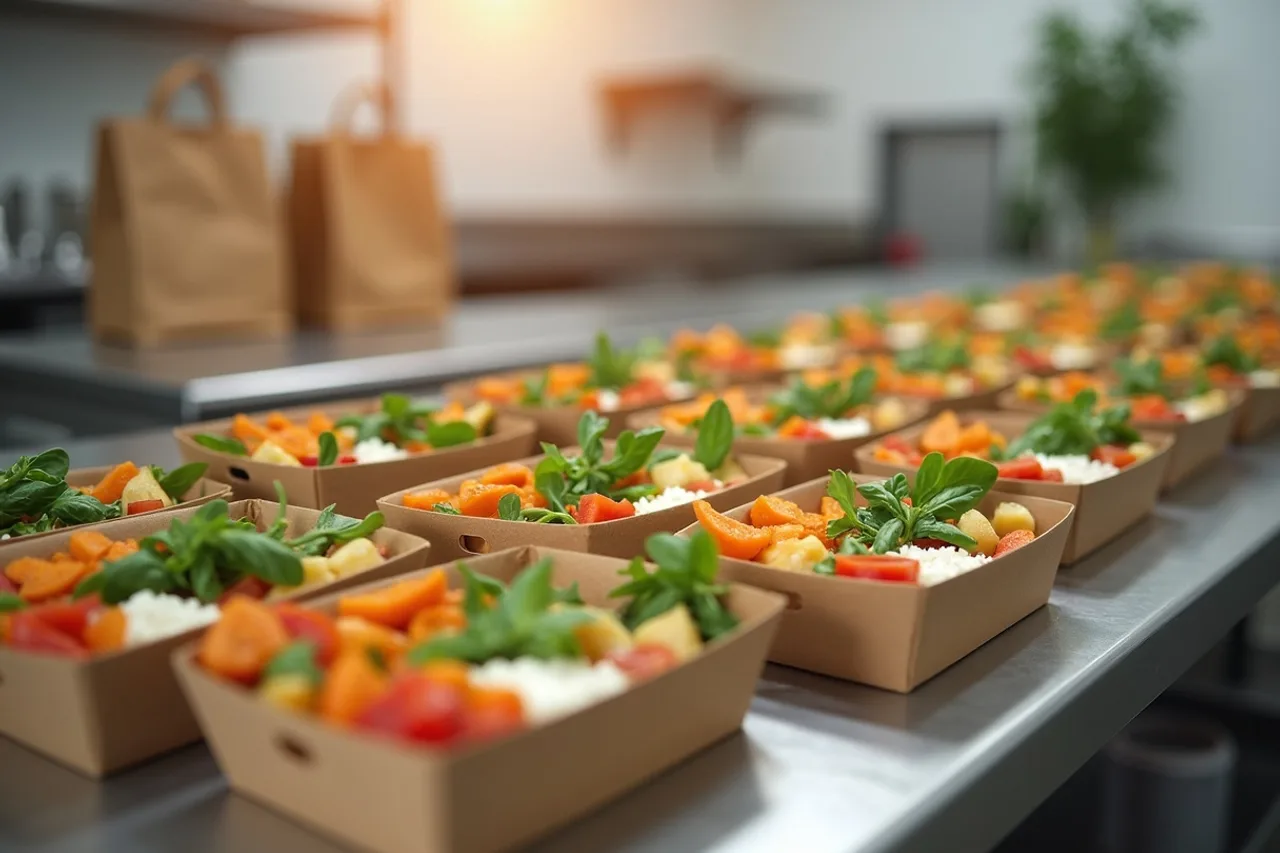
Meal-prep catering counts as open collective catering in Poland: HACCP for batch production, labelling and nutrition data, cold-chain delivery, samples.
Diet catering (meal-prep boxes) is food service at a scale a classic restaurant rarely sees: hundreds of meals a day, overnight production, deliveries left at the customer's door before dawn, and a customer who eats your food all week long. That scale changes everything - your hazard analysis has to cover transport and storage at the customer's home, meal labelling falls under distance-selling rules, and one recipe mistake gets multiplied across hundreds of boxes. Legally, a meal-prep company in Poland is an open-type mass catering establishment and must meet the same Sanepid requirements as any food business, plus a few extra obligations that new box-diet founders often miss. This guide walks you through the whole system: HACCP for serial production, labelling and nutrition declarations, the cold chain for night deliveries, food samples, and the paperwork behind it all.
What diet catering is in the eyes of the law
A meal-prep company is classified as an open-type mass catering establishment: a business providing organised meals to any consumer who places an order. It is the same category as a restaurant, with one key difference - your consumer does not eat at your table. They collect the box from their doorstep and store it in their own fridge.
That classification brings concrete obligations:
- An implemented HACCP system - required by Regulation (EC) No 852/2004, which applies directly in Poland with no exemption for "small production".
- Establishment approval and registration - an application to the local State District Sanitary Inspector (PPIS) before you start operating.
- Retained food samples - a mass catering establishment keeps samples of produced dishes for at least 72 hours.
- Food labelling - under Regulation (EU) No 1169/2011, including the distance-selling provisions, because customers order online or by phone.
- Traceability - under Regulation (EC) No 178/2002, the ability to trace which raw materials and batches went into a specific meal.
Key principle: In diet catering, your responsibility for food safety does not end at the factory gate. The hazard analysis must cover transport and delivery conditions, and mandatory food information must reach the customer before they pay - not only on the box label.
HACCP for meal-prep production
You build the system on the same seven HACCP principles as a restaurant. What changes is where the Critical Control Points (CCPs) fall and what monitoring looks like in serial production.
The process flow: from raw material to the customer's door
- Goods receiving and delivery checks (temperature, packaging condition, dates).
- Raw material storage (chiller, freezer, dry store).
- Preliminary preparation (washing, peeling, portioning).
- Cooking (boiling, baking, braising).
- Cooling of cooked dishes.
- Portioning and packing into individual containers.
- Labelling and assembly of daily meal sets.
- Finished-product storage in the dispatch chiller.
- Temperature-controlled transport.
- Delivery to the customer (often overnight, contactless).
Where CCPs usually fall in a box-diet operation
- Cooking - the classic CCP: core temperature must reach the critical limit set in your documentation, and the measurement must be recorded per batch, not per "production day".
- Cooling - a high-risk point in catering, because you cool large volumes at once. The time and temperature limit for cooling, and who monitors it with what instrument, must be written into the procedure.
- Finished-product storage and transport - meals wait for dispatch and travel to the customer under refrigeration; a temperature breach here undoes all the earlier work.
Exact temperature values for product groups are covered in our storage and processing temperature table - in your HACCP documentation they become the critical limits for your CCPs.
Hazard analysis at serial scale
Serial production changes the weight of every hazard. In a restaurant a mistake affects one plate; in catering the same mistake reaches hundreds of customers in a single batch. Pay particular attention to:
- Biological hazards in cook-chill dishes - you produce in advance, so every dish passes through the temperature danger zone twice: during cooling and potentially during transport.
- Allergen cross-contact in parallel production - several diet variants are made in the same kitchen, often at the same stations. A wrong production order or shared boards and equipment carry an allergen into a diet that was supposed to be free of it.
- Assembly errors - packing the wrong meal into the set of a customer with an allergy is a hazard that needs its own control procedure (label verification at assembly, colour coding of diets).
Meal labelling: allergens, ingredients, nutrition
Food labelling is governed by Regulation (EU) No 1169/2011, and this is where diet catering differs most from a restaurant. A restaurant provides allergen information on site; you sell food at a distance and pack it into containers the customer opens without ever meeting your staff.
Allergens: always, and before purchase
Allergen information is mandatory in every case, no exceptions. For distance selling, Regulation 1169/2011 additionally requires that mandatory food information (including allergens) is available to the customer before the purchase is concluded, not only at delivery. In practice:
- the menu published on your website or sent to the customer must mark allergens for every meal,
- the information must be free of charge and available without the customer having to ask,
- mandatory information must also be available at the moment of delivery - hence the label on the container or a card in the bag.
How to build the allergen process from recipe to label is covered in detail in our article on allergens in catering. The rule to remember: an allergen missing from the pre-purchase menu is a breach of the regulation even if the box label is correct.
Nutrition values: the core of a diet offer
Customers buy meal boxes precisely because they expect counted calories and macros. If you declare nutrition values (calorie level of a diet variant, protein, fat, carbohydrates), that declaration must be backed by your recipes: values are calculated from the recipe and portion weights, and recipes must be versioned - every ingredient change means updating the calculations and the menu. An inflated or outdated declaration misleads the consumer, and a mismatch between recipe, label and menu is one of the first things an inspection uncovers.
What belongs on the label or meal-set card
- Meal name - matching the menu the customer saw when ordering.
- Ingredient list with allergens emphasised - for example in bold.
- Storage conditions - fridge temperature and the date by which the meal should be eaten.
- Business details - name and address of the responsible operator.
- Diet variant and date marking - a customer with an allergy must be able to identify their set without any doubt.
The cold chain: night deliveries under control
Overnight delivery is the trademark of the box diet and its weakest link at the same time. A meal leaves the dispatch chiller in the evening, rides in a van for hours and waits at the customer's door until morning. Every stage needs a procedure, just as the cold chain in the summer months needs extra safeguards.
| Stage | Risk | Safeguard and record |
|---|---|---|
| Dispatch chiller | Temperature rise from frequent door opening during assembly | Equipment temperature log, assembly in batches, minimised door-open time |
| Loading | Meals waiting on the ramp at ambient temperature | "Last minute" loading procedure, insulated bulk containers |
| Transport | Cold chain break en route | Refrigerated vehicle or insulated bags with cooling packs, transport temperature log |
| Doorstep delivery | The bag waits from delivery until the customer wakes up | Insulated packaging, customer instruction (refrigerate promptly after collection), delivery time recorded |
The transport temperature log is a document the inspector will almost certainly ask for: who measured the temperature in the cargo space or bag, when, and with what instrument. If you use couriers or subcontractors, transport conditions (temperature, packaging type, maximum delivery time) should be set out in the contract - responsibility for food safety stays with you until the food is handed over to the consumer.
Food samples: a minimum of 72 hours
As a mass catering establishment you must keep samples of produced dishes for at least 72 hours. The purpose is simple: if a customer reports food poisoning, Sanepid needs material from that specific production run for laboratory testing.
Your sampling procedure should define:
- what you take - a sample of every dish from every production batch, in a quantity sufficient for testing,
- how you mark it - dish name, production date and time, signature of the person taking the sample,
- where you store it - a designated, marked place in a refrigeration unit, away from products intended for dispatch,
- when you dispose of it - after the retention period, with an entry in the sample register.
A sample register with gaps works against you twice: it is a breach in itself, and if poisoning is reported it deprives you of the evidence that could show the problem did not start in your kitchen.
Packaging: declarations of conformity, not an invoice
Containers, films and any bags in direct contact with food must be intended for food contact. The proof is not a purchase invoice or the glass-and-fork symbol on the outer box, but a declaration of conformity issued by the producer or supplier of the packaging material. In catering there is one more aspect: if the customer is meant to reheat the meal in its container (microwave), the declaration and markings must confirm the packaging is suitable for that use. Keep the declarations in your documentation binder together with supplier data - inspectors treat them like any other mandatory document.
Documentation at production scale: what you keep daily
At several hundred meals a day, documentation stops being a formality and becomes a production management tool. The minimum set of registers for a meal-prep business:
- Goods receiving register - with delivery temperatures for chilled products and raw material batch numbers (the basis of traceability).
- Equipment temperature logs - chillers, freezers, dispatch chiller.
- Cooking and cooling register - measurements per batch, not one entry per day.
- Transport temperature log - per route or vehicle.
- Food sample register - sampling and disposal.
- Recipe cards with allergens and nutrition calculations - versioned, consistent with the published menu.
- Cleaning and disinfection register - including reusable bulk transport containers, if you use them.
- Complaints register - every customer report concerning safety or quality, with the actions taken.
On top of that come the standing documents: plant description and process flow diagram, hazard analysis with CCPs, GHP/GMP procedures, staff medical certificates and training records, and packaging declarations of conformity. The whole set must be consistent: if the procedure says every batch is temperature-checked and the register shows one entry per day, the inspector will conclude the system exists only on paper.
Frequently asked questions
Does a meal-prep company need HACCP?
Yes. The obligation to implement HACCP comes from Regulation (EC) No 852/2004 and covers every business producing or placing food on the market, including catering companies. Scale is irrelevant - a box diet made in a home kitchen without establishment approval and without HACCP is an illegal operation.
Do I have to show allergens in the online menu?
Yes. For food sold at a distance, Regulation (EU) No 1169/2011 requires mandatory food information, including allergens, to be available to the customer before the purchase is concluded. The menu published online or sent to the customer must mark allergens for each meal, and the information must be repeated at delivery.
How long do I have to keep meal samples?
A mass catering establishment keeps samples of produced dishes for at least 72 hours. Samples must be marked (dish, production date and time) and stored under refrigeration in a designated place, with sampling and disposal recorded in a register.
Is contactless overnight delivery even legal?
Yes, provided you maintain the cold chain until the food is handed over to the consumer. In practice that means temperature-controlled transport (refrigerated vehicle or insulated bags with cooling packs), temperature logs, and packaging that keeps the food at a safe temperature until collection, plus an instruction for the customer to refrigerate the meals promptly.
Can I pack meals into any containers from a wholesaler?
No. Materials and articles intended for food contact must have a declaration of conformity issued by the producer or supplier. If the customer is meant to reheat the meal in the container, the packaging must be suitable for that use. You keep the declarations in your documentation and present them during inspection.
How does catering HACCP documentation differ from restaurant documentation?
The foundation is the same: seven HACCP principles, GHP/GMP procedures, registers. Catering adds stages a restaurant does not have: packing and labelling, a dispatch store, temperature-controlled transport and delivery to the customer. The process flow, hazard analysis and registers must cover these stages, and the document set grows to include recipe cards with nutrition values and a transport temperature log.
The good news: you do not have to build this documentation from scratch. The ready-made HACCP and GHP/GMP documentation packages from GastroReady contain procedures, instructions and registers prepared in line with Regulation 852/2004, which you fill in with your production data - including temperature logs, a sampling procedure and documents useful for delivery operations.