When to change frying oil: the 25% limit
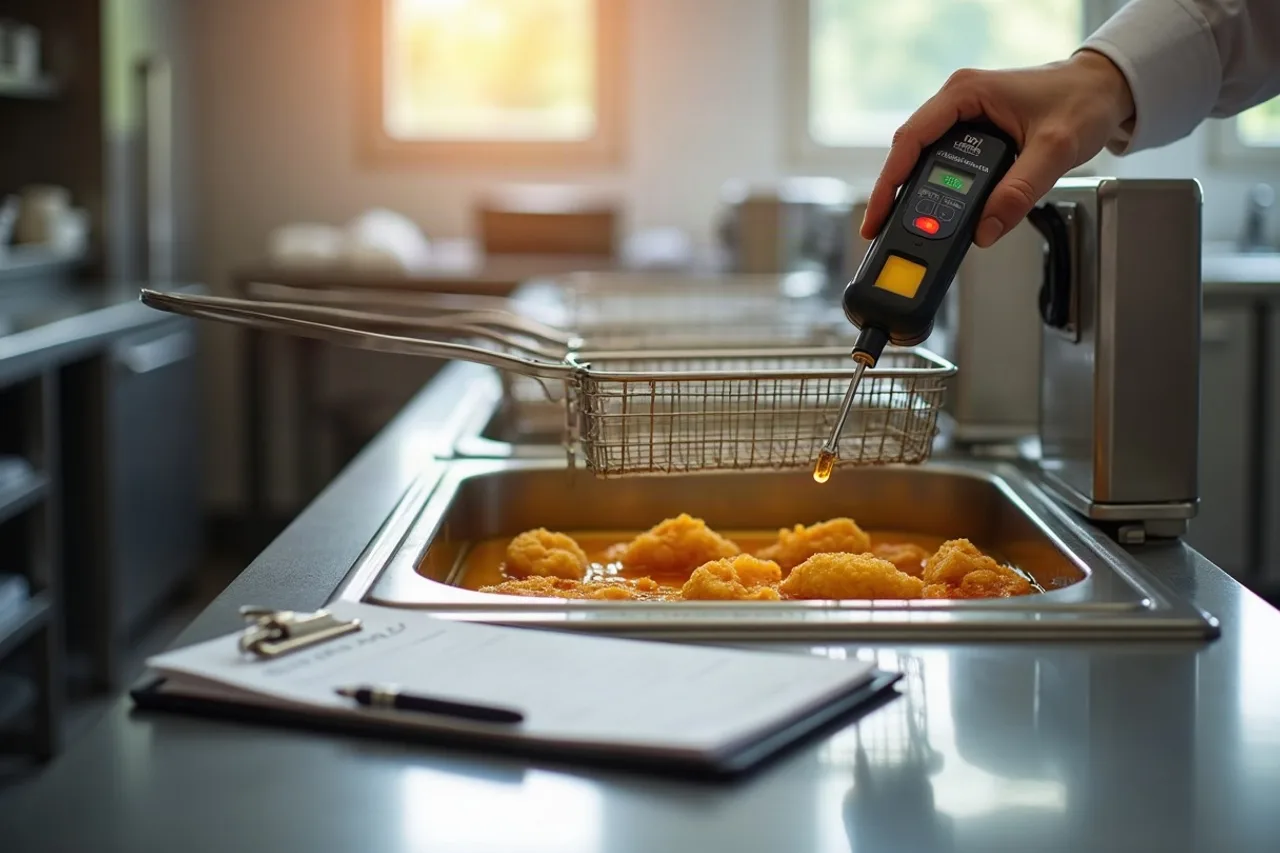
The 25% limit on polar compounds has a basis in a Polish regulation. Check how to measure, when to replace the oil and how to record it in the register.
"We change the oil when it turns dark" - that is the most common answer in the kitchen. The problem is that colour is not the criterion. The criterion is the content of polar compounds, and at an inspection it also matters whether you have recorded when and why you changed that oil.
Below: where the 25% limit comes from, how to measure it on your premises and what to do with the oil after it is poured out of the fryer.
Key points at a glance
- The 25% limit on polar compounds is a hard national regulation, not an "industry standard". It follows from § 2 of the Minister of Health regulation of 25 September 2012 (Journal of Laws (Dz.U.) 2012, item 1096), which is still in force.
- The European Union has not set a common limit for polar compounds. Each country does it on its own.
- An acid value of 2.5 mg KOH/g is a historical criterion - the regulation applied it only until 31 December 2012.
- The regulation does not say how often you must measure. You set the frequency yourself in GHP (Good Hygiene Practice) and HACCP.
- After replacement the oil becomes waste and falls under separate rules: classification, the recipient and records in BDO (Poland's waste database register).
What happens to oil during frying
Oil breaks down along three parallel paths. Oxidation is driven by contact with air, especially when the fryer stands hot with no load. Hydrolysis is driven by water from the product: a frosted frozen item or an insufficiently dried tank. Polymerisation produces a sticky deposit on the walls, foaming and smoking.
The products of all three processes are precisely polar compounds. Their content rises with every hour of operation and cannot be reversed.
Polar compounds: the limit and where it came from
It is a regulation, not a guideline
On the internet the 25% limit most often circulates without a source, as a "standard". In Poland it is a generally binding regulation.
The Minister of Health regulation of 25 September 2012 on maximum levels of contaminants in fats used for frying (Dz.U. 2012, item 1096) states in § 2: "The content of polar compounds in fats may not exceed 25%". It was issued under Art. 17(1) and (3) of the Act on Food and Nutrition Safety (25 August 2006), and in the Journal of Laws it has the status of being in force. It follows from § 1(1) that it concerns fats used for frying food by food business operators, that is, your fryer.
What this regulation does not contain
An EU limit. EU law does not set a harmonised threshold for polar compounds, so in another country the value may be different.
An acid value. The criterion of 2.5 mg KOH/g appears in § 5, but only as a transitional solution until 31 December 2012. If someone sells you "acid value" strips as a Sanepid (the State Sanitary Inspection) requirement, check it yourself.
A schedule. The regulation sets the threshold and the methods, not the frequency of testing.
How to measure: tester, strips, visual and smell assessment
The regulation itself divides testing into two levels. Screening (§ 3(1)) is carried out "using rapid tests". This is exactly the level you work at: an electronic TPM (total polar materials) tester or colorimetric strips. The reference method (§ 3(2) and § 4) comes in only when an exceedance is suspected and is carried out by a laboratory according to the PN-EN ISO 8420 standard, which the laboratories of the Voivodeship Sanitary-Epidemiological Stations have within their accredited scope.
A TPM tester measures at working temperature and requires calibration according to the manufacturer's instructions. A measurement in cold oil or just after topping up will give a result you cannot defend. Measure at the same time and in the same place in the tank. Strips are cheaper and acceptable, but give an approximate reading.
Visual and smell assessment
A dark colour, thickness, persistent foam, smoking below the normal working temperature and a rancid smell are warning signs. Treat them as a reason to measure, never as a substitute for it. Oil with a dark load can look bad at a low TPM, and light oil with a long service life may already be beyond the limit.
How long oil really lasts and what shortens it
I will not give you a number of hours, because an honest number does not exist here. The same oil behaves differently in a fish fryer and in a pastry shop. Look at the factors that shorten its life:
- Temperature. This is where the EU regulation comes in: Commission Regulation (EU) 2017/2158 in Annex II Part A, addressed directly to retail establishments, requires, when frying potato products, a temperature below 175 °C and as low as possible.
- Heating with no load. An empty, hot fryer through the whole afternoon is the most expensive way to use up oil.
- Moisture and ice in a load straight from the freezer.
- Salt and spices sprinkled over the tank.
- Crumbs and breading, which char and speed up the breakdown of the rest.
- Copper and brass in contact with the oil. Stick to stainless steel.
- Mixing loads. Fish, breaded chicken and chips in one tank is the shortest path to replacement.
The logic of supervision here is the same as for the temperatures and critical points of a kebab spit.
Filtering: when it helps and when it only postpones the problem
Filtering makes sense and is even expected. The same Regulation 2017/2158 requires you to "maintain the proper quality of frying oils and fats through frequent cleaning to remove particles and crumbs". So you have a basis for writing it into the procedures as a mandatory action.
It helps when it removes solid particles: breading crumbs, product leftovers, charred deposit. It does not help when you try to use it to rescue oil after the limit has been exceeded. Polar compounds cannot be filtered out, because they are dissolved in the fat. Filtered oil with a content of 28% still has 28%, it just looks nicer.
Topping up with fresh oil works similarly. It dilutes the result, but does not remove the breakdown products.
Template of an oil replacement and check register
The register should answer four questions: when you checked, what the result was, what you did and who is responsible.
| Date | Fryer | TPM result [%] | Visual assessment | Action | Oil quantity [l] | Signature |
|---|---|---|---|---|---|---|
| 02.09.2026 | no. 1 | 14 | no remarks | filtering | - | A.N. |
| 04.09.2026 | no. 1 | 19 | slight darkening | filtering + top-up | 4 | A.N. |
| 06.09.2026 | no. 1 | 26 | foam, smell | full replacement | 18 | A.N. |
| 06.09.2026 | no. 2 | 11 | no remarks | check, no action | - | A.N. |
Three rules that decide whether this register will hold up:
- Record good results too. A register made up only of replacements looks as if you measured only when things were bad.
- Record the value, not an assessment. "OK" is not a measurement result. A number is.
- Set the action threshold lower than the limit. If you react only at 25%, every day of delay means an exceedance.
Keep it the same way as the other HACCP registers in the venue. Next to it sit the table of storage and processing temperatures and the cleaning and disinfection procedure.
What happens after replacement: handing over the waste and BDO
This is where most guides end. Poured-out oil does not disappear, it becomes waste.
Classification. According to the position published on the BDO website (notice of 30 December 2020, supplemented on 9 March 2021), used edible oils from foodservice are municipal waste with code 20 01 25.
The consequence that surprises. Producers of municipal waste are exempt from record-keeping. The notice states explicitly that transporting such oil does not require generating a waste transfer card (KPO) in BDO, and the records are kept by the collecting entity. If someone sells you a "KPO for oil" service, ask about the basis.
When it is the other way round. The same notice indicates that where edible oils are used for industrial purposes, the waste is classified under a different code, for example from group 02 03. Then entry in the BDO Register, records via KPO and the annual report are mandatory. Classification follows the source of the waste, so check the code on the document from the recipient.
What to keep anyway. The agreement with the recipient and the documents of each collection with the date and quantity. If your register shows a replacement of 18 litres and the recipient collected nothing in that period, that is a gap to explain.
The exemption concerning oil does not relieve you of your other waste obligations. Packaging and the SUP (single-use plastics) fee operate independently, as we set out in the text on BDO obligations in foodservice and penalties for failing to meet them.
Frequently asked questions
Is the 25% limit on polar compounds a regulation or an industry recommendation?
It is a generally binding regulation in Poland, following from § 2 of the Minister of Health regulation of 25 September 2012 (Dz.U. 2012, item 1096), which has the status of being in force. EU law does not set a common threshold for polar compounds, so the national regulation applies.
How often must the content of polar compounds be measured?
The regulation does not specify a frequency - it sets the 25% threshold and the testing methods. You set the schedule yourself in GHP and HACCP, depending on the intensity of frying and the type of load, and then you stick to it and document every measurement.
Does filtering the oil extend its usability?
Filtering removes solid particles and slows breakdown, which is why Commission Regulation (EU) 2017/2158 requires frequent cleaning of the oil of particles and crumbs. It does not, however, remove polar compounds dissolved in the fat, so it will not save oil after the limit is exceeded.
Does used oil from a restaurant require a KPO in BDO?
According to the notice published on the BDO website, used edible oil from foodservice is municipal waste with code 20 01 25, and its producers are exempt from record-keeping, so you do not issue a waste transfer card for the oil alone - the recipient keeps the records. It is different for oil used for industrial purposes, classified under a different code. Always keep the collection documents.
Legal status as of: 28 August 2026
Legal basis: Minister of Health regulation of 25 September 2012 on the maximum levels of contaminants that may be present in fats used for frying and the criteria for the analytical methods used to determine them (Journal of Laws (Dz.U.) 2012, item 1096), § 1-5, issued under Art. 17(1) and (3) of the Act on Food and Nutrition Safety of 25 August 2006; Commission Regulation (EU) 2017/2158, Art. 2(2) and Annex II Part A; Act on Waste of 14 December 2012; notice published at bdo.mos.gov.pl of 30 December 2020 with the supplement of 9 March 2021.
Last review: 28 August 2026
Oil is only the beginning of waste obligations
Replacing oil ends with handing over waste, and that draws you into the whole BDO topic: registration, records, the SUP fee and reports. GastroReady has a ready set of documents and registers for this. The documents are sent by e-mail after payment. The oil replacement register itself goes into the HACCP and GHP documentation that Sanepid checks on the premises.