Freezing and Thawing in Foodservice: Rules
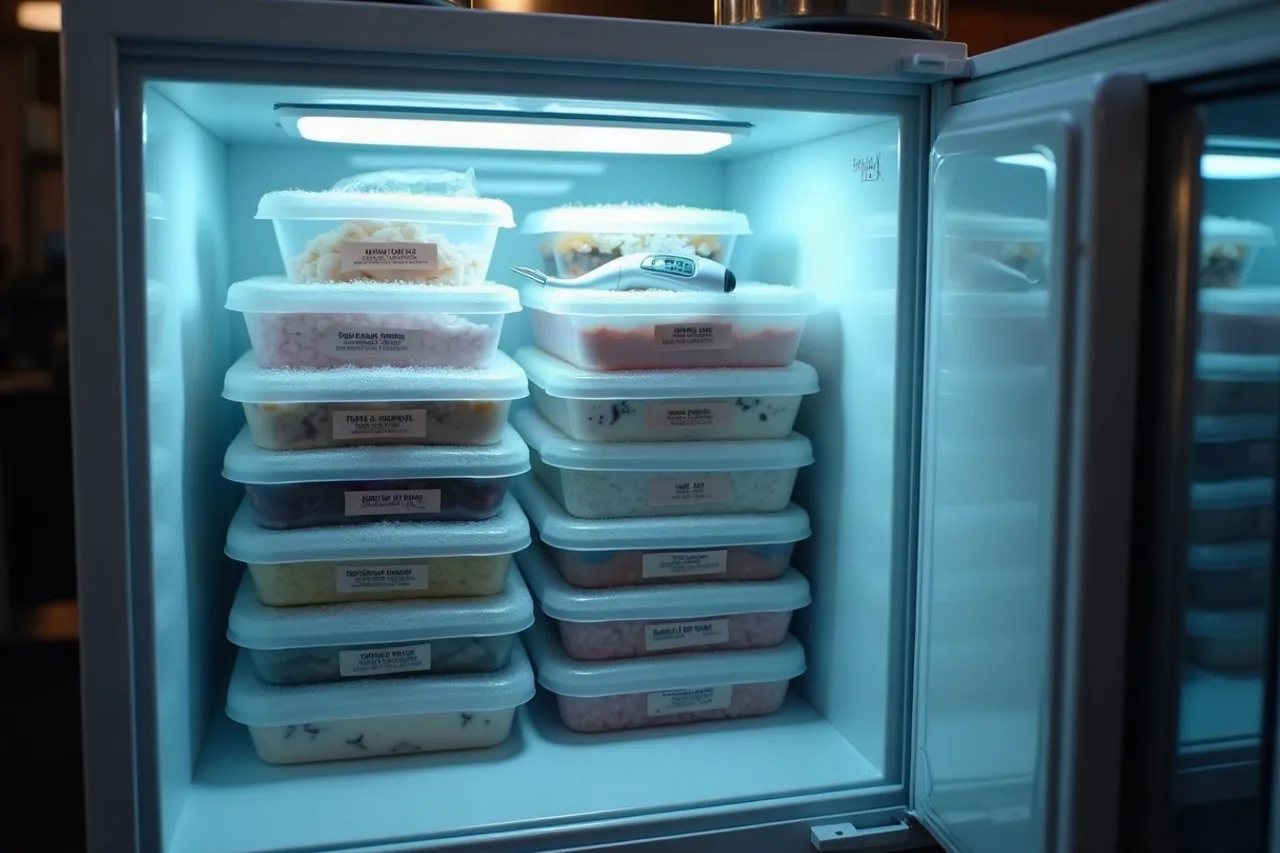
How to thaw and freeze in a venue: the Regulation 852/2004 rule, where -18 °C comes from, raw fish at -20 °C for 24 h, and the dish description.
Freezing saves your margin: it lets you buy in batches, limit losses and prepare semi-finished products in advance. The trouble is that the rules on freezing in foodservice are scattered across several acts, and what circulates in the industry as a "requirement" is sometimes a requirement only for the supplier, or only for a product sold as deep-frozen.
Freezing and thawing in foodservice have one directly worded general provision (thawing in Regulation 852/2004), several specific provisions (raw fish, frozen products as a product category) and plenty of room for decisions that you must justify in your HACCP documentation.
The key points in brief
- Thawing must minimise the risk of growth of pathogens and formation of toxins. During thawing, food must be kept at a temperature that does not pose a risk, and drip, if it may pose a risk, must be drained appropriately (Annex II, Chapter IX, point 7 of Regulation 852/2004).
- The temperature of −18 °C for frozen products comes from the regulation of the Ministry of Agriculture and Rural Development (MRiRW) of 19 September 2003 (§ 3(1): a constant temperature not higher than −18 °C during transport and storage) and Directive 89/108/EEC. It applies to deep-frozen products and is not a general norm for every freezer in a venue.
- The freezing parameters for fish to be eaten raw (−20 °C for at least 24 hours or −35 °C for at least 15 hours) come from Regulation 853/2004. Although that regulation as a rule does not apply to retail, its Annex III, Section VIII, point 2 expressly applies Chapter III, Part D to it, so it covers a restaurant too.
- The supplier of fish intended to be eaten raw must attach a document stating the type of freezing. A recipient who is not the final consumer should request it and keep it.
- If you sell thawed product as fresh, you risk an allegation of misleading (Art. 7 of Regulation 1169/2011).
Thawing: the only direct provision
Annex II, Chapter IX, point 7 of Regulation (EC) No 852/2004 provides that thawing of foodstuffs is carried out in a way that minimises the risk of growth of pathogenic micro-organisms or formation of toxins in the food. During thawing, food must be kept at a temperature that does not pose a risk to health. If drip may pose a risk, it must be drained. After thawing, food must be handled so as to minimise the risk of the same hazards.
The regulation does not specify the method, time or temperature of thawing, and the provision speaks of "minimising risk", not of a specific range. This means you have to justify your choice of method yourself and describe it in your documentation. In practice, venues use a walk-in cold room, running cold potable water, or a microwave before immediate cooking. These are common methods, not a list from the provision. It is worth writing in the procedure: where, at what temperature, for how long, where the drip goes, and what happens to the product after thawing.
Related provisions from the same chapter: point 5 prohibits breaking the cold chain, allowing limited periods outside temperature control if this poses no risk to health, and point 6 requires that foodstuffs to be kept or served at low temperatures be chilled as quickly as possible after the final heat-treatment stage, to a temperature that poses no risk to health. We describe how to record temperatures in the article on the fridge temperature register, and a summary of thresholds in the article storage and cooking temperatures: a table.
Storing frozen products: where −18 °C comes from
The regulation of the Minister of Agriculture and Rural Development of 19 September 2003 on detailed requirements for storage and transport of deep-frozen agri-food products (Journal of Laws (Dz.U.) 2003 No 177, item 1733, amended Dz.U. 2010 No 173, item 1175; listed as in force in ISAP, the Polish legal acts database) requires that "deep-frozen products" in transport and storage be kept at a constant temperature not higher than −18 °C (§ 3(1)). It allows an increase of not more than 3 °C during loading and unloading and for frozen products in refrigeration equipment in retail sale (§ 3(2)). The same value is in Council Directive 89/108/EEC: Art. 1(2) defines "quick-frozen foodstuffs" (product temperature of −18 °C or lower at all points, placed on the market as such), and Art. 5(1) requires it to be maintained, with short fluctuations not greater than 3 °C.
The provision concerns products that are "deep-frozen products" within the meaning of the regulation. We do not decide whether it covers semi-finished products that you freeze yourself in the kitchen. For your own stock, −18 °C is in any case a sensible critical limit to enter in your HACCP.
Temperature monitoring: the national regulation and Regulation 37/2005
Under § 4 of the 2003 regulation, means of transport, rooms and refrigeration equipment are fitted with calibrated instruments that measure and record air temperature at regular intervals, and the measurement documentation is kept at least for the shelf life of the frozen product, but not less than a year (para. 2). In refrigeration equipment in retail sale, temperature is measured with at least one easily readable thermometer (para. 3), and for equipment with a capacity below 10 m3, intended for storing stocks of frozen products in retail sale, measurement may be made with a thermometer without recording (para. 4). Commission Regulation (EC) No 37/2005 is worded the same way (Art. 2-3). Whether a restaurant's freezer room is "retail sale" in this sense is decided by the sanitary station. Keep temperature records for at least a year.
Raw fish: who has the obligation to freeze
Annex III, Section VIII, Chapter III, Part D of Regulation (EC) No 853/2004 requires operators placing on the market fishery products to be eaten raw, or treated insufficiently to kill viable parasites, to have the raw material or the finished product frozen. For parasites other than trematodes, this means lowering the temperature in all parts of the product to at least:
- −20 °C for not less than 24 hours, or
- −35 °C for not less than 15 hours.
Freezing is not required, among others, for products that are heat-treated before consumption in a way that kills parasites (core temperature of at least 60 °C for at least one minute), for fish caught in the natural environment from fishing grounds recognised as safe as regards parasites, if the competent authorities allow it, and for some aquaculture products (point 3). When placed on the market, where the recipient is not the final consumer, the product must be accompanied by a document issued by the operator who carried out the freezing, stating the type of freezing (point 4(a)).
Does this apply to restaurants
Yes, and here it is easy to err in the other direction. Art. 1(5)(a) of Regulation 853/2004 provides that, in the absence of indications to the contrary, the regulation does not apply to retail, and a restaurant is retail within the meaning of Art. 3(7) of Regulation 178/2002. That is, however, a reservation "in the absence of indications to the contrary", and Annex III, Section VIII, point 2 says directly: Chapter III, Parts A, C and D, Chapter IV Part A and Chapter V apply to retail. Part D (the parasite requirements) therefore also covers a venue that serves fish raw or treated insufficiently to kill parasites. The practical conclusion:
- Check whether the fish you serve requires freezing (point 1), or whether an exception from point 3 applies: heat treatment that kills parasites (core temperature of at least 60 °C for at least one minute), fish previously frozen for long enough, fish from a fishing ground recognised as safe with the consent of the competent authorities, or selected aquaculture products.
- Ask the supplier for the document stating the type of freezing (point 4(a)) and keep it with the proof of deliveries.
- If you freeze the fish yourself, apply the parameters from Part D as critical limits in HACCP and record temperature and time.
- Ask your sanitary station how it applies these provisions to venues, and write down the answer. We found no official Polish interpretation for restaurants.
We write about updating documentation for sushi and sous-vide in the article sushi and sous-vide and updating HACCP.
Name and description of the dish: "thawed" versus "fresh"
Annex VI, Part A, point 2 of Regulation 1169/2011 provides that for foodstuffs frozen before sale and sold thawed, the name is accompanied by the designation "defrosted". The requirement does not apply to ingredients present in the final product, to food for which freezing is a necessary technological step, or to food for which thawing has no adverse effect on safety or quality. In a typical restaurant dish, a thawed ingredient is therefore covered by the exception in letter (a). The provision matters when selling individual products, e.g. thawed fish or seafood.
Irrespective of this, Art. 7(1)(a) of the same regulation prohibits information that misleads as to the character and properties of food. The description "fresh fish" or "fresh seafood" for a thawed product carries that risk. We discuss the rules for descriptions in the menu in the article on menu labelling.
What to put in the documentation
- The source of frozen raw materials and proof of deliveries (including the freezing document for raw fish). Register template: delivery register: a template.
- Your own freezing: which products you freeze, how quickly, at what temperature and until when you use them. The general provisions give no permitted storage period or rules on re-freezing, so describe the decision and its justification yourself.
- Labelling of packaging: name, date of freezing, internal use-by date. This is practice, not a provision, but it makes it easier to check rotation.
- The thawing procedure in line with point 7 of Chapter IX: method, temperature, time, drip, further handling.
- A temperature register for the freezer room, with records kept for at least a year, in line with the approach in Regulation 37/2005.
- Response to a failure: what you do with the contents of the freezer room when the temperature rises, and who decides. We describe related cold chain issues in the article on the cold chain in summer.
Frequently asked questions
What freezer temperature is required?
For frozen products, the MRiRW regulation of 19.09.2003 requires a constant temperature not higher than −18 °C in transport and storage, with a permitted increase of not more than 3 °C in specified situations (§ 3). For your own semi-finished products we do not decide the scope of this provision, so adopt −18 °C as a critical limit in HACCP.
How should meat be thawed properly in a restaurant?
The provision (Annex II, Chapter IX, point 7 of Regulation 852/2004) requires thawing in a way that minimises the risk of growth of pathogens, at a temperature that poses no risk, with drip drained if it may pose a risk. Describe the method and temperature in your HACCP procedure.
Can I re-freeze thawed meat?
In the general provisions we checked, we found neither a prohibition nor a permitted period. Regulation 852/2004 requires that after thawing food be handled so as to minimise the risk of pathogens. Enter the decision and its justification in the procedure.
Does fish for sushi have to be frozen?
Fish eaten raw must be frozen to kill parasites (−20 °C for at least 24 hours or −35 °C for at least 15 hours in all parts of the product), unless an exception from point 3 of Part D applies. Part D of Chapter III of Section VIII of Annex III to Regulation 853/2004 applies to retail (Section VIII, point 2), so it covers a restaurant too. Ask the supplier for a document stating the type of freezing.
Do I have to write "thawed" on the menu?
The requirement in Annex VI, Part A, point 2 of Regulation 1169/2011 does not apply to ingredients present in the final product. In a typical dish, a thawed ingredient does not need this designation, but the description "fresh" for a thawed product is misleading.
Legal status as of: 4 October 2026
Legal basis: Regulation (EC) No 852/2004, Annex II, Chapter IX, points 5-7; Regulation (EC) No 853/2004, Art. 1(5) and Annex III, Section VIII, Chapter III, Part D (consolidated version of 9 November 2024); Regulation (EC) No 178/2002, Art. 3(7); Regulation (EU) No 1169/2011, Art. 7 and Annex VI, Part A, point 2; Regulation of the Minister of Agriculture and Rural Development of 19.09.2003 (Dz.U. 2003 No 177, item 1733, amended Dz.U. 2010 No 173, item 1175), § 3-4; Council Directive 89/108/EEC, Art. 1(2) and Art. 5 (consolidated version of 1 January 2007); Commission Regulation (EC) No 37/2005, Art. 2-3. We found no official Polish interpretation of how Part D applies to restaurants, and no act amending Regulation 37/2005 after 2005. Confirm the scope for your venue with the poviat sanitary-epidemiological station.
Last review: 4 October 2026
Do you need complete HACCP documentation?
GastroReady has a ready-made package of HACCP, GMP (Good Manufacturing Practice) and GHP (Good Hygiene Practice) documentation. The documents are sent by email after payment. From 299 PLN.