Acrylamide in foodservice: venue obligations
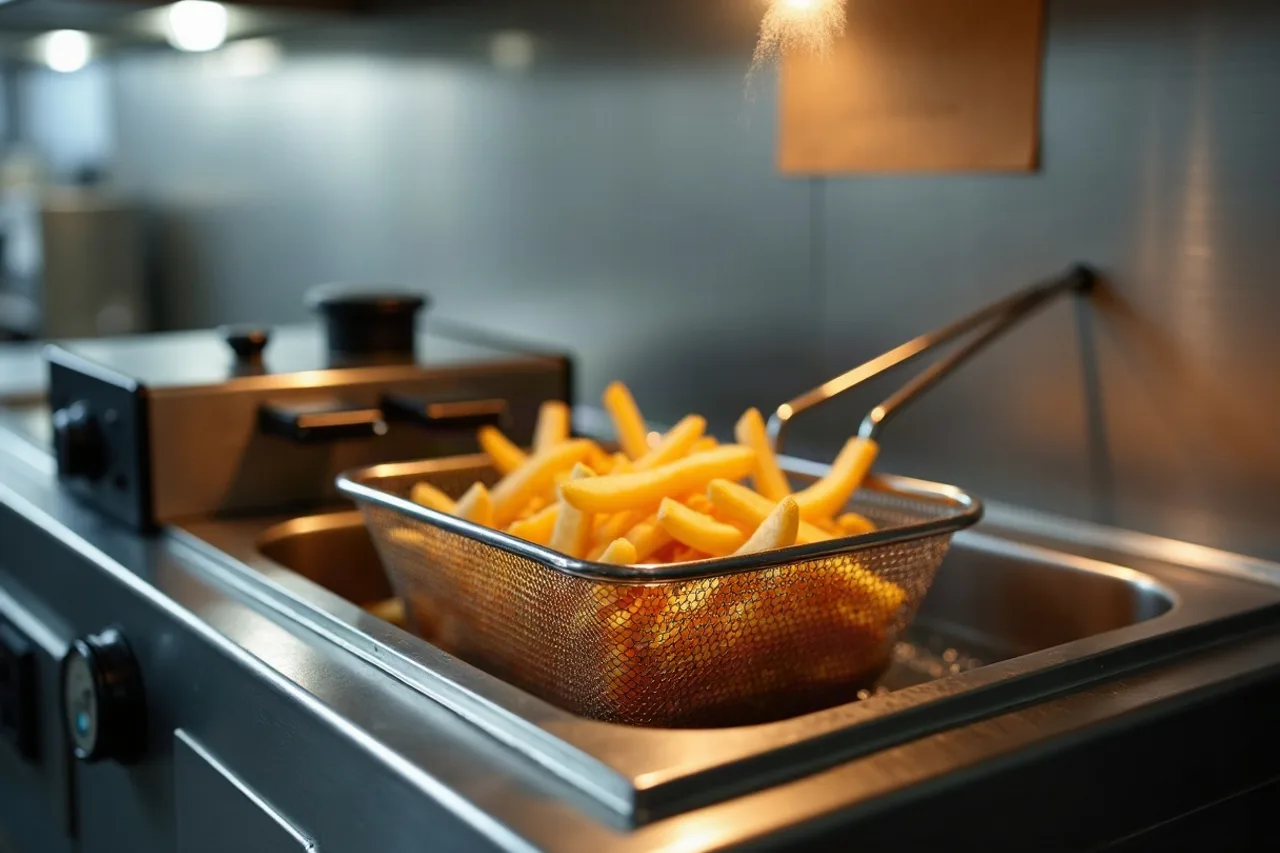
Regulation 2017/2158 also covers small venues. What you must do at the fryer and oven, which numbers are binding and what to add to the HACCP book.
The inspector asks about acrylamide, and you hear the word for the first time. That is what most inspections look like in which this topic comes up at all. The obligation is real, has applied since 11 April 2018 and concerns every venue that fries chips or bakes bread.
The requirements for a small venue are short and doable on a shift, only almost nobody has them described in their documentation. Below are the specifics: what you do at the fryer and the oven and what to add to the HACCP book.
Key points at a glance
- Commission Regulation (EU) 2017/2158 also covers foodservice. Restaurants, bars, canteens and catering are retail in food law, so you apply Annex II Part A, a simplified set of mitigation measures.
- A small venue does not test chips in a laboratory. You must, however, be able to prove that you know the mitigation measures and apply them.
- Hard numbers for chips: potatoes stored above 6 °C, a frying temperature below 175 °C and as low as possible.
- A colour guide at the fryer is the simplest control tool on a shift and the easiest evidence for the inspector.
- Chains and franchises have more: Annex II Part B, a register of measures and sample testing.
What acrylamide is and where it comes from
Acrylamide is a chemical contaminant that forms in the food itself during heat treatment. You do not add it and you do not buy it with a delivery. It forms from asparagine and sugars present in the raw material, at a temperature usually above 120 °C with low moisture, mainly in products rich in carbohydrates: in potatoes, cereals and coffee beans.
The European Food Safety Authority concluded in 2015 that acrylamide in food may increase the risk of developing cancer in all age groups. That is why it is a chemical hazard, described at the frying and baking stage in the description of the dish production process.
Whom the regulation applies to: does it really include a small venue
An independent venue, one kitchen
Yes, it applies. The regulation covers, among others, chips and other cut products deep-fried in fat, bread and bakery products. A restaurant that makes chips produces them within the meaning of this provision.
Art. 2(2) is key. Operators in retail apply not the full Annex I for industry but the shorter Annex II Part A. And retail explicitly includes catering, workplace canteens and restaurants (Art. 3(7) of Regulation 178/2002). Art. 4(6) relieves you of laboratory testing and of a formal register of measures, leaving one requirement: you must be able to prove the application of the measures from Part A of Annex II.
A chain, a franchise, a venue under one trademark
If a venue operates under a single trademark as part of a larger, linked business and is subject to instructions from an operator centrally supplying products, Art. 2(3) applies. Annex II Part B, a register of the measures applied and sample testing are then added. Part B also requires calibrated fryers with computerised timers, but the Commission guidance softens this: the timers may be free-standing and the calibration internal.
Mitigation measures for chips
The core of Annex II Part A, translated into an action on the shift and into evidence for the inspector.
| Mitigation measure | How to do it on a shift | What to record |
|---|---|---|
| A variety with a lower sugar content | Ask the supplier which variety it recommends for frying | The variety in the raw material specification |
| Potatoes above 6 °C | Dry store, not a cold room and not a fridge | Store temperature in the register |
| Reducing sugar in raw chips | Soak the sticks ideally 30 min to 2 hours in cold water or a few minutes in warm water, then rinse | A step in the pre-processing instruction |
| Blanching | Blanch, if the process allows it | A step in the process description |
| Frying below 175 °C | Set the thermostat and check the reading at start-up | The setting in the frying instruction |
| Choice of oil | Ask the supplier which oil lets you fry faster or cooler | Product data sheet or a note |
| Fat quality | Skim off particles and crumbs, filter according to a schedule | Oil filtering and replacement register |
| Frozen products: the manufacturer's instruction | Keep the time and temperature from the packaging, do not fry further by eye | A copy of the instruction at the station |
| Colour of the finished product | Compare the portion with the guide, take the basket out at a golden-yellow colour | A guide at the fryer |
If you work with frozen products, and most venues do, soaking and blanching do not apply to you. The regulation excludes frozen potato products from this requirement and refers to the manufacturer's instruction. Following it then becomes your obligation.
Bread and bakery products
If you bake bread, pizza on your own dough, rolls, biscuits or finish part-baked products, point 2 of Annex II Part A applies to you. You then apply, where possible and consistent with process and hygiene requirements:
- a longer yeast fermentation time
- optimising the moisture content of the dough for a low-moisture product
- lowering the oven temperature and lengthening the baking time
The overriding rule: you bake to a lighter final colour and avoid a dark baked crust if it results from heavy roasting and not from the recipe of a bread that simply has a dark crust. A separate point concerns sandwiches: you toast them to the optimal colour, and for packaged bread you follow the instructions on the packaging.
A colour guide as a control tool on a shift
This is the whole practical value of this provision. You cannot measure acrylamide on a shift, but you can see colour. The colour of the finished chip is linked to the acrylamide level, and it is the only parameter a cook will judge in two seconds, with the basket in hand.
The regulation says explicitly that when preparing chips, available colour guidance should be used and that it should be displayed in a place visible to the staff preparing food. The European Commission points to a specific source: the scale at goodfries.eu.
| Colour of finished chips | Scale values | Decision on the shift |
|---|---|---|
| Light golden | Agtron 65, USDA 0 | Target, take the basket out |
| Golden yellow | Agtron 55, USDA 1 | Still acceptable, do not fry longer |
| Golden brown | Agtron 40, USDA 2 | Too dark, shorten the time or lower the temperature |
Implementation takes one shift. Print the colour card in A4, laminate it and hang it at eye level by the fryer, not in a binder in the office. Agree a rule with the team: we compare the first portion from a new bag and after every oil change, because that changes the time needed to reach the colour.
To be fair: the Commission guidance specifies that for venues under Art. 2(2) and (3), displaying the colour guide is an explicit recommendation, not a legal obligation. But this is exactly the evidence that Art. 4(6) speaks of, and with it you close the topic without laboratory tests.
What to record: instruction, training, check record
The Commission guidance states explicitly that evidence may be the set frying temperature, the use of colour cards or compliance with the manufacturer's instruction. The practical minimum:
- A frying and baking instruction in the HACCP book: a setting below 175 °C, the target colour of the product, the instruction from the packaging of frozen products, potatoes above 6 °C.
- A colour guide at the frying station and at the toaster.
- Team training on this one topic, with an attendance list and signatures. Without it the instruction is a paper nobody has read.
- A check record: the fryer setting and oil filtering and replacement in the current registers.
If your HACCP registers are kept diligently, adding acrylamide is one instruction and one column in an existing record, not a new binder. You can check the settings in the table of processing temperatures, and the scope of the book in the text on what a HACCP book contains. A new dish from the fryer is one of the moments to update the documentation.
What the inspector asks
An inspection rarely starts with the word "acrylamide", but with questions about the process:
- At what temperature do you fry chips and where does that value come from?
- Where and at what temperature do you store potatoes?
- Who decides when to take the basket out, and on what basis?
- How often do you replace and filter the oil, where do you record it?
- Was the team trained in this instruction and is there a signature for it?
The answer "by eye, the cook knows" generates recommendations. The answer "we have an instruction, setting 170 °C, the guide hangs by the fryer, the team was trained in March" closes the topic. The simplest thing is to add this point to the team hygiene training.
Frequently asked questions
Does the acrylamide regulation apply to a small restaurant?
Yes. Regulation 2017/2158 covers operators producing, among others, chips, bread and bakery products, and restaurants and catering fall within the definition of retail. A small venue, however, takes the simplified path under Art. 2(2), that is, it applies Annex II Part A.
Do I have to test chips in a laboratory?
No, if you run retail only. Art. 4(6) exempts operators under Art. 2(2) from sampling and analysis. You must, however, prove that you apply the measures from Part A of Annex II. Testing comes in only for a chain or a franchise with central supply.
At what temperature should chips be fried according to the regulations?
Below 175 °C and as low as possible while maintaining food safety requirements. Store potatoes above 6 °C, because cooling below this value increases the sugar content and thereby the acrylamide level after frying.
Is the reference level of 500 µg/kg for chips a legal limit?
No. The reference levels from Annex IV are indicators of the effectiveness of mitigation measures, and the Commission stresses that they cannot be used directly to assess whether a product may be placed on the market. For ready-to-eat chips the level is 500 µg/kg, for fresh wheat bread 50 µg/kg, and for other fresh bread 100 µg/kg.
Is a colour guide at the fryer mandatory?
According to the European Commission guidance, displaying colour guidance is for foodservice an explicit recommendation, not a legal obligation. In practice it is the simplest evidence of meeting the requirement of Art. 4(6).
Legal status as of: 27 August 2026
Legal basis: Commission Regulation (EU) 2017/2158 (Art. 1(2), Art. 2(2) and (3), Art. 4(6), Annex II Part A and B, Annex IV), applicable from 11 April 2018; Art. 3(7) of Regulation (EC) No 178/2002; European Commission guidance on the implementation of Regulation (EU) 2017/2158.
Last review: 27 August 2026
Need complete HACCP documentation?
With GastroReady you get a ready HACCP, GMP (Good Manufacturing Practice) and GHP (Good Hygiene Practice) documentation package with heat treatment instructions and ready registers. The documents are sent by e-mail after payment. From 299 PLN.