Suspected food poisoning: what to do
A guest reports poisoning after a meal at your venue. What to say, what to secure, whom to notify and how an epidemiological investigation works.
A phone call at 22:40. A guest says that after yesterday's dinner at your place all four of them have a fever and diarrhoea, and one person went to the hospital emergency department. First thought: "that's impossible". Second: "what do I do now".
This text answers the second question. A guest's report is not yet an established poisoning. Between the meal and the symptoms sometimes a few hours pass and sometimes a few days, so the meal named is not always the right one. In the first day you do not decide who is right, you secure the facts.
Key points at a glance
- Do not admit fault and do not deny it. In the first conversation you gather information, you do not make a diagnosis.
- Secure the evidence before it disappears: samples, leftovers of the batch, packaging, delivery documents, registers, CCTV, the shift roster. And never fill in registers retrospectively.
- Your duty to report follows from food law, not from the Act on the Prevention and Control of Infections and Infectious Diseases in Humans (the "infectious diseases act"). Art. 19 of Regulation (EC) No 178/2002 tells you to notify the authorities without delay if you have reason to consider that food you placed on the market may be harmful to health. Cases of illness are reported by the doctor.
- An ordinary restaurant has no obligation to keep samples, but in an investigation a sample is sometimes the only evidence in your favour.
The first 24 hours: order of actions
- Take the report calmly and write it on a form, not on a napkin.
- Stop serving the dish and the batch that the report concerns.
- Secure samples, leftover raw materials and packaging. Throw nothing away.
- Download the CCTV before it is overwritten.
- Copy the registers from the last 7 to 14 days.
- Establish who worked the shift and whether anyone had symptoms.
- Remove from food handling every person with gastrointestinal symptoms.
- Assess whether there is a basis for a report and for a batch withdrawal.
- Notify the insurer and appoint one person for external contacts.
1. The first phone call from a guest: what to say and what not to
These are the riskiest three minutes of the whole case. What you say now may end up in a protocol, in a lawsuit or in a screenshot online. There is one rule: you listen, you write it down, you do not judge. You do not know the cause yet, so do not pretend you do.
What to write down during the conversation
- First name, surname and phone number of the person reporting.
- Date and time of the meal, table number or receipt number.
- Exactly what they ate and drank, all persons at the table.
- How many people have symptoms and how many do not, despite the same dish.
- What symptoms, from what hour, whether anyone is hospitalised.
- Whether within the day they ate anything outside your venue.
- The date and time of the report and who took it.
Sentences you can say
- "I am very sorry that you feel this way. I take it seriously."
- "I am writing everything down and today I will check the documentation from that day."
- "If the doctor recommends tests, please have them done. It will help establish the cause."
- "I will get back to you as soon as I have checked the batches and records."
Sentences better left unsaid
- "It must be those prawns, I apologise." An admission of a cause you do not know.
- "Definitely not from us." Sounds dismissive, and with further reports like a lie.
- "We will cover the cost of treatment." A financial commitment before the facts are established may make it harder for the insurer to handle the claim.
- "We will give you a voucher if you do not report it." Looks like an attempt to cover the matter up.
- "Please delete that review." Never.
Decide in advance who takes such calls, and keep the form in the binder with the registers. If the word "hospital" comes up, or a second independent person from that day calls, the matter stops being a complaint.
2. What to secure immediately
Evidence disappears on its own: a sample goes in the bin during cleaning, CCTV is overwritten after a dozen or so days, packaging ends up in waste sorting.
| What to secure | Who | For how long |
|---|---|---|
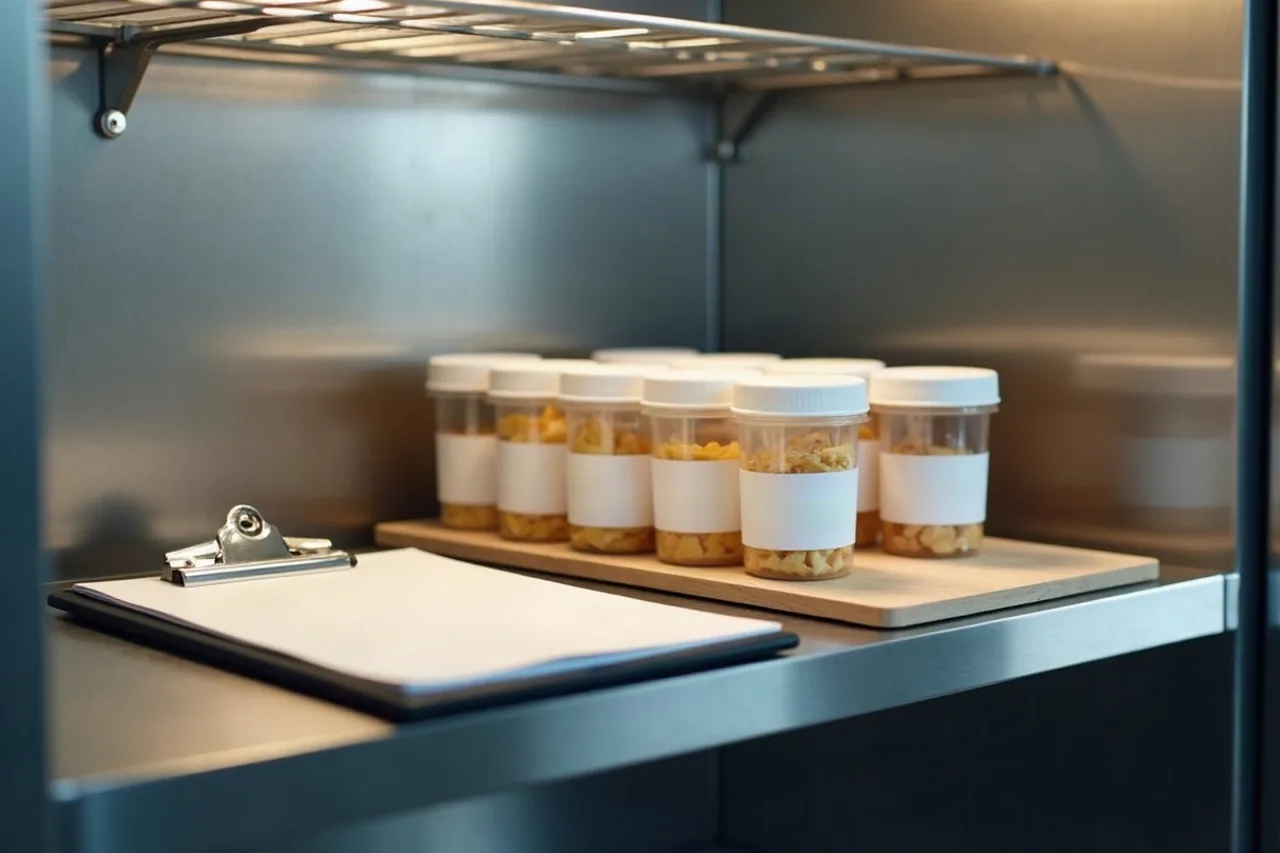
| Samples of dishes from that day, if you take them | Person in charge of samples | Until the end of the case, chilled and under lock |
| Leftover raw materials, packaging, labels and batch numbers | Head chef | Until the end of the case, labelled and separated |
| Delivery documents and registers from this week | Person in charge of documentation | Copies in the folder, originals in the book |
| CCTV recordings | Owner | A separate storage medium on the same day |
| Shift roster and the report form | Manager | A copy in the folder |
Two things are forbidden: "tidying" cleaning beyond the standard, because it destroys traces that could clear you, and filling in registers retrospectively.
3. Whom to notify and when
Cases of illness are reported to the sanitary inspector by the doctor, not by you. Your obligation follows from Art. 19 of Regulation (EC) No 178/2002: when you have reason to consider that food you placed on the market does not meet safety requirements, you immediately start a withdrawal and notify the authorities. The competent body is the county sanitary-epidemiological station.
Also notify the insurer, because liability insurance contracts have short deadlines for reporting a claim, and the supplier, if the suspicion concerns a specific raw material. Solid batch traceability lets you quickly say where the goods came from.
4. What an epidemiological investigation looks like
- The signal: reports from doctors, from a hospital or from the sick.
- Interviews with the sick. Inspectors establish what and where each person ate and when the symptoms appeared. They may demand information about the sick and contact persons from anyone who holds it (Art. 32a of the infectious diseases act).
- An inspection at the premises, usually unannounced. It resembles an unannounced Sanepid inspection (Sanepid is the State Sanitary Inspection), but the questions concern one day.
- Collection of material, tests and comparison of the results from the sick with the results from the venue.
- Decisions. What to do with them, we describe in the text on the Sanepid post-inspection decision.
5. What Sanepid collects and what it tests
- samples of dishes and raw materials from the suspect batch, if they still exist,
- sanitary swabs from countertops, boards, knives, equipment and the staff's hands,
- water samples, if the installation raises doubts,
- material from staff to test for carrier status,
- documentation from the period covered by the investigation.
A person with contraindications to work that risks transmitting infection must have that work taken away immediately by the employer (Art. 10 of the infectious diseases act). Do not wait for the authority: a cook with diarrhoea is removed the same day.
6. Documentation as a defence
Documentation will not prove that nobody was poisoned. It moves the conversation from guesses to facts and shows that supervision existed before the illnesses. The ones that work hardest:
- Temperature register of refrigeration equipment. The cold chain is the first suspect in almost every investigation.
- Goods receipt records and batch traceability. From whom, when and at what temperature the raw material arrived.
- Cleaning and disinfection registers and CCP (critical control point) monitoring. Evidence that the process was supervised on an ongoing basis.
- Staff health and training. Sanitary-epidemiological examination certificates and training confirmations.
The credibility criterion is not the thickness of the binder but continuity. Three weeks of empty columns and one perfectly filled day is worse evidence than clumsy but daily records.
7. When the case goes further
Administratively: decisions by the inspector and financial penalties under the Act on Food and Nutrition Safety (25 August 2006), set among other things according to the degree of harmfulness of the act, culpability and the scope of the violation. In the case of a direct threat to health, the inspector may order the withdrawal of food from circulation or the shutdown of the establishment, with immediate enforceability (Art. 27(2) of the Act on the State Sanitary Inspection). More in the text on Sanepid fines.
Criminally: the Criminal Code provides for liability for causing a danger to the life or health of many persons, among other ways by placing harmful foodstuffs on the market (Art. 165 § 1(2) of the Criminal Code) and, separately, for unintentional acts (§ 2).
Civilly and in insurance: the sick may seek compensation on general principles of civil law. Whether a policy stands behind you depends solely on your general terms of insurance: check in them the scope of cover, the deadline for reporting a claim, the sum insured, the deductible and the exclusions. Now, not in a crisis.
This article is informational and is not legal or insurance advice. The scope of liability and cover depends on the facts of the case and the content of the contract.
8. Communication with guests and on social media
Crises rarely kill a venue by the poisoning alone. What kills it is what the owner writes at one in the morning under a Google review.
Four rules before you write anything
- One voice. One person speaks to guests, the media and the inspector. Three versions are a ready-made headline.
- You do not announce results you do not have. While the investigation continues, you do not write "the tests showed nothing".
- You do not disclose the guest's data. Neither the name nor the state of health. It is sensitive data.
- You do not buy silence. No vouchers for deleting a review or dropping a report.
What to do with a public review
Do not delete it just because it is inconvenient. A deleted comment comes back as a screenshot captioned "they delete reviews". Reply briefly, publicly and without emotion, and move the details to private contact:
"We are sorry that you felt this way. We are checking the documentation and deliveries from that day and remain in contact with the relevant services. Please contact us at [e-mail address]."
That is all. No diagnoses and no personal digs. With further comments, reply the same way.
The journalist and the team on the floor
Do not say "no comment", because it sounds like an admission. Say that the matter is being clarified and ask for questions in writing. Give the waiters one sentence: "The matter is being clarified, I can ask the manager".
9. What to do afterwards
Go back to the hazard analysis and check whether the stage the report concerned was described in it. Often it was not, because the process changed over the year and the documentation did not. Do a written review: what was established, what we are changing, who is responsible and by when. Then update the HACCP book.
Frequently asked questions
Do I have to report to Sanepid that a guest has reported poisoning?
Cases of illness are reported to the sanitary inspector by the doctor. Your obligation is Art. 19 of Regulation (EC) No 178/2002: when you have reason to consider that your food may be harmful to health, you notify the authorities, withdraw the batch and cooperate with the inspectorate. With several independent reports from one day, or with hospitalisation, this threshold is usually met.
Does a restaurant have to keep food samples?
No. The provision concerns closed-type mass catering establishments, among others hospitals, nurseries, kindergartens, schools and workplace canteens. Since 11 March 2010 (a change introduced by the act of 8 January 2010, Journal of Laws (Dz.U.) 2010 No. 21, item 105), Art. 72(1) of the Act on Food and Nutrition Safety has said that such an establishment "may keep" samples of dishes, and an establishment placing on the market dishes from another establishment keeps samples from every batch. A restaurant and a food truck do not have this obligation, but samples are an effective defence anyway.
How are samples stored?
The Minister of Health regulation of 17 April 2007 requires taking a sample of each component part of a dish at the end of portioning, not less than 150 g for the groups of dishes listed in it. Samples are kept in tightly closed containers for at least 3 days from the moment the batch was consumed or received into the establishment, at +4°C or lower, in a designated place. Label on the container: contents, date and time of preparation, details of the person taking the sample.
Can Sanepid close the venue straight away?
It can, if the violation causes a direct threat to the life or health of people. Art. 27(2) of the Act on the State Sanitary Inspection allows it to order the withdrawal of food from circulation or the shutdown of the establishment or part of it, with immediate enforceability. An appeal does not suspend enforcement.
Legal status as of: 12 November 2026
Legal basis: Regulation (EC) No 178/2002 (Art. 19); Act on Food and Nutrition Safety (consolidated text Dz.U. 2026, item 1399; Art. 72, whose paragraphs 1-4 have the wording given by the act of 8 January 2010, Dz.U. 2010 No. 21, item 105, in force from 11 March 2010); Ministry of Health regulation of 17 April 2007 (Journal of Laws (Dz.U.) 2007 No. 80, item 545); Act on the Prevention and Control of Infections and Infectious Diseases in Humans (Art. 10, 27, 32a); Act on the State Sanitary Inspection (Art. 27); Criminal Code (Art. 165). The review of 12 November 2026 covered Art. 72 in the consolidated text Dz.U. 2026, item 1399 and in the act of 8 January 2010; we did not recheck the other acts on this list since the review of 26 August 2026.
Last review: 12 November 2026
A full set of registers before you need them
In an investigation, what counts is not what you remember but what you have written down. The Shield package is a complete HACCP, GMP (Good Manufacturing Practice) and GHP (Good Hygiene Practice) documentation set with registers, a pre-inspection checklist and PL/EN instructions. The documents are sent by e-mail after payment.