Food batch withdrawal: procedure and template
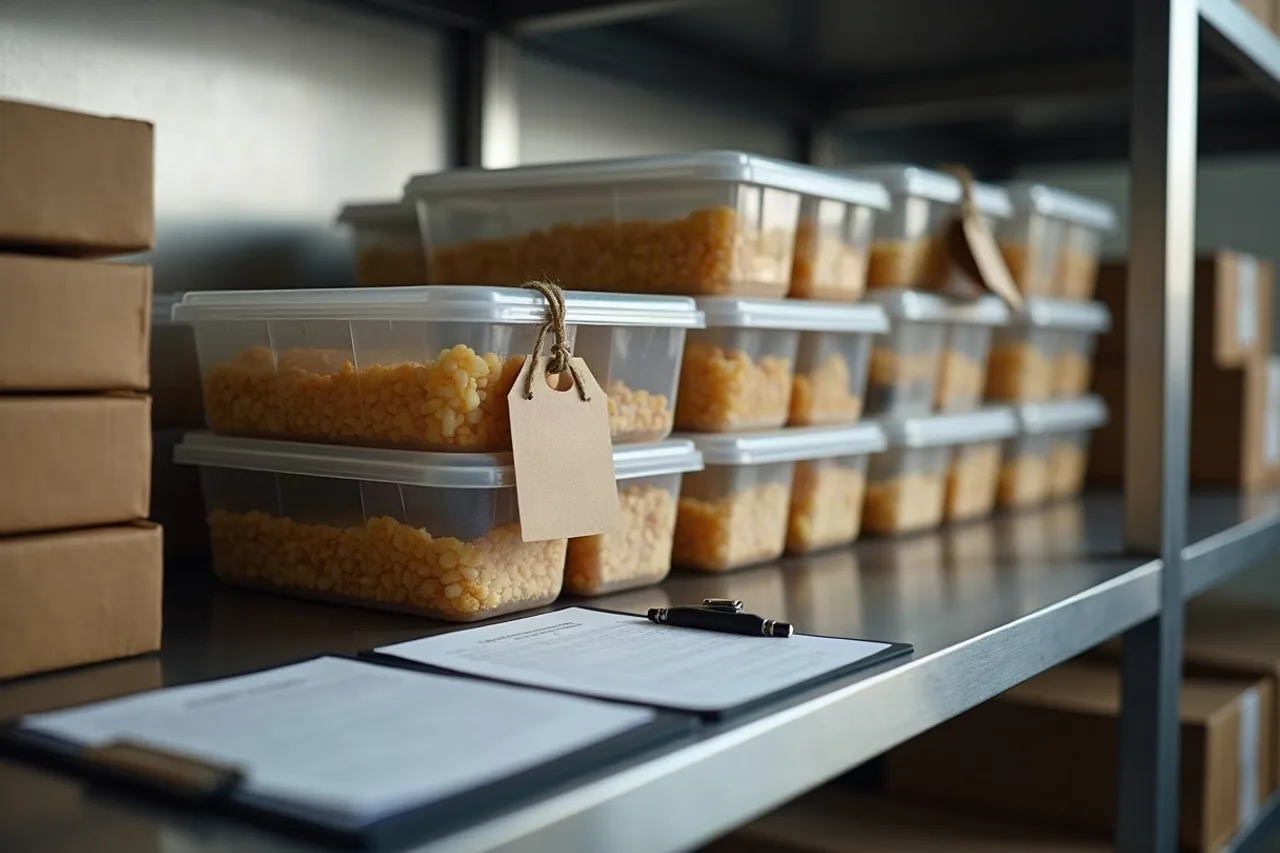
When you start a batch withdrawal, whom you notify and in what order. A withdrawal protocol template and ready wording of the notification to Sanepid.
A phone call from a supplier at 16:40 on a Friday: "batch 2417 withdrawn, you have it with you". Or an e-mail before a franchise audit: "please send your withdrawal procedure". The question is the same. Can you say within an hour how much of this product you received, how much is left in stock and how much went out onto plates.
Below is the whole food batch withdrawal procedure for foodservice, with a protocol template and ready-made wording of the notifications.
Key points at a glance
- The obligation follows from Art. 19 of Regulation (EC) No 178/2002. When you have reason to consider that food you placed on the market does not meet food safety requirements, you immediately start the withdrawal and notify the competent authorities.
- The regulation says "immediately", not "within 24 hours". A day is an operational framework, not a statutory deadline.
- The real boundary runs elsewhere than most people think. Not between a "withdrawal" and a "withdrawal from circulation", but between pulling a batch from the market and recalling products from consumers.
- Without traceability a withdrawal cannot be closed. Art. 18 requires identifying the supplier and the recipient of the batch. Without a delivery register you will not be able to fill in the protocol.
Withdrawal, withdrawal from circulation, recall from consumers
"Withdrawal from the market" is the wording of Art. 19(1) of Regulation (EC) No 178/2002. An operator who has reason to consider that food it has processed or distributed does not comply with food safety requirements "shall immediately initiate procedures to withdraw the food in question from the market" and shall inform the competent authorities of this.
"Withdrawal from circulation" is the wording of the Polish Act on Food and Nutrition Safety (25 August 2006), which in Art. 103(1)(3) penalises anyone who "does not withdraw from circulation a foodstuff harmful to human health or life, a spoiled foodstuff or an adulterated foodstuff". It is the same action, named in a second legal act.
The third thing is really separate. Art. 19(1) adds: where a product may already have reached the consumer, the operator "shall inform consumers of the reason for its withdrawal" and, if necessary, "recall from consumers products already supplied to them". The industry calls this a recall.
Why this boundary is sharp in foodservice
A restaurant, canteen and caterer fall within the definition of retail in Regulation 178/2002. Art. 19(2) concerns operators whose activities do not affect the packaging, labelling, safety or integrity of the food. Your venue operates in two modes at once. A drink resold in intact packaging falls under paragraph 2. A sauce cooked from this batch and served as the dish of the day falls under paragraph 1, and the responsibility is then yours.
When you start the procedure: five real situations
- A supplier reports a batch withdrawal. You check whether you have it and what you did with it.
- A public warning from the Chief Sanitary Inspectorate (GIS). The inspectorate publishes public warnings concerning food with the batch number. Someone in the venue must read them.
- A foreign body at your premises or at a guest's. If the source is a raw material, the matter concerns the whole batch.
- A broken cold chain. An overnight cold room failure, a delivery at too high a temperature. The batch is suspect even without testing.
- An allergen error. A recipe change at the supplier, a mixed-up package. The withdrawal also covers dishes made with this raw material.
The first 24 hours: what you do in what order
This is an operational sequence, not a statutory deadline.
- Block the batch physically. Remove it from the stations, separate it, mark it with a note "BLOCKED, DO NOT USE" with the date and signature.
- Establish the identity of the batch. Name, supplier, batch number, expiry date, delivery document.
- Calculate the balance. How much you received, how much you have in stock, how much you used. These numbers must add up.
- Answer whether the product could have reached a guest. This determines whether informing consumers is added.
- Notify the county sanitary-epidemiological station if you have reason to consider the food may be harmful to health. Art. 19(3) requires immediate notification.
- Notify the supplier and B2B recipients: a second location, off-site catering, a corporate client.
- Launch a message to guests if step 4 came out "yes".
- Secure the evidence. Photos of the label, a sample, delivery documents, the temperature register.
- Write up the protocol as you go. Times recorded during the process distinguish credible documentation from one reconstructed from memory.
Whom you notify and in what form
The official addressee is the official control authority competent for the establishment, in foodservice the county sanitary inspector. The regulations do not impose an official notification form on the business. Practice holds up: a phone call for speed, immediately followed by an e-mail with the same content so that a trace remains with the date and time. B2B recipients receive the information in writing, consumers only if the product could have reached them. A vague "a quality problem has occurred" does not meet the condition of effective and accurate information.
Without a delivery register you will not close the withdrawal
Art. 18 of Regulation 178/2002 requires a system that lets you identify from whom you received food and to whom you passed it on. One step back and one step forward. Tracing forward does not cover the final consumer, so you do not identify the guest at the table, but you do identify the batch of goods and the B2B delivery.
A withdrawal is therefore decided at goods receipt, not on the day of the supplier's phone call. Start with the minimum batch traceability in a venue, complete the delivery register using a ready template and tie it all together with the goods receipt checklist.
Batch withdrawal protocol template
This is not an official form but a list of fields that you will have to reconstruct at an inspection anyway.
| Protocol field | What you enter |
|---|---|
| Case number and date | Consecutive number, date and time the proceedings were opened |
| Person in charge | First name, surname, job title, phone |
| Source of information | Supplier / GIS warning / guest report / internal check |
| Product | Trade name, producer, supplier |
| Batch identification | Batch number, best-before or use-by date |
| Reason for withdrawal | Microbiology / foreign body / allergen / temperature |
| Quantity received | Per the delivery document, with the date of receipt |
| Quantity blocked | Actual stock, place, marking, time of blocking |
| Quantity used in production | How much went into dishes, on which days and shifts |
| Quantity passed on | B2B recipients: name, address, date, quantity |
| Balance | Received minus blocked, used and passed on. A difference requires explanation |
| Could it have reached a consumer | YES / NO plus a short justification |
| Notifications | Who, when, by what route, whether there is confirmation of receipt |
| Fate of the batch | Return / disposal / release, plus the document |
| Corrective actions | What you change, who is responsible, by when |
| Closing the case | Date, time, signature of the person in charge |
Template of notification to the sanitary-epidemiological station
To: County State Sanitary Inspector in [city]
Re: notification of the withdrawal of a batch of a foodstuffActing under Art. 19 of Regulation (EC) No 178/2002, I inform you of the start, on [date], at [time], of proceedings to withdraw the batch of food described below.
Establishment: [name, address, number in the register of establishments].
Product: [trade name], producer [name], supplier [name].
Batch: [number], [best-before / use-by] date [date].
Reason: [e.g. information from the supplier about the possible presence of a foreign body].
Quantity received / blocked / used / passed on: [data], summary attached.
Could it have reached a consumer: [YES/NO], justification: [text].
Actions taken: [blocking, notification of the supplier and recipients, message for consumers].
Contact person: [first name, surname, phone, e-mail].
Template of notification to a B2B recipient
Subject: URGENT, withdrawal of batch [product name], batch [number]
The batch [product name, number, expiry date], delivered to you on [date] in a quantity of [quantity], is covered by a withdrawal due to [reason].
We ask you to immediately: 1) stop use and sale, 2) separate and mark the goods, 3) check whether the product went any further, 4) confirm with the quantity remaining with you and the quantity used.
Confirmation to [e-mail] by [date, time]. Contact: [first name, surname, phone].
What Sanepid does after your notification
The notification goes to the official control authority (Sanepid, the State Sanitary Inspection), not directly to RASFF (the EU Rapid Alert System for Food and Feed). Under Art. 85 of the Act on Food and Nutrition Safety, the RASFF network is run by the Chief Sanitary Inspector, who maintains the national contact point and notifies the European Commission. You are at the beginning of this chain.
Next, the inspectorate assesses the information, may carry out an inspection, take samples and demand traceability documentation. When the product is on the wider market, the case may end with a GIS public warning.
The other side of the equation is Art. 103(1)(3) of the act: a financial penalty for failing to withdraw from circulation a foodstuff harmful to human health or life, spoiled or adulterated. It reaches thirty times the average monthly salary in the national economy for the previous year, and here it may be imposed up to five times the gross value of the challenged quantity. It is imposed by the Voivodeship State Sanitary Inspector.
How to write the procedure in the book so that it passes an audit
A procedure in the HACCP book should answer four questions: who decides, in what order we act, whom we notify, on which form we record it. In addition, two things that B2B auditors ask about most often: a named list of emergency contacts and evidence that the procedure was rehearsed as a dry run.
The test is simple. You take a random product from the fridge and try, within a set time, to reconstruct the path: from whom, when, how much, where it went. You record the result and the time.
Also check what a HACCP book should contain, how to keep registers so that data can be reconstructed, and, for a questionnaire from a franchisor, what a B2B audit requires.
Frequently asked questions
What is the difference between a withdrawal and a withdrawal from circulation?
They are two names for the same action in two legal acts. Regulation (EC) No 178/2002 speaks of withdrawal from the market, and the Act on Food and Nutrition Safety of withdrawal from circulation. The real difference lies elsewhere: between pulling a batch from the market and recalling products from consumers.
Does a small restaurant need a written withdrawal procedure?
The duty to act follows from Art. 19 of Regulation 178/2002 and does not depend on the size of the venue. The regulations do not impose a document template, but without a written procedure and protocol you will not be able to document that you carried out the withdrawal.
Whom do I notify first: Sanepid or the supplier?
First you block the batch, because that stops the harm. Notifying the official control authority is an obligation under Art. 19(3) when the food may be harmful to health. You notify the supplier in parallel, not instead.
What if I do not know how much of this batch I served to guests?
You assume the worst case, that is, that the product could have reached a consumer, and describe the case that way in the protocol. Along the way you learn where you have a gap in your registers.
Do I report anything directly to the RASFF system?
No. RASFF is a network for exchanging information between authorities. It is run by the Chief Sanitary Inspector, who maintains the national contact point and notifies the European Commission. Your notification goes to Sanepid.
Legal status as of: 25 August 2026
Legal basis: Regulation (EC) No 178/2002 (Art. 3(7), Art. 18, Art. 19); Act on Food and Nutrition Safety of 25 August 2006 (Art. 85, Art. 103(1)(3) and (2)(1), Art. 104).
Last review: 25 August 2026
Need a ready withdrawal procedure in your HACCP book?
The Shield package contains HACCP, GHP (Good Hygiene Practice) and GMP (Good Manufacturing Practice) documentation with procedures for responding to non-conformities, corrective action templates, registers and a pre-inspection checklist. Editable files, PL/EN, available to download after purchase.