The Cold Chain in Winter
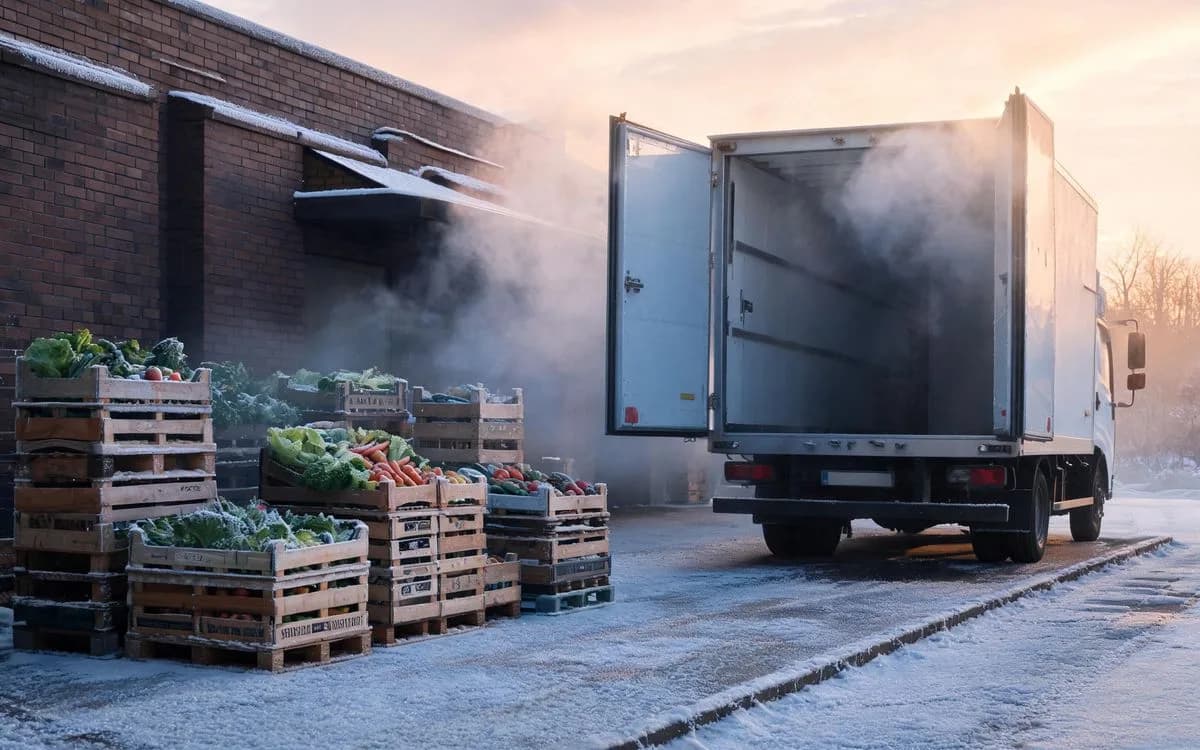
Frost is no ally of your chiller. Partial freezing, freeze-thaw cycles, cold store rooms and a breakdown over the holidays - what to change for winter.
In summer everyone watches the fridges, because the hazard is obvious. In winter vigilance drops, because "it is cold anyway" - and that is exactly why December non-conformities in temperature logs are so common. Frost is not an ally of the cold chain. It is simply a different failure of the same system.
Partial freezing is damage too
Chilled products have a storage range with a lower bound, not only an upper one. Lettuce, eggs, dairy, vegetables and many fresh products lose structure below zero - and after thawing they look fine for a while, then spoil faster than they should.
Typical places where this happens in winter:
- A delivery waiting at the back door. Crates left on the loading bay "for ten minutes" at minus five is real freeze damage.
- An unheated store room. A room that held 18°C in summer can drop to a few degrees or lower in winter. Dry goods have storage requirements too.
- A chiller on an external wall. Refrigeration works on a temperature differential; at very low ambient temperatures some units run unstably and can drop below their setpoint.
The freeze-thaw cycle
The real danger is not frost itself but fluctuation. A product that partially froze in transit, thawed at the back door and went back into the chiller has been through a complete cycle that nobody recorded. Its structure is damaged, moisture has been released, and conditions for microbial growth after thawing are better than in a product that never froze.
So on winter deliveries it is worth checking not only whether it is cold but whether it is too cold - and recording both situations as a non-conformity. We set out goods-in rules in our goods receipt checklist.
What to change in the procedure for winter
This is not about writing separate documentation, but about making the existing documentation cover winter conditions too:
- Two-sided limits in the delivery log. If your procedure says "delivery temperature no higher than X", add a lower bound for chilled products.
- Time on the loading bay. Define a maximum time from unloading to going into the chiller and enforce it as in summer, only for a different reason.
- Dry store monitoring. If the room can drop below the required range in winter, that is a point to monitor, not to ignore.
- Response to a part-frozen product. Write down what you do: accept with reservation, refuse, or raise a complaint. Without that, the decision gets made at the loading bay and nobody records it.
The way records are kept is unchanged from the rest of the year - see our guides to refrigerator temperature logs and the delivery log.
The heating season works the other way
In winter the kitchen is warmer than in summer, counter-intuitive as that sounds. Heating plus closed windows plus hard-working ovens raise the temperature at the pass and on work surfaces. Products waiting to be prepared stand in warmer surroundings, and ventilation runs with the windows shut.
This is worth verifying by measurement rather than by feel. If the temperature in your preparation area rises during the heating season, the permissible exposure time for products genuinely shortens.
Breakdowns happen at the worst moment
The holidays and the turn of the year are when refrigeration engineers work reduced hours and your stores are full ahead of New Year's Eve. Two things are worth arranging in advance: a service contact with confirmed availability over the holiday period, and a procedure for chiller failure - where you move stock, how you document the interruption, and on what basis you decide what happens to the products.
A record of the failure together with the corrective action taken is exactly what an inspector expects in the non-conformity log. Its absence, alongside evidence of a power interruption, looks considerably worse than the breakdown itself.
Frequently asked questions
Do temperature logs have to be kept in winter as in summer?
Yes. The monitoring obligation does not depend on the season, and winter adds hazards summer does not have - partial freezing of chilled products, unstable compressor operation at low ambient temperatures, and cold store rooms.
Can I accept a product that partly froze in transit?
The decision is yours as the recipient and should follow an established procedure rather than improvisation at the loading bay. Partial freezing of a chilled product is a departure from storage conditions that should be recorded as a non-conformity and resolved under your agreed rules - conditional acceptance, refusal, or a complaint to the supplier.
Does frost outside replace a chiller?
No. Food storage requires a controlled and documented temperature, and weather is neither controlled nor stable. Keeping products outdoors or in an unheated room without temperature monitoring is a non-conformity.
What should I record when refrigeration fails?
The date and time the failure was found, the measured temperature, how long the interruption lasted, the action taken (moving stock, calling out an engineer) and the decision on the stored products with your reasoning. An entry in the non-conformity and corrective action log is proof the system worked.
Records that cover the whole year
Documentation describing only summer hazards does not describe your kitchen in December. GastroReady supplies a complete set of HACCP, GMP and GHP records and procedures with PL/EN instructions. From 299 PLN.