Fire safety rules and PSP acceptance
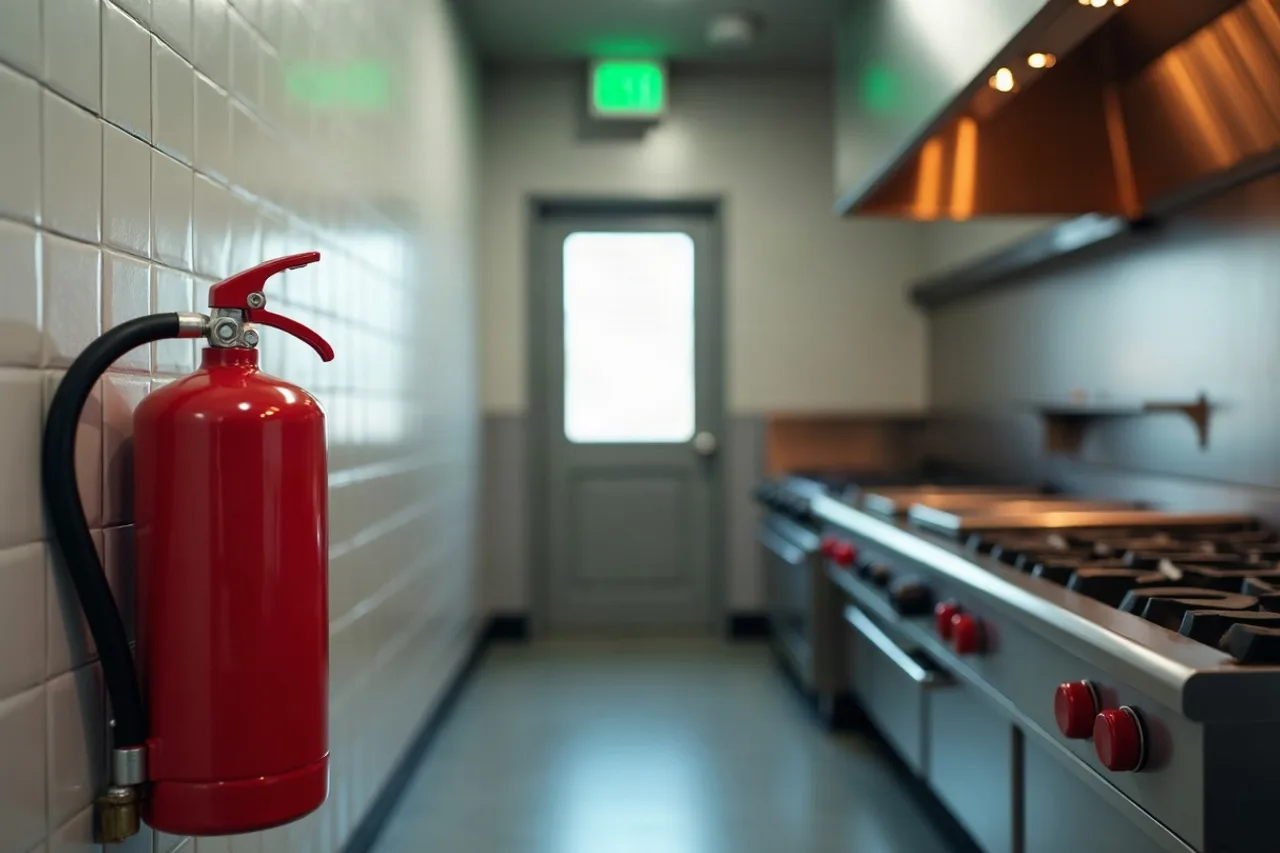
Class F extinguisher, monthly chimney cleaning, annual gas inspection and PSP acceptance. A fire safety document table for foodservice venues.
Sanepid (the State Sanitary Inspection) comes for the food. The fire service comes for the equipment and the protocols. Venue owners mix up these two inspections all the time: a HACCP binder polished down to the last detail, and an empty slot where the chimney sweep's protocol should be. Below are the fire safety requirements for a foodservice business and a table of documents: how often, and who signs.
Key points at a glance
- Notifying the State Fire Service (PSP) of the completion of construction is mandatory only if the project required fire safety approval. A dining room for more than 50 guests usually triggers this.
- In the kitchen you need a fire extinguisher for fire class F, that is, fats and oils in kitchen appliances. ABC powder alone does not cover this.
- The standard: 2 kg (or 3 dm³) of extinguishing agent for every 100 m² of a ZL I, ZL II, ZL III or ZL V zone, with a reach of up to 30 m.
- Smoke and flue ducts from foodservice hearths are cleaned at least once a month, ventilation ducts once a year.
- Inspection of the gas installation and chimneys: once a year. Electrical installation: once every 5 years. This is the duty of the owner or manager of the building, not the tenant.
When a PSP acceptance is needed and when it is not
A universal "fire service acceptance of the premises" does not exist. What exists is a notification of the completion of construction and of the intention to start using the building, submitted to the county (city) commander of the PSP. Under Art. 56 of the Construction Law, you have this obligation only if the project required fire safety approval. The Ministry of the Interior and Administration regulation of 5 August 2023 lists the cases relevant to foodservice:
- a fire zone ZL I, ZL II or ZL V. ZL I is a zone with a room for more than 50 people who are not permanent users, that is, a typical larger restaurant dining room;
- the building must have a fire alarm system, fixed fire-extinguishing equipment or a sound warning system;
- a conversion or a change of use of the premises to foodservice, if the works affect fire protection conditions.
The authority then issues its position, and no response within 14 days means no objection has been raised. The absence of a notification exempts you from nothing: the PSP can still enter for inspection and recognition activities.
Fire-fighting equipment in the kitchen: type, quantity, placement
The type of extinguishers must match the fire classes possible in the building: in a kitchen usually A (solid materials), F (fats and oils in kitchen appliances) and C (gases) where there is a gas kitchen. Class F is the only correct answer to "which extinguisher for a deep fryer": burning oil is put out with an agent that cuts off oxygen, whereas powder or water scatters it.
Quantity: one unit of extinguishing agent mass, 2 kg or 3 dm³, for every 100 m² of a fire zone not protected by a fixed extinguishing system and classified as ZL I, ZL II, ZL III or ZL V. Outside this list, one unit per 300 m².
Placement: easily accessible and visible places, away from heat sources, a reach of up to 30 m, access at least 1 m wide. An extinguisher hidden behind a shelf is a violation, not a detail.
Gas installation: who inspects and what they sign
Art. 62 of the Construction Law requires inspection of gas installations at least once a year. It is carried out by a person with the qualifications required for supervising the operation of gas appliances and networks, and the inspection results in a protocol with findings and recommendations.
A feature of professional kitchens: if the total nominal heat output of gas appliances in a room exceeds 60 kW, the technical conditions require a device that signals and shuts off the gas supply.
Chimney and ventilation ducts: two different activities
This is where most owners get lost: inspection and cleaning are two separate obligations, with two frequencies and two documents.
Inspection of the technical condition of smoke, flue and ventilation ducts follows from Art. 62 of the Construction Law and takes place once a year. Gravity ducts are inspected by a master chimney sweep, and ducts with mechanically forced draught, that is, the typical extraction ventilation above a kitchen, by a person with construction licences.
Removal of contamination is regulated by the fire safety regulation:
- smoke and flue ducts from the hearths of mass catering and foodservice businesses - at least once a month, unless local regulations provide otherwise,
- ventilation ducts - at least once a year, unless more frequent cleaning results from the conditions of use,
- this is done by persons with chimney sweep qualifications.
Monthly cleaning is not over-zealousness on the part of the chimney sweep but the literal rule for foodservice. If your contractor visits once a quarter, you have a violation documented by invoices.
Hood and grease filters
After a year of work, the extraction duct above a grill line is lined with condensed grease. It is fuel that carries fire from the kitchen straight to the roof. That is why "once a year, unless more frequent cleaning results from the conditions of use" should, for a deep fryer, be read as "more often", and the cycle should be set in writing.
The technical conditions add a requirement: above restaurant-type gas appliances that discharge flue gases into the room, hoods are installed that discharge flue gases into flue ducts, and for an output above 30 kW, sensors that switch the appliance off when the draught fails. Washing the filters is a task for your team, so enter it in the registers kept on an ongoing basis.
Evacuation routes and signage in a small venue
In a small venue, evacuation rarely requires complicated scenarios, but it is easy to make mistakes that the regulation lists explicitly as prohibited:
- storing flammable materials on evacuation routes or narrowing them below the required dimensions,
- locking evacuation doors so that they cannot be used immediately,
- blocking fire doors that are meant to close automatically,
- restricting access to extinguishers, evacuation exits, electricity switches and gas valves,
- using installations that are not subject to periodic inspections.
On the side of obligations: working extinguishers, a displayed fire procedure with emergency phone numbers, and marking of evacuation routes and exits, extinguishers and gas valves with signs compliant with Polish Standards. The Labour Code adds the designation of employees for fire-fighting and evacuation, one person per shift.
Documents the inspection looks for: the complete list
The table has the same layout as the one in which we describe the HACCP registers. The "where to keep it" column matters more than it seems: some protocols belong to the building owner, and you need a copy on your premises.
| Document | Issued by | How often | Where to keep it |
|---|---|---|---|
| Protocol of inspection of chimney ducts: smoke, flue, ventilation | master chimney sweep; for forced draught, a person with construction licences | at least once a year | building logbook held by the owner, a copy in the fire safety binder |
| Protocol of removal of contamination from smoke and flue ducts | person with chimney sweep qualifications | at least once a month for the hearths of mass catering businesses | fire safety binder, together with invoices |
| Protocol of cleaning ventilation ducts, including the duct from the hood | person with chimney sweep qualifications | at least once a year, more often with intensive frying | fire safety binder |
| Protocol of inspection of the gas installation | person qualified to supervise the operation of gas networks | at least once a year | building logbook, a copy on the premises |
| Protocol of inspection of the electrical and lightning protection installation | person with supervisory qualifications, electrical installations | at least once every 5 years, as part of the building's five-year inspection | building logbook, a copy on the premises |
| Protocol of inspection and maintenance of fire extinguishers | fire equipment maintenance technician | within the manufacturer's deadlines, no less often than once a year | label on the extinguisher plus a protocol in the binder |
| Protocol of inspection of fire protection devices: emergency lighting, fire alarm, hydrants, smoke extraction | authorised maintenance technician | no less often than once a year; pressure test of hydrant hoses once every 5 years | fire safety binder |
| Fire safety instructions | expert or fire protection specialist | at least once every 2 years and after a change of use | on the premises, available to inspectors |
| Designation of employees for fire-fighting and evacuation | employer | update with every change in the team | employee records, information for the team |
| PSP position after notification of completion of construction | county or city commander of the PSP | one-off, before use begins, if the project required approval | premises acceptance file |
The inspections under Art. 62 are the duty of the owner or manager. If you rent, write the handover of copies of the protocols into the lease agreement and keep them together with the documentation for Sanepid. Both inspections start with the question "where do you keep it", as in the checklist for the 30 minutes before an inspection.
When a missing protocol comes out after a loss
After a fire, the insurer asks for documents showing the technical condition: chimney and gas protocols, inspections of the electrics and extinguishers. A missing protocol for the period before the event is, for the loss adjuster, a signal for a deeper analysis of the cause. Under the Civil Code, in the case of gross negligence by the policyholder, no compensation is due, unless the contract or the general terms of insurance provide otherwise or payment accords with considerations of fairness. The general terms of insurance usually impose a separate obligation to carry out inspections.
This is not insurance advice. The outcome of a specific case depends on your policy and its general terms and on the findings of the proceedings. The conclusion is simple and cheap: list the inspections required by the general terms of insurance and put them in your calendar. Regardless of the insurer, the PSP commander can order by decision that deficiencies be removed, and where human life is at risk, prohibit use of the premises with immediate effect.
Frequently asked questions
Which fire extinguisher for a restaurant kitchen?
Class F is key, that is, fats and oils in kitchen appliances, alongside which there is usually class A and, with a gas kitchen, class C. A class F extinguisher should hang within reach of the frying station, and the quantity is calculated by the standard of 2 kg or 3 dm³ per 100 m² of a ZL I, ZL II, ZL III or ZL V zone.
How often should the gas installation in a restaurant be inspected?
At least once a year, under Art. 62(1)(1)(c) of the Construction Law, which covers gas installations and chimney ducts. The inspection is carried out by a person with the qualifications required for supervising the operation of gas networks and appliances.
How often are chimneys and ventilation cleaned in a foodservice business?
Smoke and flue ducts from the hearths of mass catering businesses are cleaned at least once a month, unless local regulations provide otherwise. Ventilation ducts once a year, more often if the conditions of use require it. This is done by persons with chimney sweep qualifications. It is a separate obligation from the annual inspection of the technical condition.
Does a small venue need a fire service acceptance before opening?
Not every one. A PSP notification is required when the project required fire safety approval, and a room for more than 50 people who are not permanent users qualifies the zone as ZL I. A smaller venue often falls outside this, but it still has to meet the requirements for extinguishers, signage, evacuation and inspections. We described the order of the procedure in the guide on how to open a restaurant.
Legal status as of: 19 August 2026
Legal basis: Construction Law (Art. 56, 62, 62a, 93); Ministry of the Interior and Administration regulation on the fire protection of buildings, Journal of Laws (Dz.U.) 2023, item 822 (§ 3, 4, 6, 32-34); Ministry of the Interior and Administration regulation of 5 August 2023 on the approval of projects, Dz.U. item 1563 (§ 3); technical conditions for buildings (§ 158, 174, 209); Act on the State Fire Service (Art. 26); Labour Code (Art. 2091); Civil Code (Art. 827).
Last review: 19 August 2026
Need complete HACCP documentation?
You track fire safety inspections in your calendar, and your food documentation can be ready from day one. With GastroReady you get a HACCP, GMP (Good Manufacturing Practice) and GHP (Good Hygiene Practice) package with procedures and registers. The documents are sent by e-mail after payment. From 299 PLN.