Corporate Christmas Catering
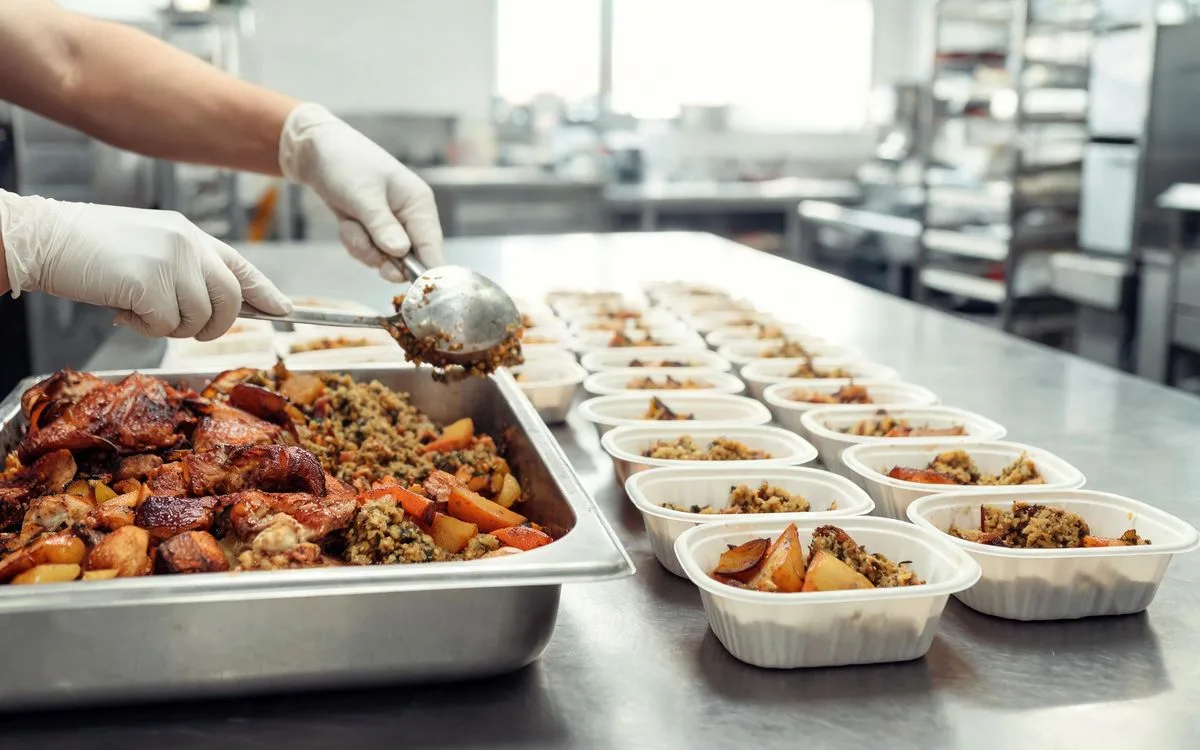
Who actually has the duty to take control samples, where HACCP breaks when production triples, and how to divide responsibility after delivery.
Corporate Christmas catering is usually the best-paid work of the year and, at the same time, the moment your kitchen operates far beyond its normal load. Same kitchen, same team, but three hundred covers instead of sixty, transport to the client's office, and food standing for two hours before anyone eats it. Documentation describing a normal day stops describing reality - and that is precisely the definition of a problem during an inspection.
First check whether your registration covers it
Before you count portions, check the scope of your entry in the register of establishments. A restaurant registered as fixed catering premises that starts delivering meals to offices is extending its activity to preparing and supplying food off-site. A material change of business profile must be notified to the district sanitary inspector.
This is not a consequence-free formality - your business profile also feeds into the risk category assigned to you, and therefore into how often you will see an inspector.
Control samples: who actually has the duty
More misunderstanding surrounds samples than any other topic here, so it is worth separating two situations.
The duty to take and store food samples comes from the Regulation of the Minister of Health of 17 April 2007 and applies to closed-type mass catering establishments - schools, preschools, nurseries, hospitals, care homes - and to catering companies cooking for such institutions. Samples are kept for no less than 72 hours at 0-4°C, and at -18°C for ice cream.
A restaurant delivering a Christmas dinner to a commercial client usually falls outside that definition. But if your festive bookings include an educational, care or medical institution - and in December that happens more often than you would expect - the duty sits with you as the business preparing the meals. We covered that route in our guide to HACCP in school and preschool canteens.
Regardless of legal classification: taking samples on large jobs is simply sensible. If someone reports symptoms after a corporate dinner for two hundred people, the sample is the only evidence you have.
Scaling production, or where HACCP breaks
Tripling volume is not the same process, only bigger. The parameters your hazard analysis assumed for normal scale change:
- Cooling. A pot for sixty portions cools differently from a vessel for three hundred. Time spent passing through the temperature range that favours bacterial growth stretches, sometimes several times over. This is the single most common place where a large booking creates real risk.
- Chiller capacity. Preparing ahead requires fridge space you usually do not have. Putting warm containers into a packed chiller raises the temperature of the whole chamber.
- Zone separation. Under increased production, teams start using surfaces "just for a moment, there is nowhere else". That is how cross-contamination happens.
- Seasonal staff. Anyone hired for December needs a current medical certificate for sanitary-epidemiological purposes and a documented briefing before being allowed to handle food.
The practical conclusion: before the season, review your hazard analysis against the scale you actually plan to run. If your CCPs assume cooling times from an ordinary day and December will not meet them, that is not a paperwork problem - it is a safety problem.
Transport and what happens at the client's site
Responsibility does not end at the kitchen door. Three things need documenting:
- Transport temperature. Hot and cold dishes must hold their range for the whole journey. Measure at dispatch and on delivery, and record both.
- Time from service to consumption. A buffet standing in an office for three hours is a condition your procedure must address - either by holding temperature or by limiting display time agreed with the client.
- Division of responsibility. Write into the contract where your control ends. If the client collects the food and sets it out themselves, record that in writing along with handling instructions.
Allergens in a festive menu
Christmas menus are unusually risky here: nuts in sauces and desserts, fish, gluten in coatings and dumplings, celery in stocks, eggs in cakes. On top of that comes an email order in which someone adds "one person gluten-free" and considers the matter closed.
Allergen information must be available to the person ordering before the order is placed, and on delivery to an office it has to reach the end consumer in a usable form - buffet labels or product labelling. We set out the labelling rules in our guide to allergens in catering, and claims such as "gluten-free" carry separate consequences covered in "gluten-free" and "vegan" claims.
Frequently asked questions
Does a restaurant doing Christmas catering have to take food samples?
The duty under the Regulation of the Minister of Health of 17 April 2007 applies to closed-type mass catering establishments and to catering companies preparing meals for them. Catering for a commercial client usually falls outside that definition, but if you serve an educational, care or medical institution the duty is yours. Regardless of classification, taking samples on large jobs is a sensible evidential safeguard.
How long are control samples kept?
No less than 72 hours from preparation of the given batch, at 0-4°C. For ice cream the required temperature is -18°C.
Do I have to notify Sanepid that I am starting catering?
A material change of business profile must be notified to the district sanitary inspector. Extending a restaurant's activity to preparing and delivering meals off-site is usually such a change - check the scope of your register entry before you accept the first booking.
Who is responsible for the food once it is delivered to the client's office?
That depends on how you divided the roles, which is why it is worth putting in the contract. Your responsibility covers preparation, transport and the conditions of handover. If the client displays the food themselves, give them written instructions on temperature and permissible display time.
Documentation for catering, not for a dining room
Catering carries a different risk profile from table service: transport, display time, production scale. GastroReady prepares HACCP, GMP and GHP documentation matched to your form of activity, with PL/EN instructions. From 299 PLN.